Li Ming-zhe, Deng Liang, Wang Jing-jing, Xiao Long-bin, Wu Wen-hui, Yang Shi-bin, Li Wen-feng
Department of Gastrointestinal and Pancreatic Surgery, The First Affiliated Hospital, Sun Yat-sen University, Guangzhou, China.
Department of General Surgery I, the Eastern Hospital of the First Affiliated Hospital, Sun Yat-sen University, Guangzhou, China.
PLoS One. 2014 Sep 11;9(9):e107061. doi: 10.1371/journal.pone.0107061. eCollection 2014.
To evaluate surgical outcomes and prognostic factors for T4 gastric cancer treated with curative resection.
Between January 1994 and December 2008, 94 patients diagnosed with histological T4 gastric carcinoma and treated with curative resection were recruited. Patient characteristics, surgical complications, survival, and prognostic factors were analyzed.
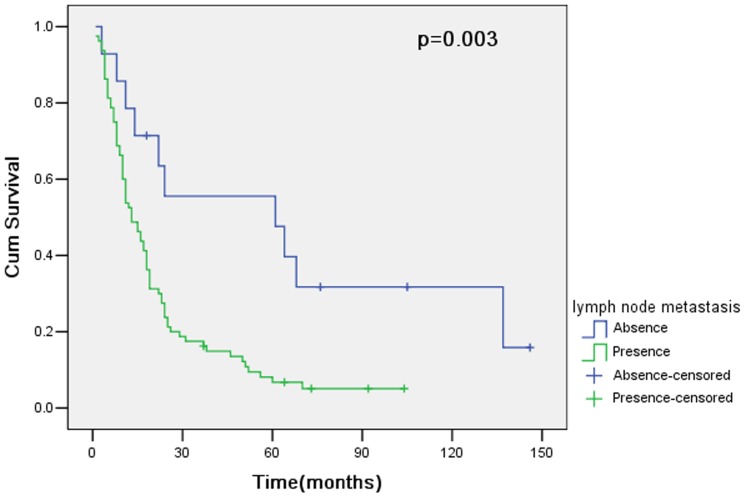
Postoperative morbidity and mortality were 18.1% and 2.1%, respectively. Multivariate analysis indicated lymph node metastasis (hazard ratio, 2.496; 95% confidence interval, 1.218-5.115; p = 0.012) was independent prognostic factor.
For patients with T4 gastric cancer, lymph node metastasis was associated with poorer survival. Neoadjuvant chemotherapy or aggressive adjuvant chemotherapy after radical resection was strongly recommended for these patients.
评估接受根治性切除的T4期胃癌的手术效果及预后因素。
选取1994年1月至2008年12月间94例经组织学诊断为T4期胃癌并接受根治性切除的患者。分析患者特征、手术并发症、生存率及预后因素。
术后发病率和死亡率分别为18.1%和2.1%。多因素分析表明淋巴结转移(风险比,2.496;95%置信区间,1.218 - 5.115;p = 0.012)是独立的预后因素。
对于T4期胃癌患者,淋巴结转移与较差的生存率相关。强烈建议这些患者在根治性切除后进行新辅助化疗或积极的辅助化疗。