Sissoko Daouda, Trottier Helen, Malvy Denis, Johri Mira
Department of Social and Preventive Medicine, Faculty of Public Health, Université de Montréal, Montreal, Quebec, Canada; Sainte-Justine Hospital Research Center, Montreal, Quebec, Canada; International Health Unit (USI), Centre de Recherche du Centre Hospitalier de l'Université de Montréal (CRCHUM), Montreal, Quebec, Canada.
Department of Social and Preventive Medicine, Faculty of Public Health, Université de Montréal, Montreal, Quebec, Canada; Sainte-Justine Hospital Research Center, Montreal, Quebec, Canada.
PLoS One. 2014 Sep 11;9(9):e106528. doi: 10.1371/journal.pone.0106528. eCollection 2014.
Children unreached by vaccination are at higher risk of poor health outcomes and India accounts for nearly a quarter of unvaccinated children worldwide. The objective of this study was to investigate compositional and contextual determinants of non-receipt of childhood vaccines in India using multilevel modelling.
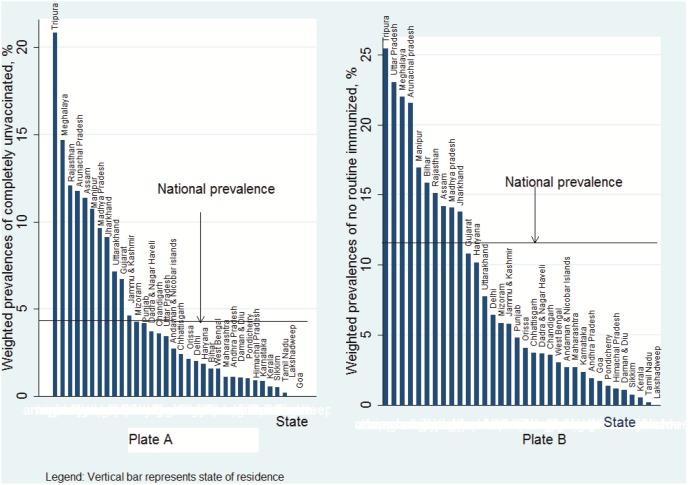
We studied characteristics of unvaccinated children using the District Level Health and Facility Survey 3, a nationally representative probability sample containing 65 617 children aged 12-23 months from 34 Indian states and territories. We developed four-level Bayesian binomial regression models to examine the determinants of non-vaccination. The analysis considered two outcomes: completely unvaccinated (CUV) children who had not received any of the eight vaccine doses recommended by India's Universal Immunization Programme, and children who had not received any dose from routine immunisation services (no RI). The no RI category includes CUV children and those who received only polio doses administered via mass campaigns. Overall, 4.83% (95% CI: 4.62-5.06) of children were CUV while 12.01% (11.68-12.35) had received no RI. Individual compositional factors strongly associated with CUV were: non-receipt of tetanus immunisation for mothers during pregnancy (OR = 3.65 [95% CrI: 3.30-4.02]), poorest household wealth index (OR = 2.44 [1.81-3.22] no maternal schooling (OR = 2.43 [1.41-4.05]) and no paternal schooling (OR = 1.83 [1.30-2.48]). In rural settings, the influence of maternal illiteracy disappeared whereas the role of household wealth index was reinforced. Factors associated with no RI were similar to those for CUV, but effect sizes for individual compositional factors were generally larger. Low maternal education was the strongest risk factor associated with no RI in all models. All multilevel models found significant variability at community, district, and state levels net of compositional factors.
Non-vaccination in India is strongly related to compositional characteristics and is geographically distinct. Tailored strategies are required to overcome current barriers to immunisation.
未接种疫苗的儿童健康状况不佳的风险更高,而印度的未接种疫苗儿童数量占全球近四分之一。本研究的目的是使用多水平模型调查印度儿童未接种疫苗的构成因素和背景因素。
我们利用第三次地区级卫生和设施调查研究未接种疫苗儿童的特征,该调查是一个具有全国代表性的概率样本,包含来自印度34个邦和地区的65617名12至23个月大的儿童。我们开发了四级贝叶斯二项回归模型来研究未接种疫苗的决定因素。分析考虑了两个结果:完全未接种疫苗(CUV)的儿童,即未接种印度通用免疫计划推荐的八种疫苗中的任何一种的儿童,以及未接受常规免疫服务任何一剂疫苗的儿童(无RI)。无RI类别包括CUV儿童和那些仅通过大规模运动接种了脊髓灰质炎疫苗的儿童。总体而言,4.83%(95%CI:4.62 - 5.06)的儿童为CUV,而12.01%(11.68 - 12.35)的儿童无RI。与CUV密切相关的个体构成因素有:母亲在孕期未接种破伤风疫苗(OR = 3.65 [95%CrI:3.30 - 4.02])、家庭财富指数最差(OR = 2.44 [1.81 - 3.22])、母亲未接受过学校教育(OR = 2.43 [1.41 - 4.05])以及父亲未接受过学校教育(OR = 1.83 [1.30 - 2.48])。在农村地区,母亲文盲的影响消失,而家庭财富指数的作用得到加强。与无RI相关的因素与CUV相似,但个体构成因素的效应大小通常更大。在所有模型中,母亲教育程度低是与无RI相关的最强风险因素。所有多水平模型均发现,在排除构成因素后,社区、地区和邦层面存在显著差异。
印度的未接种疫苗情况与构成特征密切相关,且在地理上存在差异。需要制定针对性策略来克服当前的免疫障碍。