
肝脂肪变性患者肝脏血管结构血流动力学变化的多普勒超声评估
The Doppler ultrasonographic evaluation of hemodynamic changes in hepatic vascular structures in patients with hepatosteatosis.
作者信息
Karasin Mehmet, Tokgoz Ozlem, Serifoglu Ismail, Oz Ilker, Erdem Oktay
机构信息
Department of Radiology, Bulent Ecevit University, School of Medicine, Zonguldak, Turkey.
出版信息
Pol J Radiol. 2014 Sep 7;79:299-304. doi: 10.12659/PJR.890608. eCollection 2014.
BACKGROUND
The hemodynamic changes in hepatic vascular structures of hepatosteatosis patients were examined using Doppler ultrasonography.
MATERIAL/METHODS: Ninety hepatosteatosis patients, classified as mild, moderate or severe, and 30 healthy volunteers were included in this 120-person study. The height, weight, liver size, blood lipids and blood liver function tests of the subjects were measured. Those values were compared in the patient and control groups. In the patient and control groups, color duplex Doppler ultrasonography was used to examine portal vein peak velocity, portal vein flow volume, hepatic artery resistive index (RI), hepatic artery pulsatility index (PI) and hepatic artery flow volume.
RESULTS
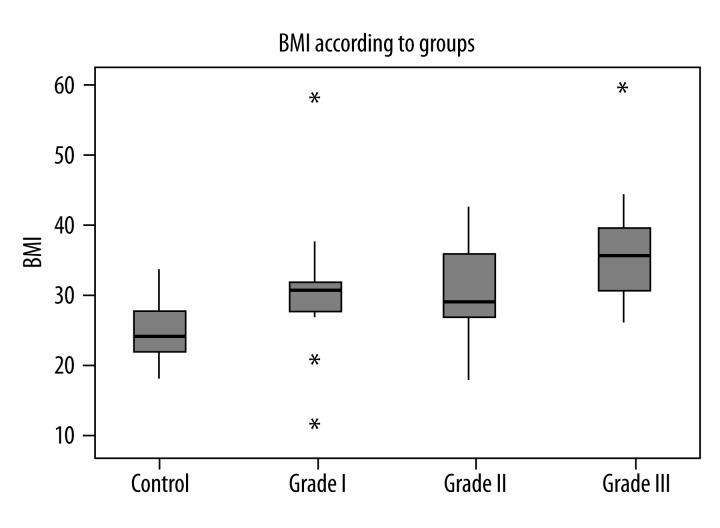
Similarly to the degree of hepatosteatosis, increases in body mass index, liver size, liver enzyme levels and blood lipid levels were statistically significant (p<0.05). While the difference in portal vein peak velocity in the hepatosteatosis and control groups was not statistically significant, there was an increasing reduction in the degree of steatosis (p>0.05). As the degree of hepatosteatosis increased, there was a reduction in hepatic artery flow volume, portal vein flow volume and total flow volume that was not statistically significant. In the mild hepatosteatosis group, hepatic artery RI and PI values were statistically significantly lower than in the other groups (p<0.05). In the severe hepatosteatosis group, although the hepatic artery RI and PI values were not statistically significant, there was a minimal increase compared to the other groups.
CONCLUSIONS
It is believed that those results were caused by a reduction in liver compliance and hepatic vascular compliance, in addition to resistance increase in vascular structures.
背景
采用多普勒超声检查肝脂肪变性患者肝血管结构的血流动力学变化。
材料/方法:本研究纳入120人,包括90例分为轻度、中度或重度的肝脂肪变性患者和30名健康志愿者。测量受试者的身高、体重、肝脏大小、血脂和肝功能血液检查。在患者组和对照组中比较这些值。在患者组和对照组中,使用彩色双功多普勒超声检查门静脉峰值流速、门静脉血流量、肝动脉阻力指数(RI)、肝动脉搏动指数(PI)和肝动脉血流量。
结果
与肝脂肪变性程度相似,体重指数、肝脏大小、肝酶水平和血脂水平的升高具有统计学意义(p<0.05)。虽然肝脂肪变性组和对照组门静脉峰值流速的差异无统计学意义,但脂肪变性程度呈逐渐降低趋势(p>0.05)。随着肝脂肪变性程度的增加,肝动脉血流量、门静脉血流量和总血流量有所减少,但无统计学意义。在轻度肝脂肪变性组中,肝动脉RI和PI值显著低于其他组(p<0.05)。在重度肝脂肪变性组中,虽然肝动脉RI和PI值无统计学意义,但与其他组相比有轻微升高。
结论
据信,这些结果是由肝脏顺应性和肝血管顺应性降低以及血管结构阻力增加引起的。

 Zotero 插件