Dellon Evan S, Speck Olga, Woodward Kimberly, Covey Shannon, Rusin Spencer, Shaheen Nicholas J, Woosley John T
1] Center for Esophageal Diseases and Swallowing, Division of Gastroenterology and Hepatology, Department of Medicine, University of North Carolina School of Medicine, Chapel Hill, NC, USA [2] Center for Gastrointestinal Biology and Disease, Division of Gastroenterology and Hepatology, Department of Medicine, University of North Carolina School of Medicine, Chapel Hill, NC, USA.
Department of Pathology and Laboratory Medicine, University of North Carolina School of Medicine, Chapel Hill, NC, USA.
Mod Pathol. 2015 Mar;28(3):383-90. doi: 10.1038/modpathol.2014.110. Epub 2014 Sep 12.
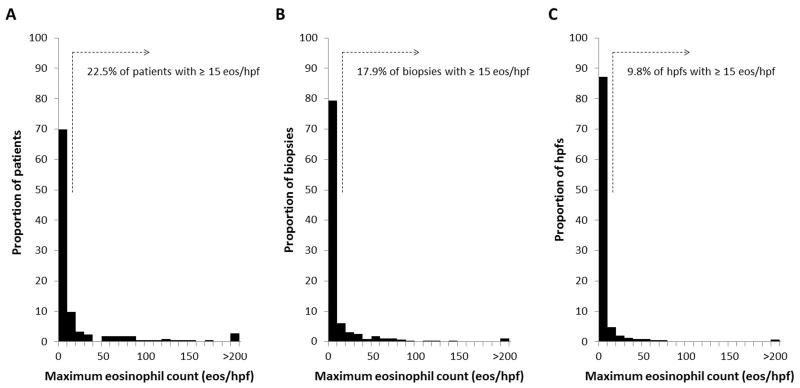
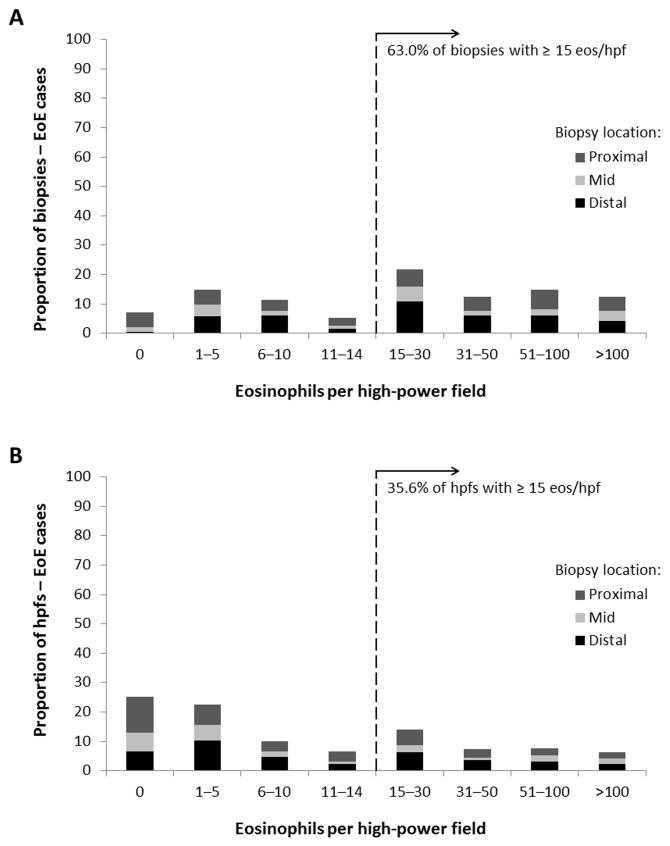
The variability of eosinophilic infiltrates in eosinophilic esophagitis is not well described. This study aimed to determine the distribution of esophageal eosinophilia and the utility of histologic cut-points for eosinophilic esophagitis diagnosis in subjects undergoing endoscopy. We performed a prospective study of adults undergoing outpatient endoscopy. Research protocol esophageal biopsies were obtained from all subjects. Incident cases of eosinophilic esophagitis were diagnosed per consensus guidelines. Biopsies were interpreted following a validated protocol, and maximum eosinophil counts (eosinophils per high-power field; eos/hpf) were determined. Histologic analyses were performed on a per-patient, per-biopsy, and per-hpf basis. There were 213 patients, yielding 923 esophageal biopsies with 4588 hpfs. Overall, 48 patients (23%), 165 biopsy fragments (18%), and 449 hpfs (10%) had ≥15 eos/hpf; most subjects had no or low levels of eosinophils. In the eosinophilic esophagitis cases, 119 biopsy fragments (63%) and 332 hpfs (36%) had ≥15 eos/hpf. There was a mean 104-fold difference between the lowest and highest hpf eosinophil count for the eosinophilic esophagitis patients; 85% of the biopsies from eosinophilic esophagitis cases also had at least one hpf with <15 eos/hpf. The cut-point of 15 eos/hpf had a sensitivity of 100% and a specificity of 96% for diagnosis of eosinophilic esophagitis. In conclusion, most patients have little to no esophageal eosinophilia. In patients with eosinophilic esophagitis, there was marked variability in the eosinophil counts by biopsy and by hpf within a given biopsy. Additionally, the 15 eos/hpf cut-point was highly sensitive and specific for eosinophilic esophagitis. Multiple esophageal biopsies from different locations should be obtained to optimize eosinophilic esophagitis diagnosis.
嗜酸性粒细胞性食管炎中嗜酸性粒细胞浸润的变异性尚未得到充分描述。本研究旨在确定食管嗜酸性粒细胞增多的分布情况以及组织学切点在接受内镜检查的受试者中诊断嗜酸性粒细胞性食管炎的效用。我们对接受门诊内镜检查的成年人进行了一项前瞻性研究。从所有受试者获取研究方案规定的食管活检标本。根据共识指南诊断嗜酸性粒细胞性食管炎的新发病例。活检标本按照经过验证的方案进行解读,并确定最大嗜酸性粒细胞计数(每高倍视野嗜酸性粒细胞数;eos/hpf)。组织学分析按患者、每份活检标本和每个高倍视野进行。共有213例患者,获得923份食管活检标本,共4588个高倍视野。总体而言,48例患者(23%)、165份活检标本片段(18%)和449个高倍视野(10%)的嗜酸性粒细胞计数≥15个/eos/hpf;大多数受试者的嗜酸性粒细胞数量为无或低水平。在嗜酸性粒细胞性食管炎病例中,119份活检标本片段(63%)和332个高倍视野(36%)的嗜酸性粒细胞计数≥15个/eos/hpf。嗜酸性粒细胞性食管炎患者的最低和最高高倍视野嗜酸性粒细胞计数之间平均相差104倍;85%的嗜酸性粒细胞性食管炎病例活检标本至少有一个高倍视野的嗜酸性粒细胞计数<15个/eos/hpf。15个/eos/hpf的切点对嗜酸性粒细胞性食管炎诊断的敏感性为100%,特异性为96%。总之,大多数患者几乎没有食管嗜酸性粒细胞增多。在嗜酸性粒细胞性食管炎患者中,给定活检标本内按活检和按高倍视野计算的嗜酸性粒细胞计数存在明显变异性。此外,15个/eos/hpf的切点对嗜酸性粒细胞性食管炎具有高度敏感性和特异性。应从不同部位获取多份食管活检标本以优化嗜酸性粒细胞性食管炎的诊断。