Department of Medicine, College of Physicians & Surgeons, Columbia University, New York, NY, USA; Department of Pathology and Cell Biology, College of Physicians & Surgeons, Columbia University, New York, NY, USA.
Department of Medicine, College of Physicians & Surgeons, Columbia University, New York, NY, USA; Department of Pathology and Cell Biology, College of Physicians & Surgeons, Columbia University, New York, NY, USA.
Biochem Biophys Res Commun. 2014 Oct 3;452(4):958-61. doi: 10.1016/j.bbrc.2014.09.020. Epub 2014 Sep 11.
Mutations in the LMNA gene encoding A-type nuclear lamins can cause dilated cardiomyopathy with or without skeletal muscular dystrophy. Previous studies have shown abnormally increased extracellular signal-regulated kinase 1/2 activity in hearts of Lmna(H222P/H222P) mice, a small animal model. Inhibition of this abnormal signaling activity with a mitogen-activated protein kinase kinase 1/2 (MEK1/2) inhibitor has beneficial effects on heart function and survival in these mice. However, such treatment has not been examined relative to any standard of care intervention for dilated cardiomyopathy or heart failure. We therefore examined the effects of an angiotensin II converting enzyme (ACE) inhibitor on left ventricular function in Lmna(H222P/H222P) mice and assessed if adding a MEK1/2 inhibitor would provide added benefit.
Male Lmna(H222P/H222P) mice were treated with the ACE inhibitor benazepril, the MEK1/2 inhibitor selumetinib or both. Transthoracic echocardiography was used to measure left ventricular diameters and fractional shortening was calculated.
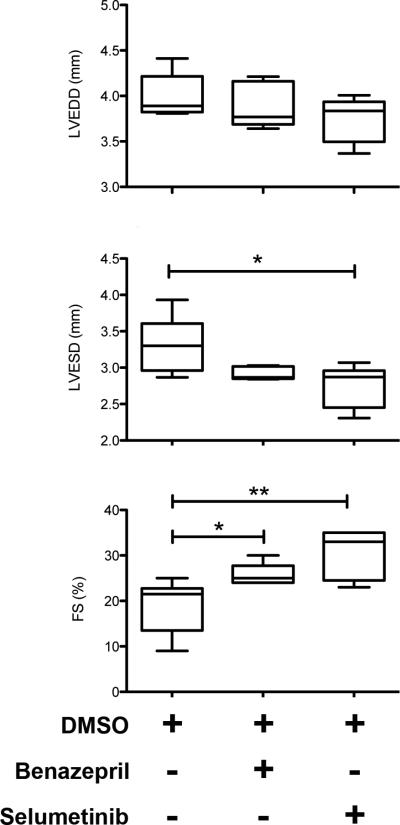
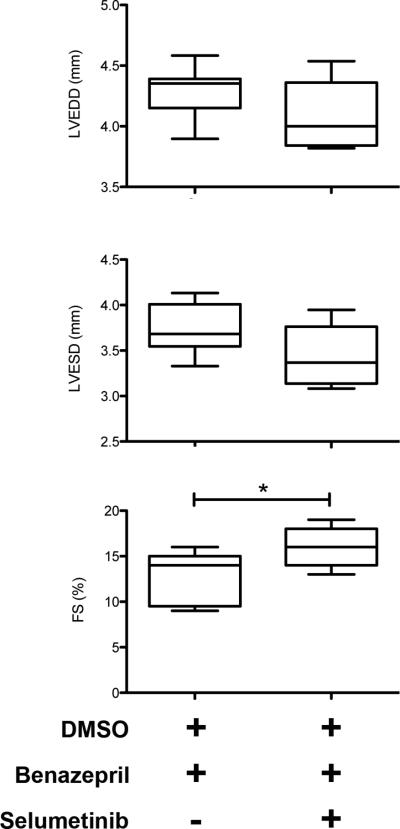
Treatment of Lmna(H222P/H222P) mice with either benazepril or selumetinib started at 8weeks of age, before the onset of detectable left ventricular dysfunction, lead to statistically significantly increased fractional shortening compared to placebo at 16weeks of age. There was a trend towards a great value for fractional shortening in the selumetinib-treated mice. When treatment was started at 16weeks of age, after the onset of left ventricular dysfunction, the addition of selumetinib treatment to benazepril lead to a statistically significant increase in left ventricular fractional shortening at 20weeks of age.
Both ACE inhibition and MEK1/2 inhibition have beneficial effects on left ventricular function in Lmna(H222P/H222P) mice and both drugs together have a synergistic benefit when initiated after the onset of left ventricular dysfunction. These results provide further preclinical rationale for a clinical trial of a MEK1/2 inhibitor in addition to standard of care in patients with dilated cardiomyopathy caused by LMNA mutations.
编码 A 型核纤层蛋白的 LMNA 基因突变可导致扩张型心肌病伴或不伴骨骼肌营养不良。先前的研究表明,在 Lmna(H222P/H222P)小鼠的心脏中,一种小动物模型,细胞外信号调节激酶 1/2(ERK1/2)活性异常增加。用丝裂原活化蛋白激酶激酶 1/2(MEK1/2)抑制剂抑制这种异常信号活性对这些小鼠的心脏功能和存活有有益的影响。然而,尚未针对扩张型心肌病或心力衰竭的任何标准治疗干预措施来检查这种治疗。因此,我们研究了血管紧张素转换酶(ACE)抑制剂对 Lmna(H222P/H222P)小鼠左心室功能的影响,并评估了添加 MEK1/2 抑制剂是否会带来额外的益处。
雄性 Lmna(H222P/H222P)小鼠用 ACE 抑制剂贝那普利、MEK1/2 抑制剂 selumetinib 或两者联合治疗。经胸超声心动图测量左心室直径,计算左心室缩短分数。
Lmna(H222P/H222P)小鼠在 8 周龄时开始用贝那普利或 selumetinib 治疗,在可检测到左心室功能障碍之前,与安慰剂相比,16 周龄时左心室缩短分数显著增加。selumetinib 治疗组的缩短分数有较大的趋势。当在 16 周龄时开始治疗,即在左心室功能障碍发生后,贝那普利联合 selumetinib 治疗可使 20 周龄时左心室缩短分数显著增加。
ACE 抑制和 MEK1/2 抑制均对 Lmna(H222P/H222P)小鼠的左心室功能有有益的影响,当在左心室功能障碍发生后开始治疗时,两种药物联合使用具有协同作用。这些结果为在 LMNA 突变引起的扩张型心肌病患者中,除了标准治疗外,加用 MEK1/2 抑制剂进行临床试验提供了进一步的临床前依据。