Dinel Anne-Laure, Joffre Corinne, Trifilieff Pierre, Aubert Agnes, Foury Aline, Le Ruyet Pascale, Layé Sophie
J Neuroinflammation. 2014 Sep 17;11:155. doi: 10.1186/s12974-014-0155-x.
The postnatal period is a critical time window during which inflammatory events have significant and enduring effects on the brain, and as a consequence, induce alterations of emotional behavior and/or cognition later in life. However, the long-term effect of neonatal inflammation on behavior during adolescence, a sensitive period for the development of neurodevelopmental psychiatric disorders, has been little studied. In this study, we examined whether an early-life inflammatory challenge could alter emotional behaviors and spatial memory at adolescence and adulthood and whether stress axis activity, inflammatory response and neurogenesis were affected.
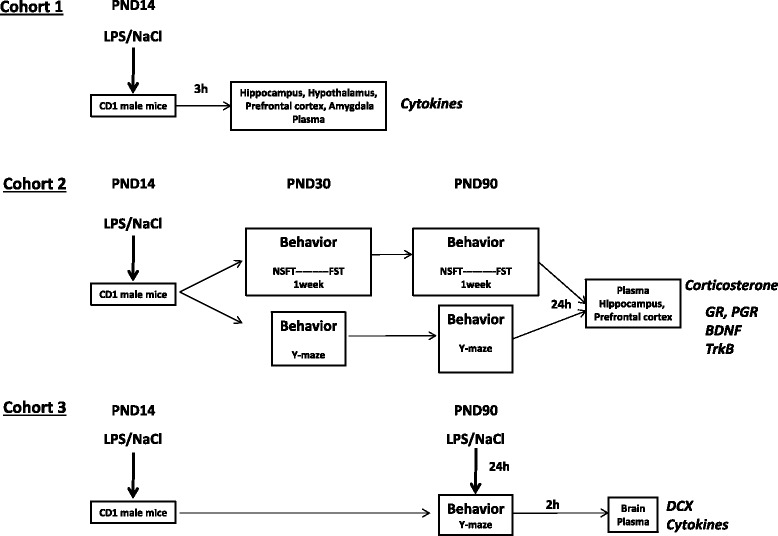
Lipopolysaccharide (LPS, 100 μg/kg) was administered to mice on postnatal day (PND) 14 and cytokine expression was measured in the plasma and in brain structures 3 hours later. Anxiety-like and depressive-like behavior (measured in the novelty-suppressed feeding test and the forced swim test, respectively) and spatial memory (Y-maze test) were measured at adolescence (PND30) and adulthood (PND90). Hypothalamic-pituitary-adrenal (HPA) axis activity (plasma corticosterone and glucocorticoid receptors in the hippocampus and prefrontal cortex) was measured at adulthood. In addition, the impact of a novel adult LPS challenge (100 μ/kg) was measured on spatial memory (Y-maze test), neurogenesis (doublecortin-positive cell numbers in the hippocampus) and plasma cytokine expression.
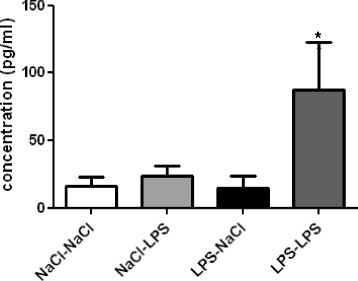
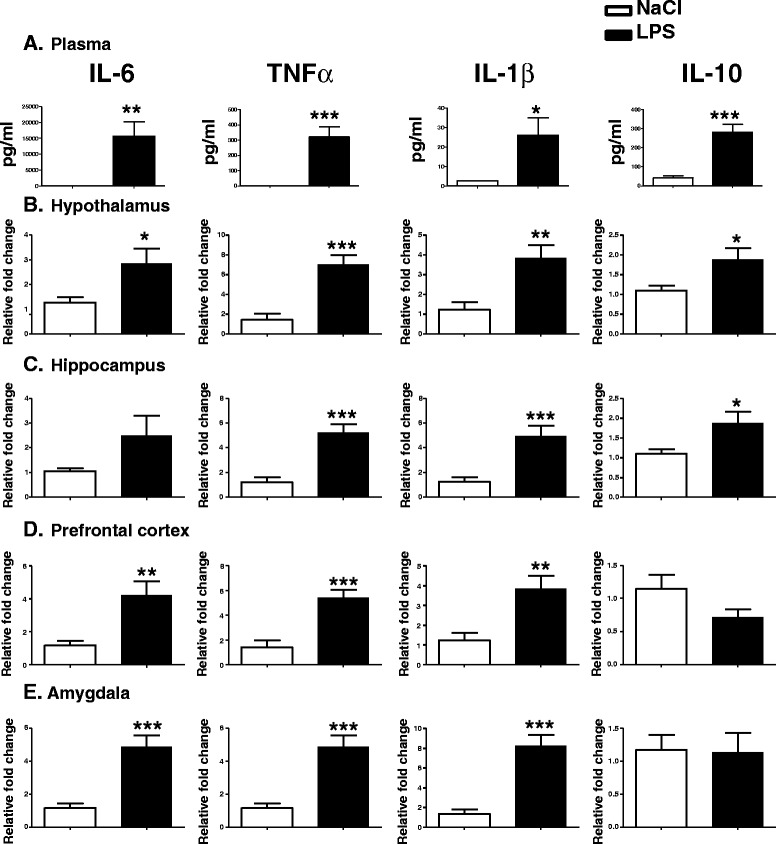
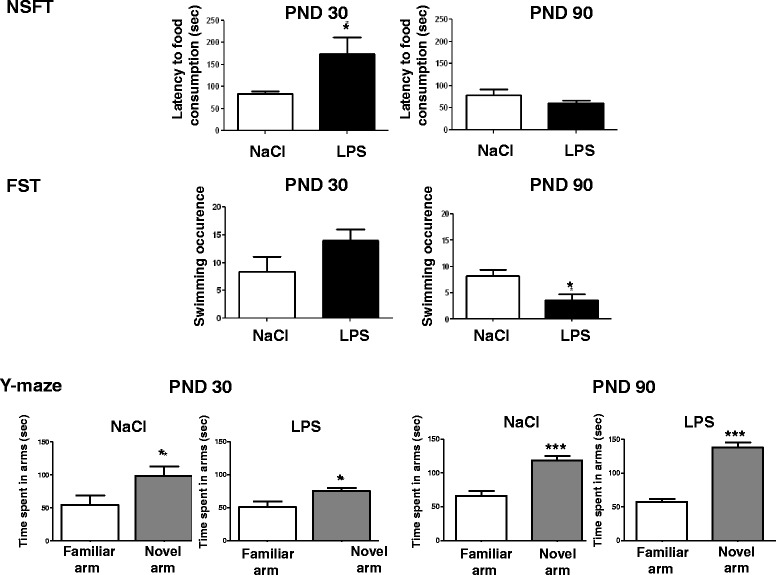
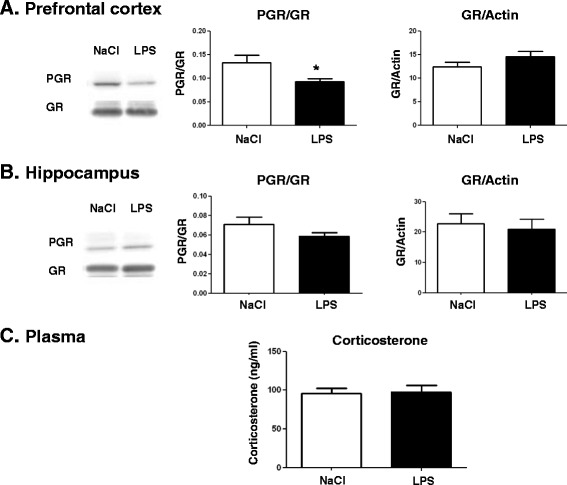
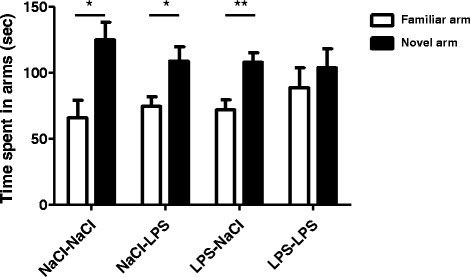
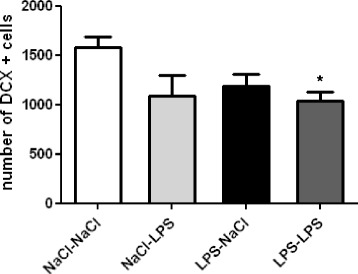
First, we show in PND14 pups that a peripheral administration of LPS induced the expression of pro- and anti-inflammatory cytokines in the plasma and brain structures that were studied 3 hours after administration. Anxiety-like behavior was altered in adolescent, but not in adult, mice, whereas depressive-like behavior was spared at adolescence and increased at adulthood. This was accompanied by a decreased phosphorylation of the glucocorticoid receptor in the prefrontal cortex, with no effect on corticosterone levels. Second, neonatal LPS treatment had no effect on spatial memory in adolescence and adulthood. However, a second challenge of LPS in adulthood impaired spatial memory performance and neurogenesis and increased circulating levels of CCL2.
Our study shows for the first time, in mice, that a peripheral LPS treatment at PND14 differentially alters emotional behaviors, but not spatial memory, at adolescence and adulthood. The behavioral effect of LPS at PND14 could be attributed to HPA axis deregulation and neurogenesis impairment.
产后时期是一个关键的时间窗口,在此期间炎症事件会对大脑产生重大且持久的影响,进而在日后诱发情绪行为和/或认知的改变。然而,新生儿期炎症对青春期行为的长期影响,而青春期是神经发育性精神障碍发展的敏感期,目前研究较少。在本研究中,我们探究了早期炎症刺激是否会改变青春期和成年期的情绪行为及空间记忆,以及应激轴活动、炎症反应和神经发生是否会受到影响。
在出生后第14天(PND14)给小鼠注射脂多糖(LPS,100μg/kg),3小时后检测血浆和脑结构中的细胞因子表达。在青春期(PND30)和成年期(PND90)测量焦虑样和抑郁样行为(分别在新奇抑制摄食试验和强迫游泳试验中测量)以及空间记忆(Y迷宫试验)。在成年期测量下丘脑-垂体-肾上腺(HPA)轴活动(血浆皮质酮以及海马体和前额叶皮质中的糖皮质激素受体)。此外,测量成年期新的LPS刺激(100μg/kg)对空间记忆(Y迷宫试验)、神经发生(海马体中双皮质素阳性细胞数量)和血浆细胞因子表达的影响。
首先,我们发现,在PND14的幼崽中,外周注射LPS会诱导血浆和脑结构中促炎和抗炎细胞因子的表达,这是在注射后3小时检测的。青春期小鼠的焦虑样行为发生改变,但成年小鼠未出现这种情况,而抑郁样行为在青春期未受影响,在成年期增加。这伴随着前额叶皮质中糖皮质激素受体磷酸化的降低,而对皮质酮水平无影响。其次,新生儿期LPS处理对青春期和成年期的空间记忆没有影响。然而,成年期再次给予LPS刺激会损害空间记忆表现和神经发生,并增加CCL2的循环水平。
我们的研究首次在小鼠中表明,PND14时外周给予LPS会在青春期和成年期差异性地改变情绪行为,但不影响空间记忆。PND14时LPS的行为效应可能归因于HPA轴失调和神经发生受损。