Mortier Rienske A R, Barkema Herman W, Orsel Karin, Wolf Robert, De Buck Jeroen
Department of Production Animal Health, University of Calgary, Hospital Drive NW, Calgary, AB, Canada.
Vet Res. 2014 Jul 17;45(1):71. doi: 10.1186/s13567-014-0071-1.
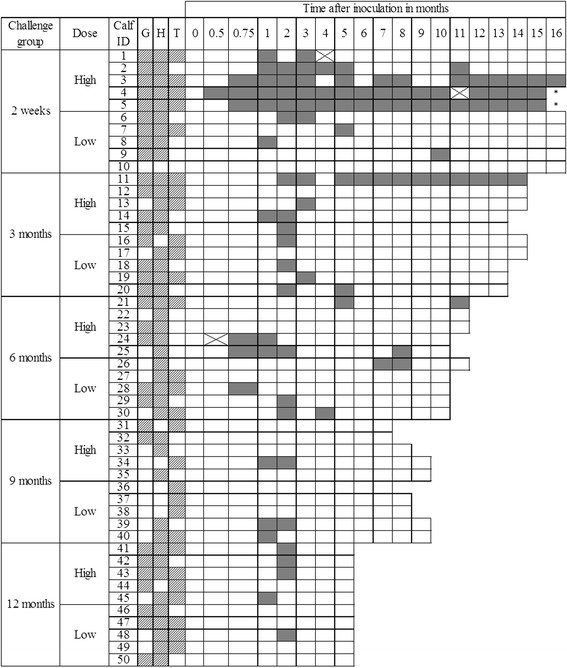
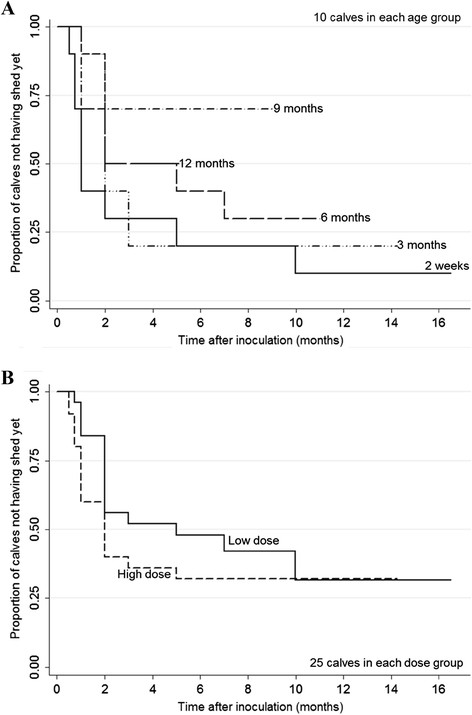
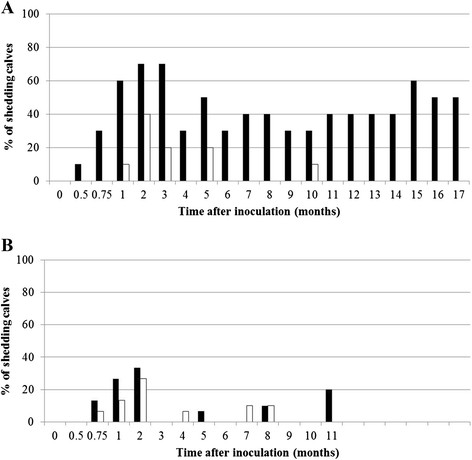
Although substantial fecal shedding is expected to start years after initial infection with Mycobacterium avium subspecies paratuberculosis (MAP), the potential for shedding by calves and therefore calf-to-calf transmission is underestimated in current Johne's disease (JD) control programs. Shedding patterns were determined in this study in experimentally infected calves. Fifty calves were challenged at 2 weeks or at 3, 6, 9 or 12 months of age (6 calves served as a control group). In each age group, 5 calves were inoculated with a low and 5 with a high dose of MAP. Fecal culture was performed monthly until necropsy at 17 months of age. Overall, 61% of inoculated calves, representing all age and dose groups, shed MAP in their feces at least once during the follow-up period. Although most calves shed sporadically, 4 calves in the 2-week and 3-month high dose groups shed at every sampling. In general, shedding peaked 2 months after inoculation. Calves inoculated at 2 weeks or 3 months with a high dose of MAP shed more frequently than those inoculated with a low dose. Calves shedding frequently had more culture-positive tissue locations and more severe gross and histological lesions at necropsy. In conclusion, calves inoculated up to 1 year of age shed MAP in their feces shortly after inoculation. Consequently, there is potential for MAP transfer between calves (especially if they are group housed) and therefore, JD control programs should consider young calves as a source of infection.
尽管预计在初次感染副结核分枝杆菌(MAP)数年之后才会出现大量粪便排菌,但在当前的约内氏病(JD)控制计划中,犊牛排菌的可能性以及由此导致的犊牛间传播风险被低估了。本研究确定了实验感染犊牛的排菌模式。五十头犊牛分别在2周龄或3、6、9或12月龄时接受攻毒(6头犊牛作为对照组)。在每个年龄组中,5头犊牛接种低剂量MAP,5头接种高剂量MAP。每月进行粪便培养,直至犊牛在17月龄时进行剖检。总体而言,在随访期间,所有年龄和剂量组的接种犊牛中有61%至少有一次粪便排菌。尽管大多数犊牛是间歇性排菌,但2周龄和3月龄高剂量组中有4头犊牛每次采样时都有排菌。一般来说,接种后2个月排菌量达到峰值。2周龄或3月龄接种高剂量MAP的犊牛比接种低剂量的犊牛排菌更频繁。频繁排菌的犊牛在剖检时有更多培养阳性的组织部位以及更严重的大体和组织学病变。总之,1岁龄以内接种的犊牛在接种后不久粪便中就会排出MAP。因此,犊牛之间存在MAP传播的可能性(尤其是如果它们群居),所以JD控制计划应将幼龄犊牛视为感染源。