Momboisse Fanny, Olivares María José, Báez-Matus Ximena, Guerra María José, Flores-Muñoz Carolina, Sáez Juan C, Martínez Agustín D, Cárdenas Ana M
Centro Interdisciplinario de Neurociencias de Valparaíso, Universidad de Valparaíso Valparaíso, Chile.
Centro Interdisciplinario de Neurociencias de Valparaíso, Universidad de Valparaíso Valparaíso, Chile ; Departamento de Fisiología, Pontifícia Universidad Católica de Chile Santiago, Chile.
Front Cell Neurosci. 2014 Sep 4;8:270. doi: 10.3389/fncel.2014.00270. eCollection 2014.
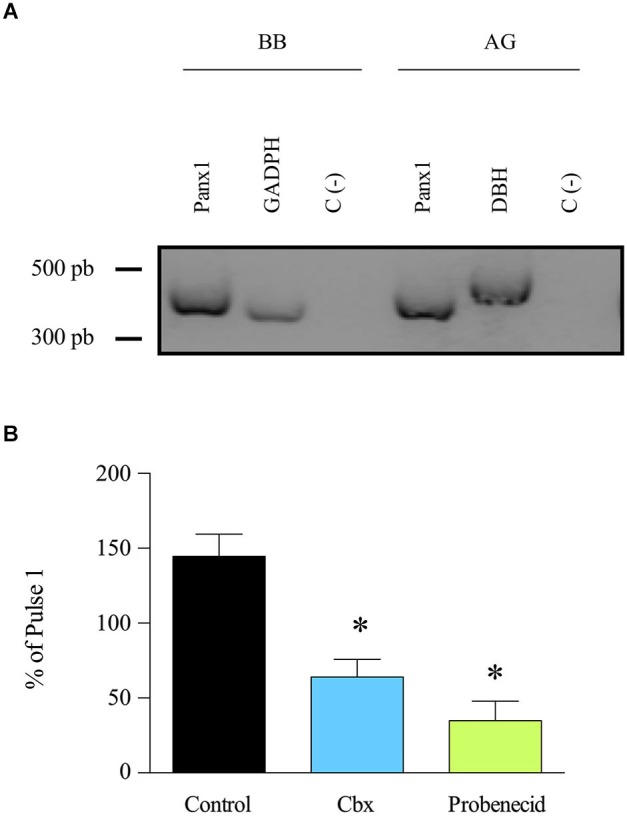
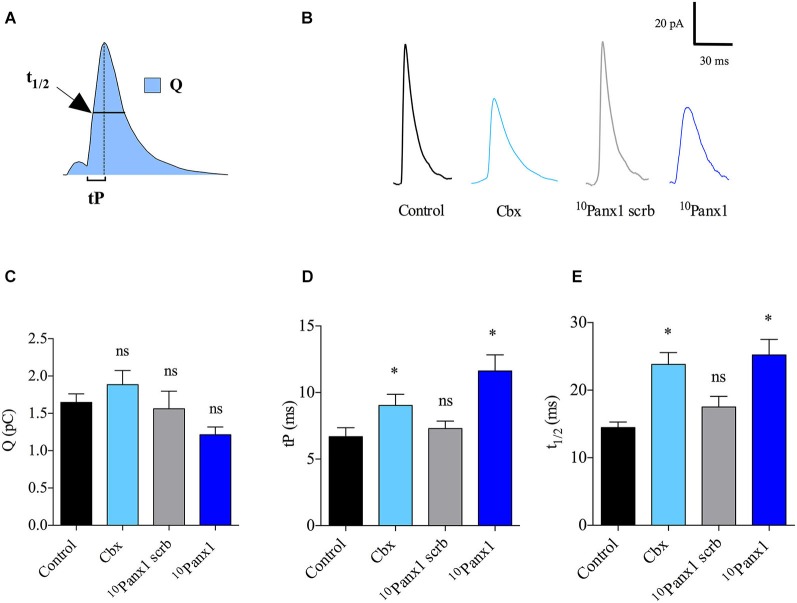
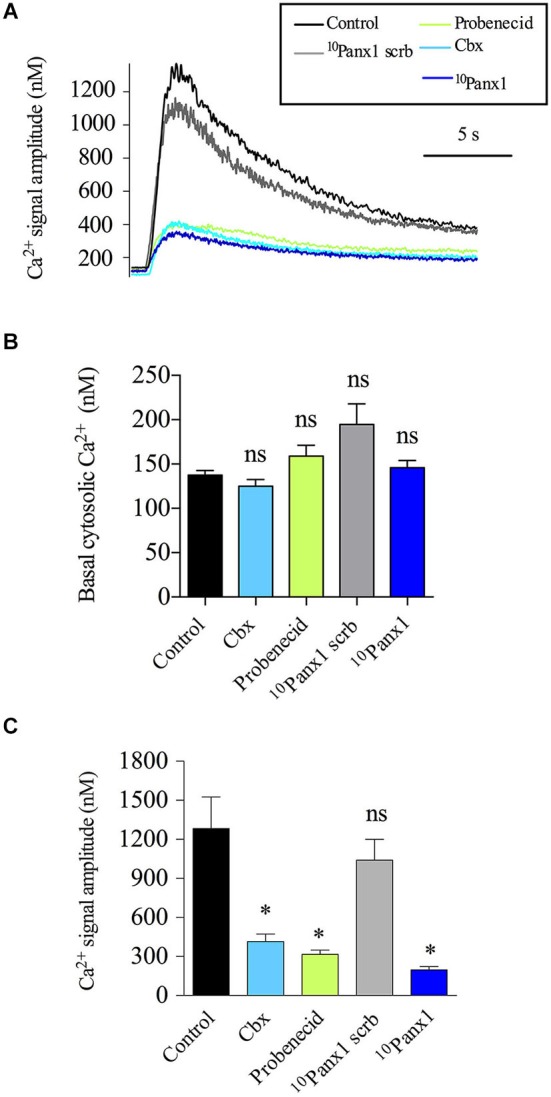
Chromaffin cells of the adrenal gland medulla synthesize and store hormones and peptides, which are released into the blood circulation in response to stress. Among them, adrenaline is critical for the fight-or-flight response. This neurosecretory process is highly regulated and depends on cytosolic [Ca(2+)]. By forming channels at the plasma membrane, pannexin-1 (Panx1) is a protein involved in many physiological and pathological processes amplifying ATP release and/or Ca(2+) signals. Here, we show that Panx1 is expressed in the adrenal gland where it plays a role by regulating the release of catecholamines. In fact, inhibitors of Panx1 channels, such as carbenoxolone (Cbx) and probenecid, reduced the secretory activity induced with the nicotinic agonist 1,1-dimethyl-4-phenyl-piperazinium (DMPP, 50 μM) in whole adrenal glands. A similar inhibitory effect was observed in single chromaffin cells using Cbx or (10)Panx1 peptide, another Panx1 channel inhibitors. Given that the secretory response depends on cytosolic [Ca(2+)] and Panx1 channels are permeable to Ca(2+), we studied the possible implication of Panx1 channels in the Ca(2+) signaling occurring during the secretory process. In support of this possibility, Panx1 channel inhibitors significantly reduced the Ca(2+) signals evoked by DMPP in single chromaffin cells. However, the Ca(2+) signals induced by caffeine in the absence of extracellular Ca(2+) was not affected by Panx1 channel inhibitors, suggesting that this mechanism does not involve Ca(2+) release from the endoplasmic reticulum. Conversely, Panx1 inhibitors significantly blocked the DMPP-induce dye uptake, supporting the idea that Panx1 forms functional channels at the plasma membrane. These findings indicate that Panx1 channels participate in the control the Ca(2+) signal that triggers the secretory response of adrenal chromaffin cells. This mechanism could have physiological implications during the response to stress.
肾上腺髓质的嗜铬细胞合成并储存激素和肽类,这些物质会在应激反应时释放到血液循环中。其中,肾上腺素对于“战斗或逃跑”反应至关重要。这种神经分泌过程受到高度调节,且依赖于胞质[Ca(2+)]。通过在质膜上形成通道,泛连接蛋白1(Panx1)是一种参与许多生理和病理过程的蛋白质,可放大ATP释放和/或Ca(2+)信号。在此,我们表明Panx1在肾上腺中表达,它通过调节儿茶酚胺的释放发挥作用。事实上,Panx1通道抑制剂,如甘草次酸(Cbx)和丙磺舒,可降低全肾上腺中烟碱激动剂1,1 - 二甲基 - 4 - 苯基 - 哌嗪鎓(DMPP,50 μM)诱导的分泌活性。在单个嗜铬细胞中使用Cbx或(10)Panx1肽(另一种Panx1通道抑制剂)也观察到了类似的抑制作用。鉴于分泌反应依赖于胞质[Ca(2+)]且Panx1通道对Ca(2+)具有通透性,我们研究了Panx1通道在分泌过程中发生的Ca(2+)信号传导中的可能作用。为支持这种可能性,Panx1通道抑制剂显著降低了单个嗜铬细胞中DMPP诱发的Ca(2+)信号。然而,在无细胞外Ca(2+)时咖啡因诱导的Ca(2+)信号不受Panx1通道抑制剂影响,这表明该机制不涉及内质网释放Ca(2+)。相反地,Panx1抑制剂显著阻断了DMPP诱导的染料摄取,支持了Panx1在质膜上形成功能性通道的观点。这些发现表明Panx1通道参与控制触发肾上腺嗜铬细胞分泌反应的Ca(2+)信号。这种机制在应激反应过程中可能具有生理意义。