Rezai Mohammad R, Maclagan Laura C, Donovan Linda R, Tu Jack V
Mohammad R. Rezai, MD, PhD, is a Postdoctoral Fellow in the Cardiovascular Research Program, Institute for Clinical Evaluative Sciences, Toronto, Ontario.
Laura C. Maclagan, MSc, is an Epidemiologist in the Cardiovascular Research Program, Institute for Clinical Evaluative Sciences, Toronto, Ontario.
Open Med. 2013 Oct 1;7(4):e85-93. eCollection 2013.
The Permanent Resident Database of Citizenship and Immigration Canada (CIC) contains sociodemographic information on immigrants but lacks ethnic group classifications. To enhance its usability for ethnicityrelated research, we categorized immigrants in the CIC database into one of Canada's official visible minority groups or a white category using their country of birth and mother tongue.
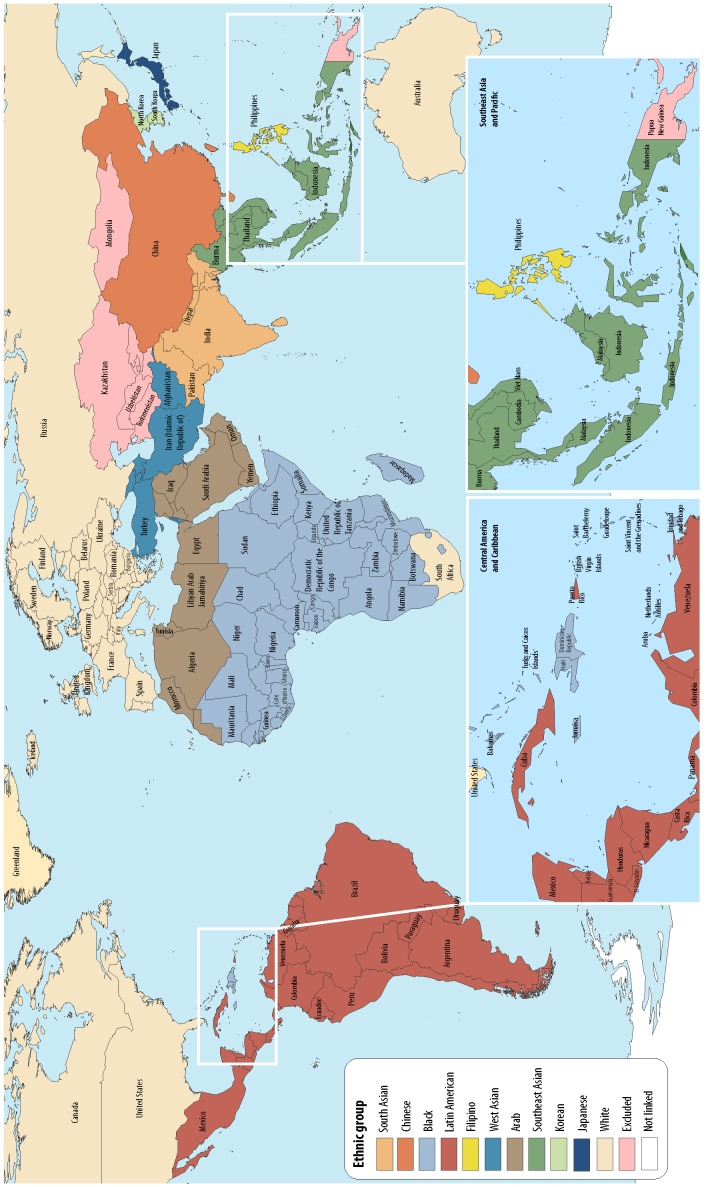
Using public data sources, we classified each of 267 country names and 245 mother tongues in the CIC data into 1 of 10 visible minority groups (South Asian, Chinese, black, Latin American, Filipino, West Asian, Arab, Southeast Asian, Korean, and Japanese) or a white group. We then used country of birth alone (method A) or country of birth plus mother tongue (method B) to classify 2.5 million people in the CIC database who immigrated to Ontario between 1985 and 2010 and who had a valid encrypted health card number. We validated the ethnic categorizations using linked selfreported ethnicity data for 6499 people who responded to the Canadian Community Health Survey (CCHS).
Among immigrants listed in the CIC database, the 4 most frequent visible minority groups as classified by method B were South Asian (n = 582 812), Chinese (n = 400 771), black (n = 254 189), and Latin American (n = 179 118). Methods A and B agreed in 94% of the categorizations (kappa coefficient 0.94, 95% confidence interval [CI] 0.93-0.94). Both methods A and B agreed with self-reported CCHS ethnicity in 86% of all categorizations (for both comparisons, kappa coefficient 0.83, 95% CI 0.82-0.84). Both methods A and B had high sensitivity and specificity for most visible minority groups when validated using self-reported ethnicity from the CCHS (e.g., with method B, sensitivity and specificity were, respectively, 0.85 and 0.97 for South Asians, 0.93 and 0.99 for Chinese, and 0.90 and 0.97 for blacks).
The use of country of birth and mother tongue is a validated and practical method for classifying immigrants to Canada into ethnic categories.
加拿大公民及移民部(CIC)的永久居民数据库包含移民的社会人口学信息,但缺乏种族分类。为提高其在种族相关研究中的可用性,我们根据出生国家和母语将CIC数据库中的移民归类为加拿大官方可见少数群体之一或白人类别。
利用公共数据源,我们将CIC数据中的267个国家名称和245种母语分别归类为10个可见少数群体(南亚裔、华裔、黑人、拉丁裔、菲律宾裔、西亚裔、阿拉伯裔、东南亚裔、韩裔和日裔)或白人群体之一。然后,我们仅使用出生国家(方法A)或出生国家加母语(方法B)对1985年至2010年间移民到安大略省且拥有有效加密健康卡号码的CIC数据库中的250万人进行分类。我们使用来自6499名参与加拿大社区健康调查(CCHS)的人的自我报告种族数据链接来验证种族分类。
在CIC数据库列出的移民中,方法B分类的4个最常见的可见少数群体是南亚裔(n = 582 812)、华裔(n = 400 771)、黑人(n = 254 189)和拉丁裔(n = 179 118)。方法A和B在94%的分类中一致(kappa系数0.94,95%置信区间[CI] 0.93 - 0.94)。方法A和B在所有分类的86%中与自我报告的CCHS种族一致(两种比较的kappa系数均为0.83,95% CI 0.82 - 0.84)。当使用CCHS的自我报告种族进行验证时,方法A和B对大多数可见少数群体都具有高敏感性和特异性(例如,使用方法B时,南亚裔的敏感性和特异性分别为0.85和0.97,华裔为0.93和0.99,黑人为0.90和0.97)。
使用出生国家和母语是将加拿大移民分类为种族类别的一种经过验证的实用方法。