School of Chinese Medicine, Graduate Institute of Integrated Medicine, Graduate Institute of Acupuncture Science, College of Chinese Medicine, Research Center for Chinese Medicine & Acupuncture, China Medical University, Taichung, Taiwan.
BMC Complement Altern Med. 2014 Sep 19;14:341. doi: 10.1186/1472-6882-14-341.
Acupuncture and moxibustion are used to treat pruritus and atopic dermatitis. However, whether cold stimulation (defined as that the temperature conducted under skin temperature) of acupoints affects itching in experimental murine models remains unclear.
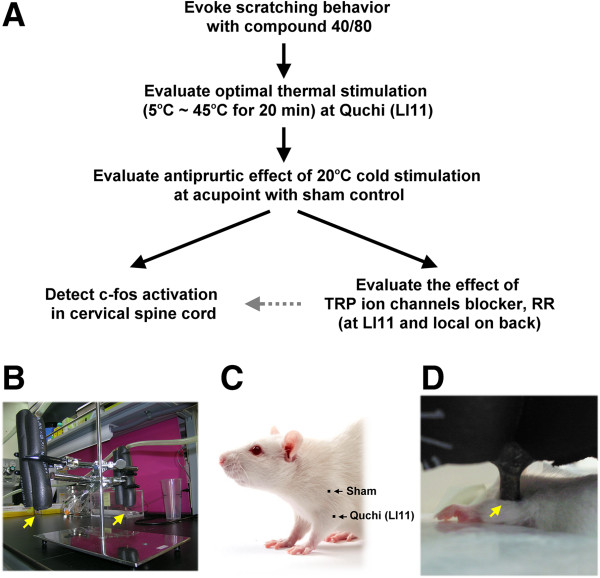
The present study was designed to determine the therapeutic effects of different thermal stimulations at the Quchi acupoint (LI11) in a murine model in which scratching behaviour was elicited by subcutaneous injection with a pruritogenic agent (compound 48/80). Male ICR mice were divided into several groups as follows: control (saline), those receiving compound 48/80 and compound 48/80 with various thermal stimulations (5°C-45°C) at LI11 (n = 6 per group). The scratch response of each animal to these stimulations was recorded for 30 min. The antipruritic effect of the acupoint was further evaluated in LI11 and sham (non-acupoint) groups (n = 6 per group).
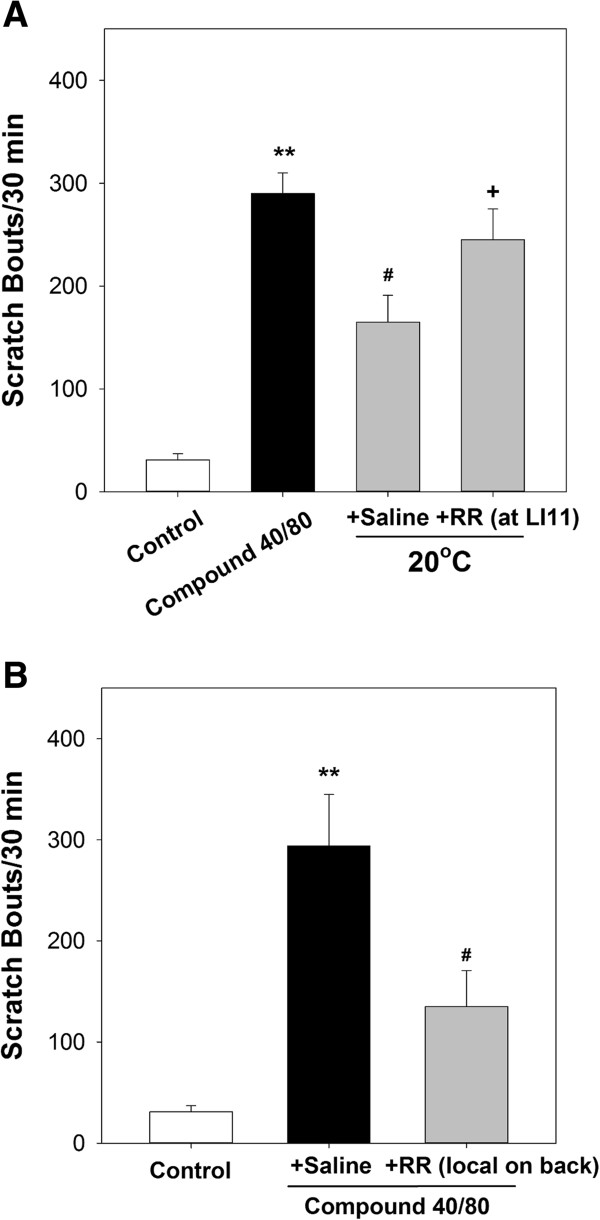
Treatment with lower temperature (20°C) at the LI11 acupoint significantly attenuated compound 48/80-induced scratching; however, this antipruritic effect was not observed with stimulation at the sham point. The expression of c-fos in the neuron of the cervical spine induced by compound 48/80 was suppressed by cold stimulation at LI11. The antipruritic effect of cold stimulation was blocked by ruthium red (RR), a non-selective transient receptor potential (TRP) channel blocker, suggesting that TRP channels may play an important role in the antipruritic effect of cold stimulation at LI11 in mice.
This study demonstrated that cold stimulation at LI11 attenuated compound 48/80-induced scratching behaviour in mice, possibly by a TRP-related pathway.
针灸用于治疗瘙痒和特应性皮炎。然而,穴位冷刺激(定义为皮肤下传导的温度)是否会影响实验性瘙痒模型中的瘙痒尚不清楚。
本研究旨在确定 Quchi 穴位(LI11)在一种通过皮下注射致痒剂(48/80 混合物)引起搔抓行为的小鼠模型中的不同热刺激的治疗效果。雄性 ICR 小鼠分为几组:对照组(生理盐水)、接受 48/80 混合物和不同热刺激(5°C-45°C)的 48/80 混合物的小鼠(每组 6 只)。记录每组动物对这些刺激的搔抓反应 30 分钟。在 LI11 和 sham(非穴位)组(每组 6 只)进一步评估穴位的止痒效果。
LI11 穴位的低温(20°C)治疗显著减轻了 48/80 混合物引起的搔抓;然而,在 sham 点刺激时未观察到这种止痒作用。48/80 混合物诱导的颈椎神经元中 c-fos 的表达被 LI11 冷刺激抑制。LI11 冷刺激的止痒作用被非选择性瞬时受体电位(TRP)通道阻滞剂 ruthium red(RR)阻断,表明 TRP 通道可能在小鼠 LI11 冷刺激的止痒作用中发挥重要作用。
本研究表明,LI11 的冷刺激减轻了 48/80 混合物诱导的小鼠搔抓行为,可能通过 TRP 相关途径。