Ebenhan Thomas, Gheysens Olivier, Kruger Hendrick Gert, Zeevaart Jan Rijn, Sathekge Mike Machaba
Department of Nuclear Medicine, University of Pretoria & Steve Biko Academic Hospital, Corner of Malherbe and Steve Biko Road, Pretoria 0001, South Africa ; Catalysis and Peptide Research Unit, School of Health Sciences, University of KwaZulu Natal, E-Block 6th Floor, Westville Campus, University Road, Westville, Durban 3630, South Africa.
Department of Nuclear Medicine, University Hospitals Leuven, Katholieke Universiteit Leuven, Campus Gasthuisberg, Herestraat 49, 3000 Leuven, Belgium.
Biomed Res Int. 2014;2014:867381. doi: 10.1155/2014/867381. Epub 2014 Aug 27.
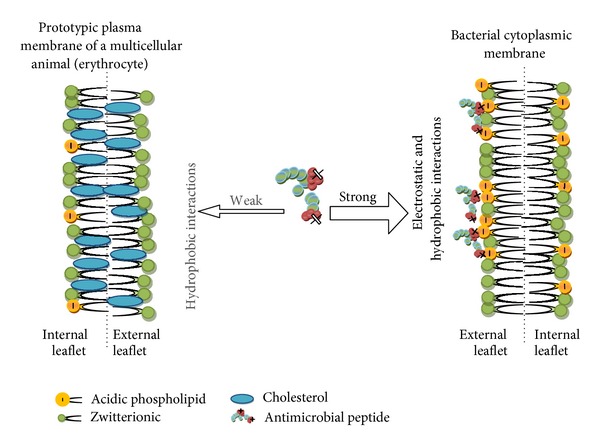
Antimicrobial peptides (AMPs) are a heterogeneous class of compounds found in a variety of organisms including humans and, so far, hundreds of these structures have been isolated and characterised. They can be described as natural microbicide, selectively cytotoxic to bacteria, whilst showing minimal cytotoxicity towards the mammalian cells of the host organism. They act by their relatively strong electrostatic attraction to the negatively charged bacterial cells and a relatively weak interaction to the eukaryote host cells. The ability of these peptides to accumulate at sites of infection combined with the minimal host's cytotoxicity motivated for this review to highlight the role and the usefulness of AMPs for PET with emphasis on their mechanism of action and the different interactions with the bacterial cell. These details are key information for their selective properties. We also describe the strategy, design, and utilization of these peptides as potential radiopharmaceuticals as their combination with nuclear medicine modalities such as SPECT or PET would allow noninvasive whole-body examination for detection of occult infection causing, for example, fever of unknown origin.
抗菌肽(AMPs)是一类异质性化合物,存在于包括人类在内的多种生物体中,到目前为止,已经分离和鉴定了数百种此类结构。它们可被描述为天然杀菌剂,对细菌具有选择性细胞毒性,而对宿主生物体的哺乳动物细胞显示出最小的细胞毒性。它们通过与带负电荷的细菌细胞相对较强的静电吸引以及与真核宿主细胞相对较弱的相互作用来发挥作用。这些肽在感染部位积聚的能力以及对宿主最小的细胞毒性促使本综述强调抗菌肽在正电子发射断层扫描(PET)中的作用和实用性,重点关注其作用机制以及与细菌细胞的不同相互作用。这些细节是其选择性特性的关键信息。我们还描述了将这些肽作为潜在放射性药物的策略、设计和应用,因为它们与单光子发射计算机断层扫描(SPECT)或PET等核医学模式相结合,将允许进行无创全身检查,以检测例如不明原因发热等隐匿性感染的病因。