Zhou Yang, Kim Young-Seung, Milenic Diane E, Baidoo Kwamena E, Brechbiel Martin W
Radioimmune & Inorganic Chemistry Section, Radiation Oncology Branch, National Cancer Institute , 10 Center Drive, Bethesda, Maryland 20892, United States.
Bioconjug Chem. 2014 Oct 15;25(10):1801-10. doi: 10.1021/bc500312w. Epub 2014 Oct 3.
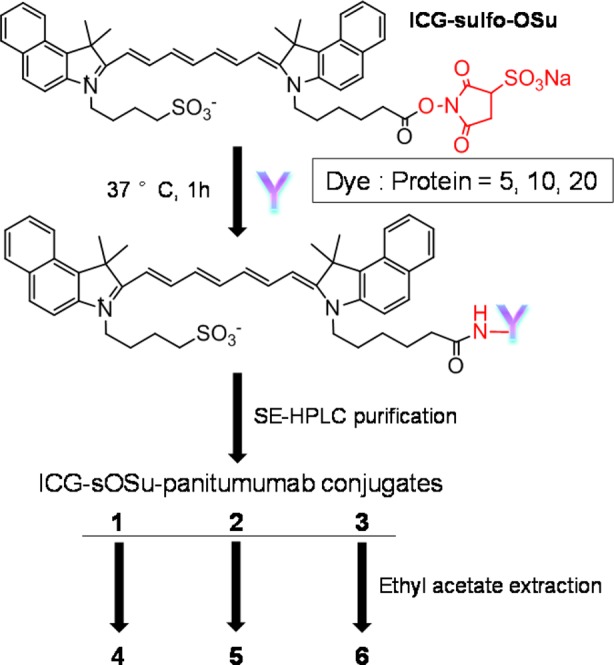
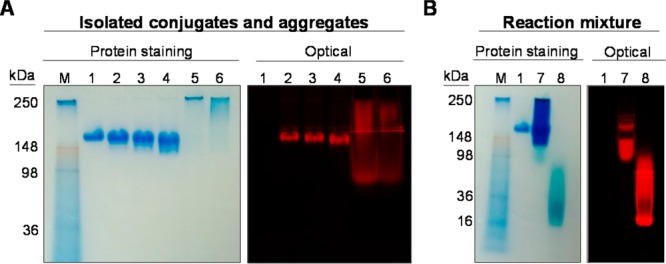
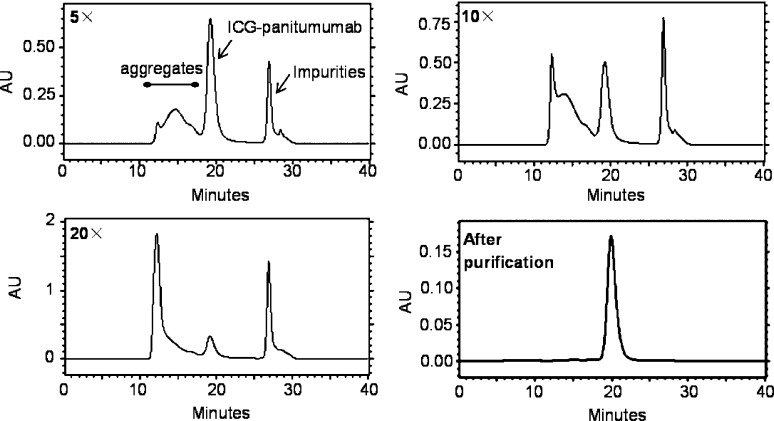
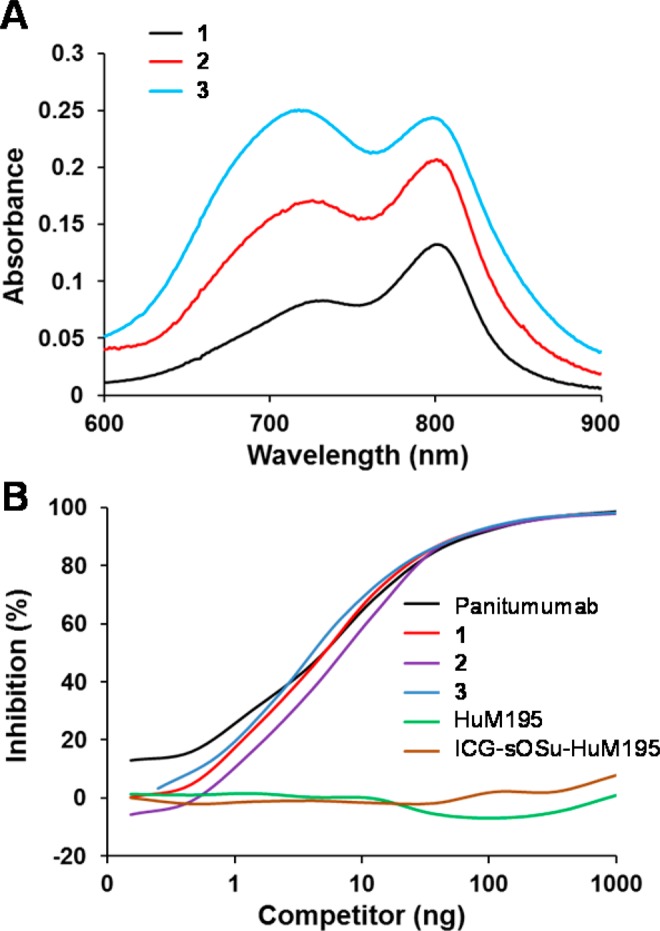
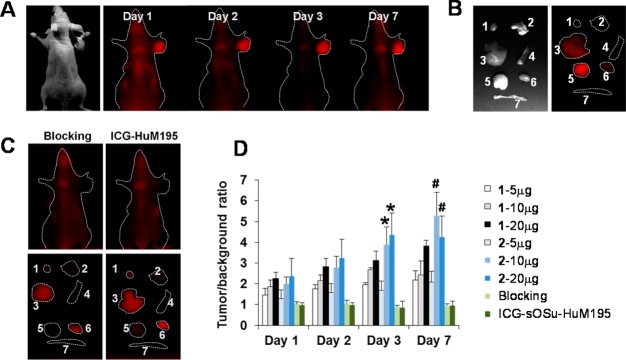
Indocyanine green (IC-Green), the only FDA approved near-infrared (NIR) fluorophore for clinical use, is attractive to researchers for the development of targeted optical imaging agents by modification of its structure and conjugation to monoclonal antibodies (mAbs) or their fragments. IC-Green derivative, ICG-sulfo-OSu (ICG-sOSu), is frequently used for antibody conjugation. However, ICG-sOSu is amphiphilic and readily facilitates aggregation of mAbs that is not easily separable from the desired immunoconjugates. Complications originating from this behavior are frequently overlooked by researchers. This study examined detailed chemical and biological characteristics of an ICG-sOSu-labeled mAb, panitumumab, and provided a clinically applicable strategy to deliver a pure conjugation product. Size-exclusion high-performance liquid chromatography (SE-HPLC) analysis of conjugation reactions, performed at molar reaction ratios of ICG-sOSu: mAb of 5, 10, or 20, resulted in isolable desired ICG-sOSu-panitumumab conjugation product in 72%, 53%, and 19% yields, respectively, with the remainder consisting of high molecular weight aggregates (>150 kDa) 14%, 30%, and 51%, respectively. The HPLC-purified ICG-sOSu-panitumumab products were analyzed by native and SDS polyacrylamide gel electrophoresis (PAGE) followed by optical imaging. Results indicated that the interaction between ICG-sOSu and panitumumab was due to both covalent and noncovalent binding of the ICG-sOSu to the protein. Noncovalently bound dye in the ICG-sOSu-panitumumab conjugate products was removed by extraction with ethyl acetate to further purify the HPLC-isolated conjugation products. With conserved immunoreactivity, excellent target-specific uptake of the doubly purified bioconjugates was observed with minimal liver retention in athymic nude mice bearing HER1-expressing tumor xenografts. In summary, the preparation of well-defined bioconjugate products labeled with commercial ICG-sOSu dye is not a simple process and control of the conjugation reaction ratio and conditions is crucial. Furthermore, absolute purification and characterization of the products is necessitated prior to in vivo optical imaging. Use of validated and characterized dye conjugate products should facilitate the development of clinically viable and reproducible IC-Green derivative and other NIR dye mAb conjugates for optical imaging applications.
吲哚菁绿(IC - 绿)是唯一经美国食品药品监督管理局(FDA)批准用于临床的近红外(NIR)荧光团,通过修饰其结构并与单克隆抗体(mAb)或其片段偶联,对研究人员开发靶向光学成像剂具有吸引力。IC - 绿衍生物ICG - 磺基 - O - 琥珀酰亚胺(ICG - sOSu)常用于抗体偶联。然而,ICG - sOSu具有两亲性,容易促进mAb聚集,且这种聚集物不易与所需的免疫偶联物分离。研究人员常常忽视源于这种行为的并发症。本研究检测了ICG - sOSu标记的mAb帕尼单抗的详细化学和生物学特性,并提供了一种临床适用策略以获得纯的偶联产物。在ICG - sOSu与mAb的摩尔反应比为5、10或20的条件下进行偶联反应的尺寸排阻高效液相色谱(SE - HPLC)分析,分别以72%、53%和19%的产率得到可分离的所需ICG - sOSu - 帕尼单抗偶联产物,其余部分分别为高分子量聚集体(>150 kDa),占14%、30%和51%。通过天然和十二烷基硫酸钠聚丙烯酰胺凝胶电泳(PAGE)对HPLC纯化的ICG - sOSu -帕尼单抗产物进行分析,随后进行光学成像。结果表明,ICG - sOSu与帕尼单抗之间的相互作用是由于ICG - sOSu与蛋白质的共价和非共价结合。通过用乙酸乙酯萃取去除ICG - sOSu - 帕尼单抗偶联产物中非共价结合的染料,以进一步纯化HPLC分离的偶联产物。在无胸腺裸鼠体内携带表达HER1的肿瘤异种移植物时,在保留免疫反应性的情况下,观察到双纯化生物偶联物具有优异的靶向特异性摄取,且肝脏滞留最少。总之,用市售ICG - sOSu染料标记明确的生物偶联产物的制备并非简单过程,控制偶联反应比例和条件至关重要。此外,在进行体内光学成像之前,必须对产物进行绝对纯化和表征。使用经过验证和表征的染料偶联产物应有助于开发临床上可行且可重复的IC - 绿衍生物和其他用于光学成像应用的近红外染料mAb偶联物。