Waisman Center, University of Wisconsin-Madison Madison, WI, USA.
Department of Biostatistics and Medical Informatics, University of Wisconsin-Madison Madison, WI, USA.
Front Genet. 2014 Sep 9;5:309. doi: 10.3389/fgene.2014.00309. eCollection 2014.
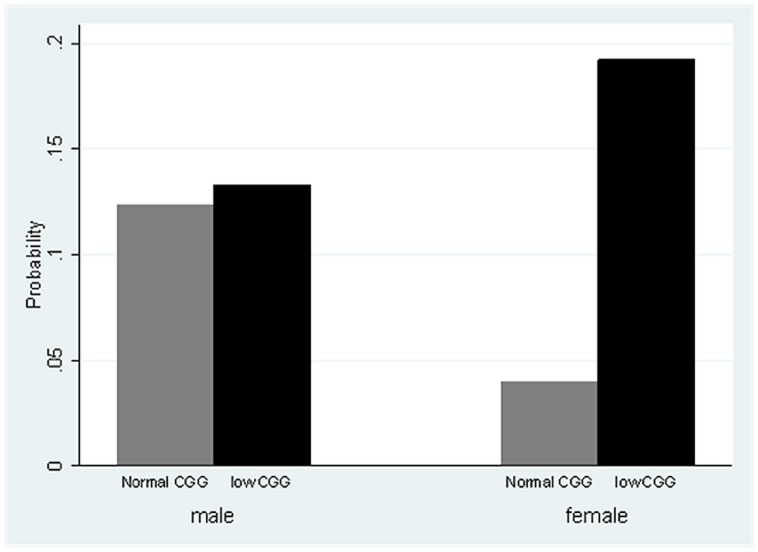
This population-based study investigates genotype-phenotype correlations of "low- normal" CGG repeats in the fragile X mental retardation 1 (FMR1) gene. FMR1 plays an important role in brain development and function, and encodes FMRP (fragile X mental retardation protein), an RNA-binding protein that regulates protein synthesis impacting activity-dependent synaptic development and plasticity. Most past research has focused on CGG premutation expansions (41-200 CGG repeats) and on fragile X syndrome (200+ CGG repeats), with considerably less attention on the other end of the spectrum of CGG repeats. Using existing data, older adults with 23 or fewer CGG repeats (2 SDs below the mean) were compared with age-peers who have normal numbers of CGGs (24-40) with respect to cognition, mental health, cancer, and having children with disabilities. Men (n = 341 with an allele in the low-normal range) and women (n = 46 with two low-normal alleles) had significantly more difficulty with their memory and ability to solve day to day problems. Women with both FMR1 alleles in the low-normal category had significantly elevated odds of feeling that they need to drink more to get the same effect as in the past. These women also had two and one-half times the odds of having had breast cancer and four times the odds of uterine cancer. Men and women with low-normal CGGs had higher odds of having a child with a disability, either a developmental disability or a mental health condition. These findings are in line with the hypothesis that there is a need for tight neuronal homeostatic control mechanisms for optimal cognitive and behavioral functioning, and more generally that low numbers as well as high numbers of CGG repeats may be problematic for health.
本基于人群的研究调查了脆性 X 智力低下 1 基因(FMR1)中“低正常”CGG 重复的基因型-表型相关性。FMR1 在大脑发育和功能中发挥重要作用,编码 FMRP(脆性 X 智力低下蛋白),一种调节影响活性依赖性突触发育和可塑性的蛋白质合成的 RNA 结合蛋白。大多数过去的研究都集中在 CGG 前突变扩增(41-200 CGG 重复)和脆性 X 综合征(200+ CGG 重复)上,而对 CGG 重复谱的另一端关注较少。利用现有数据,将 23 个或更少 CGG 重复(低于平均值 2 个标准差)的老年人与 CGG 数量正常(24-40)的同龄老年人进行比较,比较的方面包括认知、心理健康、癌症以及生育有残疾子女的情况。男性(n=341,等位基因处于低正常范围)和女性(n=46,两个等位基因处于低正常范围)在记忆和解决日常问题的能力方面明显更困难。FMR1 两个等位基因都处于低正常范围的女性,感到需要喝更多的酒才能达到过去同样效果的几率明显升高。这些女性患乳腺癌的几率也高出两倍半,患子宫癌的几率高出四倍。CGG 低正常的男性和女性生育有残疾子女(发育障碍或心理健康状况)的几率更高。这些发现与以下假设一致,即存在需要紧密神经元动态平衡控制机制来实现最佳认知和行为功能,更普遍地说,低数量和高数量的 CGG 重复可能对健康有问题。