Viain Anouck, Savard Jean-Pierre L, Gilliland Scott, Perry Matthew C, Guillemette Magella
Département de Biologie, Chimie et Géographie, Université du Québec à Rimouski, Rimouski, QC, Canada.
Sciences and Technology, Environment Canada, Sainte-Foy, QC, Canada.
PLoS One. 2014 Sep 24;9(9):e107929. doi: 10.1371/journal.pone.0107929. eCollection 2014.
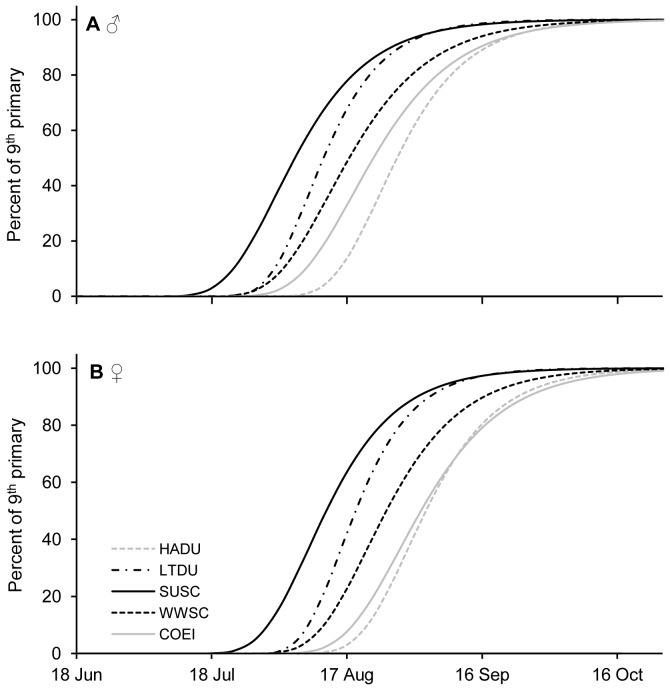
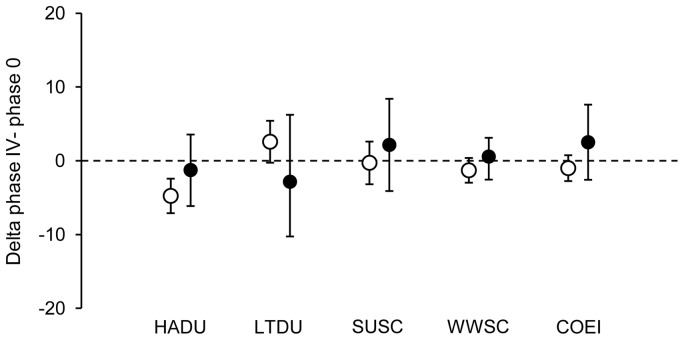
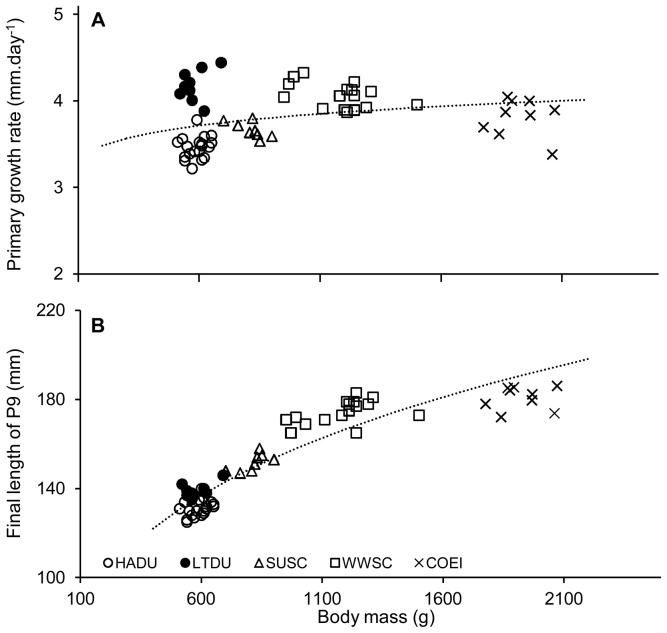
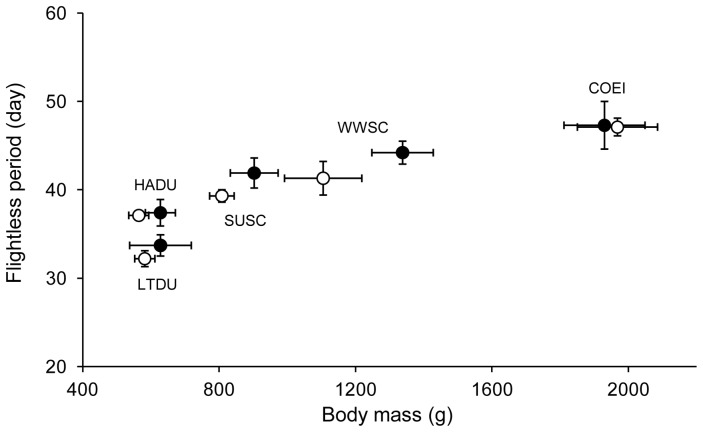
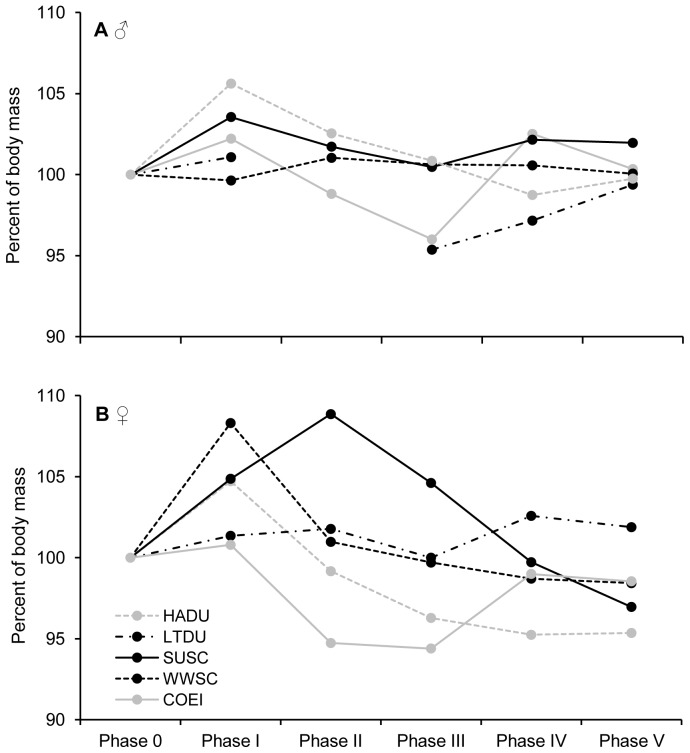
Remigial moult is one of the crucial events in the annual life cycle of waterfowl as it is energetically costly, lasts several weeks, and is a period of high vulnerability due to flightlessness. In waterfowl, remigial moult can be considered as an energy-predation trade-off, meaning that heavier individuals would minimise the flightless period by increasing feather growth rate and energy expenditure. Alternatively, they could reduce body mass at the end of this period, thereby reducing wing-loading to increase flight capability. We studied timing of remigial moult, primary growth rates, flightlessness duration, and the pattern of body mass variation in 5 species of captive seaducks (Melanitta fusca, M. perspicillata, Clangula hyemalis, Histrionicus histrionicus, and Somateria mollissima) ranging in size from 0.5 to 2.0 kg. Their feather growth rates weakly increased with body mass (M0.059) and no correlation was found at the intra-specific level. Consequently, heavier seaduck species and especially heavier individuals had a longer flightless period. Although birds had access to food ad libidum, body mass first increased then decreased, the latter coinciding with maximum feather growth rate. Level of body mass when birds regained flight ability was similar to level observed at the beginning of remigial moult, suggesting they were not using a strategic reduction of body mass to reduce the flightlessness duration. We suggest that the moulting strategy of seaducks may be the result of a compromise between using an intense moult strategy (simultaneous moult) and a low feather growth rate without prejudice to feather quality. Despite the controlled captive status of the studied seaducks, all five species as well as both sexes within each species showed timing of moult reflecting that of wild birds, suggesting there is a genetic component acting to shape moult timing within wild birds.
飞羽换羽是水鸟年度生命周期中的关键事件之一,因为它能量消耗巨大,持续数周,且由于无法飞行而处于高脆弱期。在水鸟中,飞羽换羽可被视为一种能量与被捕食风险之间的权衡,这意味着体型较大的个体将通过提高羽毛生长速度和能量消耗来尽量缩短无法飞行的时间。或者,它们可以在这段时间结束时减轻体重,从而降低翼载荷以提高飞行能力。我们研究了5种圈养海鸭(斑脸海番鸭、鹊鸭、丑鸭、斑头秋沙鸭和绒鸭)的飞羽换羽时间、初级飞羽生长速度、无法飞行的持续时间以及体重变化模式,这些海鸭的体重在0.5至2.0千克之间。它们的羽毛生长速度随体重略有增加(M0.059),在种内水平上未发现相关性。因此,体型较大的海鸭种类,尤其是体型较大的个体,无法飞行的时间更长。尽管鸟类可以自由取食,但体重先增加后减少,后者与最大羽毛生长速度同时出现。鸟类恢复飞行能力时的体重水平与飞羽换羽开始时观察到的水平相似,这表明它们没有通过战略性地减轻体重来缩短无法飞行的持续时间。我们认为,海鸭的换羽策略可能是在采用高强度换羽策略(同时换羽)和低羽毛生长速度之间进行折中的结果,且不会影响羽毛质量。尽管所研究的海鸭处于圈养受控状态,但所有五个物种以及每个物种内的两性都表现出与野生鸟类相似的换羽时间,这表明存在一个遗传因素在塑造野生鸟类的换羽时间。