Li Junhui, Dong Fei, Lu Ying, Yan Qiuyan, Shim Hojae
College of Natural Resources and Environment, South China Agricultural University, Guangzhou, China.
College of Natural Resources and Environment, South China Agricultural University, Guangzhou, China; Agricultural Bureau of Xiangfen County, Shanxi Province, Xiangfen, China.
PLoS One. 2014 Sep 24;9(9):e108300. doi: 10.1371/journal.pone.0108300. eCollection 2014.
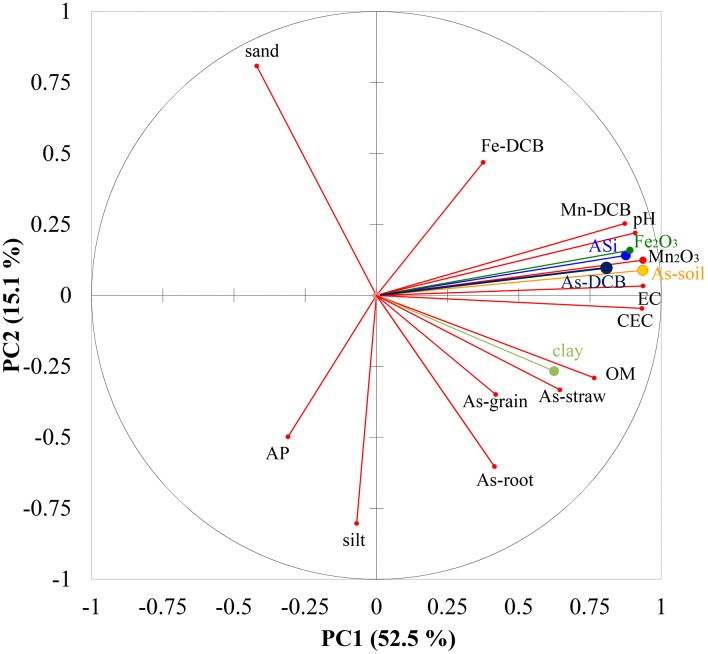
Foods produced on soils impacted by Pb-Zn mining activities are a potential health risk due to plant uptake of the arsenic (As) associated with such mining. A field survey was undertaken in two Pb-Zn mining-impacted paddy fields in Guangdong Province, China to assess As accumulation and translocation, as well as other factors influencing As in twelve commonly grown rice cultivars. The results showed that grain As concentrations in all the surveyed rice failed national food standards, irrespective of As speciation. Among the 12 rice cultivars, "SY-89" and "DY-162" had the least As in rice grain. No significant difference for As concentration in grain was observed between the rice grown in the two areas that differed significantly for soil As levels, suggesting that the amount of As contamination in the soil is not necessarily the overriding factor controlling the As content in the rice grain. The iron and manganese plaque on the root surface curtailed As accumulation in rice roots. Based on our results, the accumulation of As within rice plants was strongly associated with such soil properties such as silicon, phosphorus, organic matter, pH, and clay content. Understanding the factors and mechanisms controlling As uptake is important to develop mitigation measures that can reduce the amount of As accumulated in rice grains produced on contaminated soils.
受铅锌矿开采活动影响的土壤上生产的食物存在潜在健康风险,因为植物会吸收与这种开采相关的砷(As)。在中国广东省的两个受铅锌矿开采影响的稻田进行了一项实地调查,以评估砷的积累和转运,以及影响12个常见种植水稻品种中砷的其他因素。结果表明,所有被调查水稻的籽粒砷浓度均未达到国家食品标准,无论砷的形态如何。在这12个水稻品种中,“SY - 89”和“DY - 162”的水稻籽粒中砷含量最少。在土壤砷含量差异显著的两个地区种植的水稻之间,籽粒砷浓度没有显著差异,这表明土壤中的砷污染量不一定是控制水稻籽粒中砷含量的首要因素。根表面的铁和锰斑减少了水稻根中砷的积累。根据我们的研究结果,水稻植株内砷的积累与土壤性质如硅、磷、有机质、pH值和粘土含量密切相关。了解控制砷吸收的因素和机制对于制定减轻措施很重要,这些措施可以减少受污染土壤上生产的水稻籽粒中积累的砷含量。