Jia Jun, Yu Bin, Wu Leiming, Wang Hongwu, Wu Zhiliang, Li Ming, Huang Pengyan, Feng Shengqiu, Chen Peng, Zheng Yonglian, Peng Liangcai
National Key Laboratory of Crop Genetic Improvement and National Centre of Plant Gene Research (Wuhan), Huazhong Agricultural University, Wuhan, P.R. China; Biomass and Bioenergy Research Centre, Huazhong Agricultural University, Wuhan, P.R. China; College of Plant Science and Technology, Huazhong Agricultural University, Wuhan, P.R. China.
National Key Laboratory of Crop Genetic Improvement and National Centre of Plant Gene Research (Wuhan), Huazhong Agricultural University, Wuhan, P.R. China; Biomass and Bioenergy Research Centre, Huazhong Agricultural University, Wuhan, P.R. China; College of Life Science and Technology, Huazhong Agricultural University, Wuhan, P.R. China.
PLoS One. 2014 Sep 24;9(9):e108449. doi: 10.1371/journal.pone.0108449. eCollection 2014.
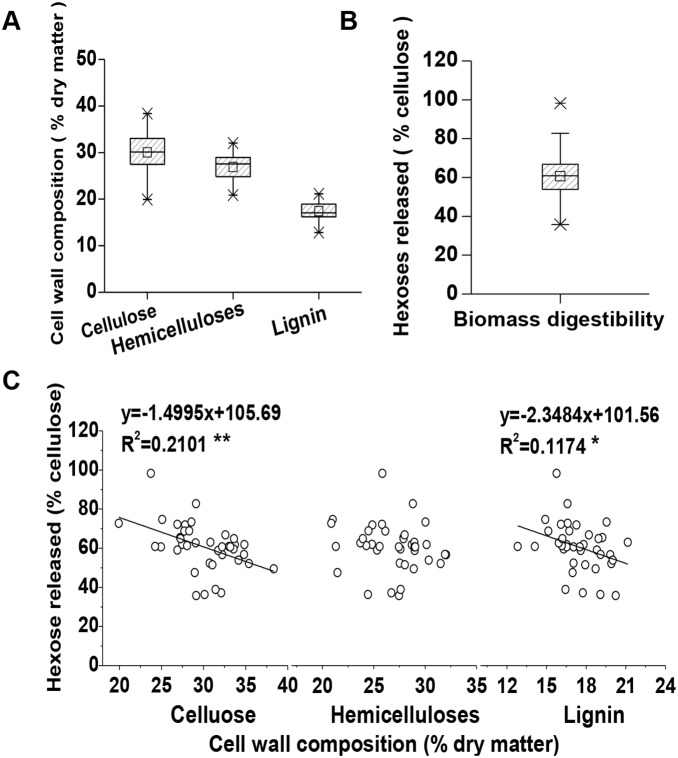
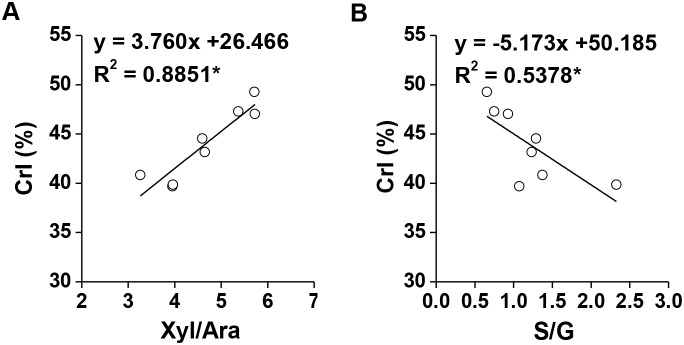
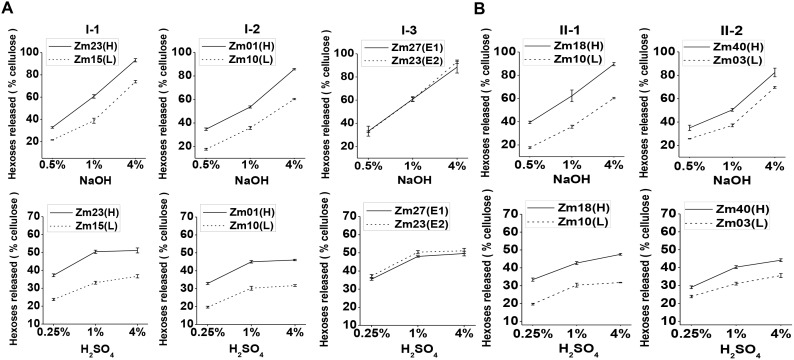
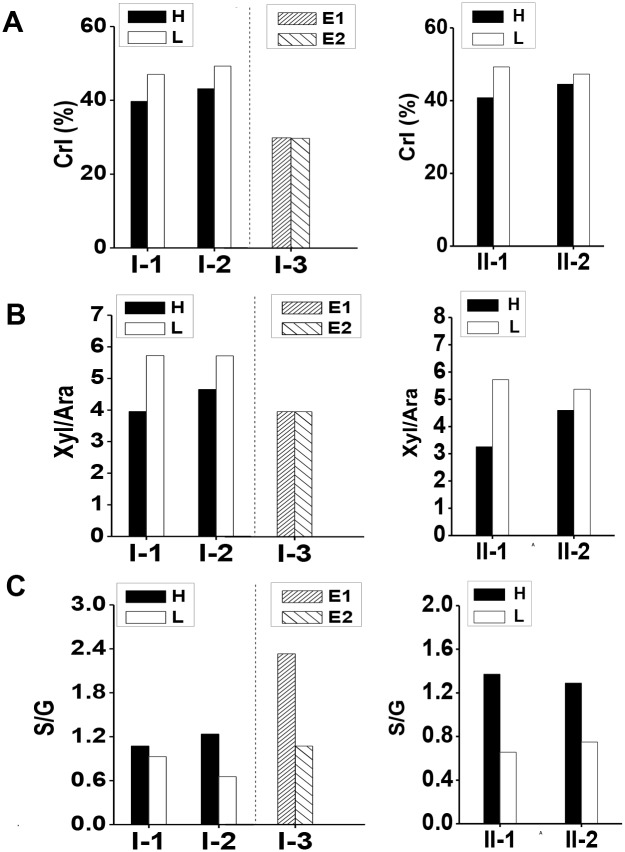
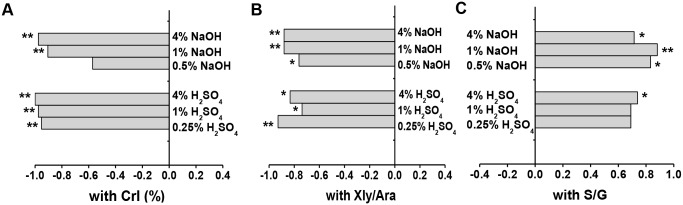
Corn is a major food crop with enormous biomass residues for biofuel production. Due to cell wall recalcitrance, it becomes essential to identify the key factors of lignocellulose on biomass saccharification. In this study, we examined total 40 corn accessions that displayed a diverse cell wall composition. Correlation analysis showed that cellulose and lignin levels negatively affected biomass digestibility after NaOH pretreatments at p<0.05 & 0.01, but hemicelluloses did not show any significant impact on hexoses yields. Comparative analysis of five standard pairs of corn samples indicated that cellulose and lignin should not be the major factors on biomass saccharification after pretreatments with NaOH and H2SO4 at three concentrations. Notably, despite that the non-KOH-extractable residues covered 12%-23% hemicelluloses and lignin of total biomass, their wall polymer features exhibited the predominant effects on biomass enzymatic hydrolysis including Ara substitution degree of xylan (reverse Xyl/Ara) and S/G ratio of lignin. Furthermore, the non-KOH-extractable polymer features could significantly affect lignocellulose crystallinity at p<0.05, leading to a high biomass digestibility. Hence, this study could suggest an optimal approach for genetic modification of plant cell walls in bioenergy corn.
玉米是一种主要的粮食作物,有大量的生物质残余物可用于生物燃料生产。由于细胞壁的顽固性,确定木质纤维素对生物质糖化的关键因素变得至关重要。在本研究中,我们检测了总共40份具有不同细胞壁组成的玉米种质。相关性分析表明,在p<0.05和0.01的情况下,经氢氧化钠预处理后,纤维素和木质素水平对生物质消化率有负面影响,但半纤维素对己糖产量没有任何显著影响。对五对标准玉米样品的比较分析表明,在用三种浓度的氢氧化钠和硫酸预处理后,纤维素和木质素不应是生物质糖化的主要因素。值得注意的是,尽管不可用氢氧化钾提取的残余物占总生物质中12%-23%的半纤维素和木质素,但它们的细胞壁聚合物特征对生物质酶解具有主要影响,包括木聚糖的阿拉伯糖取代度(反向木糖/阿拉伯糖)和木质素的S/G比。此外,不可用氢氧化钾提取的聚合物特征在p<0.05时可显著影响木质纤维素结晶度,从而导致高生物质消化率。因此,本研究可为生物能源玉米植物细胞壁的基因改造提供一种优化方法。