State Key Laboratory of Medicinal Chemical Biology, College of Pharmacy and Tianjin Key Laboratory of Molecular Drug Research, Nankai University, Tianjin 300071, China.
BMC Complement Altern Med. 2014 Sep 25;14:356. doi: 10.1186/1472-6882-14-356.
Rhizoma Menispermi (RM) is the dried root of Menispermum dauricum DC, which is traditionally used to treat swelling and pain for sore throat, enteritis and rheumatic arthralgia in the clinic, but its bioactive compounds remain unclear.
In this study, RM extract was administered orally to ICR mice followed by challenging with an intratracheal Pseudomonas aeruginosa suspension. Then mortality, histological features of lung, and inflammatory cytokines were evaluated. RM treatment significantly ameliorated Pseudomonas aeruginosa-induced acute lung inflammation and reduced levels of inflammatory mediators. To screen for potential anti-inflammatory constituents of the RM extract, a simple and rapid method based on ultra-performance liquid chromatography/quadrupole time-of-flight mass spectrometry (UPLC-Q/TOF MS) coupled with a luciferase reporter assay system to detect nuclear factor-κB (NF-κB) activity was established.
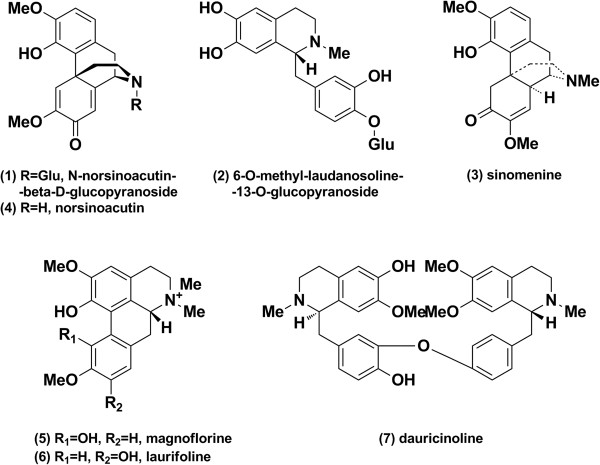
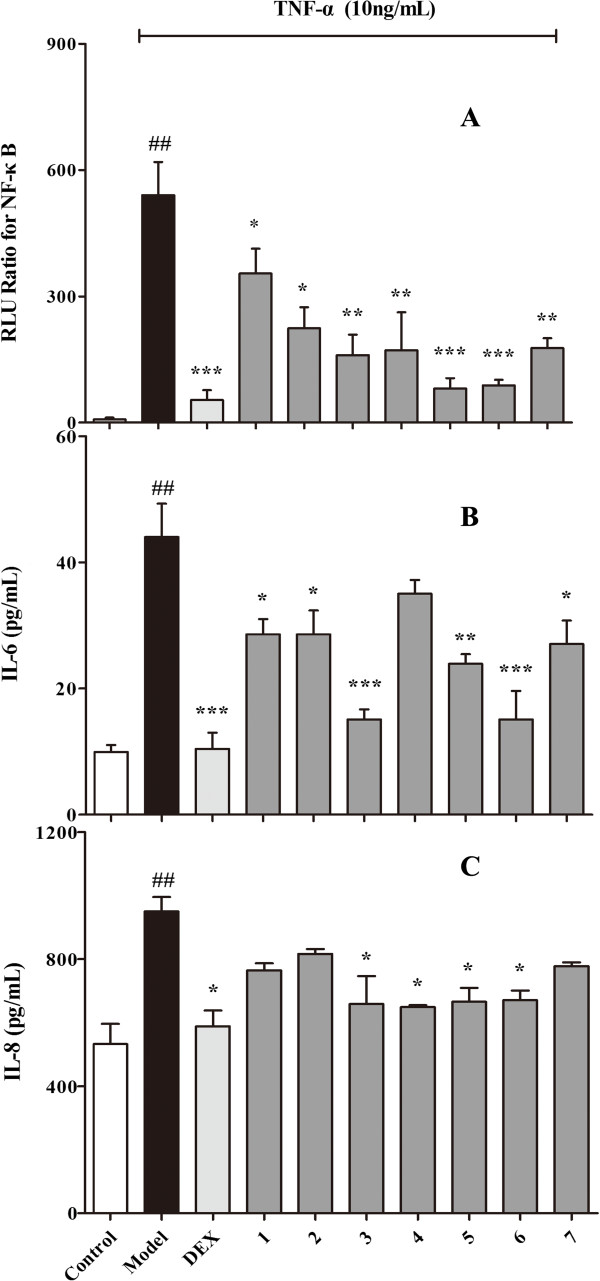
Using this system, seven potential NF-κB inhibitors were detected, including sinomenine, norsinoacutin, N-norsinoacutin-β-D-glucopyranoside, 6-O-methyl-laudanosoline-13-O-glucopyranoside, magnoflorine, laurifloline and dauricinoline. Furthermore, IL-6 and IL-8 assays confirmed the anti-inflammatory effects of these potential NF-κB inhibitors, in which norsinoacutin, 6-O-methyl-laudanosoline-13-O-glucopyranoside laurifloline, dauricinoline and N-norsinoacutin-β-D-glucopyranoside were revealed as new NF-κB inhibitors.
This method of UPLC-Q/TOF coupled with the luciferase reporter assay system was initially applied to the study of RM and was demonstrated to represent a simple, rapid and practical approach to screen for anti-inflammatory compounds. This study provided useful results for further investigation on the anti-inflammatory mechanism of RM.
防己(RM)是防己科千金藤属植物粉防己(Menispermum dauricum DC)的干燥根,在临床上常用于治疗咽喉肿痛、肠炎和风湿性关节炎的肿痛,但它的生物活性化合物仍不清楚。
本研究中,将 RM 提取物灌胃给药 ICR 小鼠,然后用气管内铜绿假单胞菌悬液进行攻毒。然后评估死亡率、肺组织学特征和炎症细胞因子。RM 治疗显著改善了铜绿假单胞菌诱导的急性肺炎症,并降低了炎症介质水平。为了筛选 RM 提取物的潜在抗炎成分,建立了一种基于超高效液相色谱/四极杆飞行时间质谱(UPLC-Q/TOF MS)结合荧光素酶报告基因检测系统检测核因子-κB(NF-κB)活性的简单快速方法。
使用该系统,检测到 7 种潜在的 NF-κB 抑制剂,包括青藤碱、北豆根素、N-去甲北豆根素-β-D-吡喃葡萄糖苷、6-O-甲基劳丹醇-13-O-β-D-吡喃葡萄糖苷、粉防己碱、laurifloline 和 dauricinoline。此外,IL-6 和 IL-8 测定证实了这些潜在 NF-κB 抑制剂的抗炎作用,其中北豆根素、6-O-甲基劳丹醇-13-O-β-D-吡喃葡萄糖苷、laurifloline、dauricinoline 和 N-去甲北豆根素-β-D-吡喃葡萄糖苷被证明是新的 NF-κB 抑制剂。
本研究首次将 UPLC-Q/TOF 与荧光素酶报告基因检测系统相结合应用于 RM 的研究,表明该方法是一种简单、快速、实用的筛选抗炎化合物的方法。本研究为进一步研究 RM 的抗炎机制提供了有价值的结果。