BMC Vet Res. 2014 Sep 25;10:223. doi: 10.1186/s12917-014-0223-6.
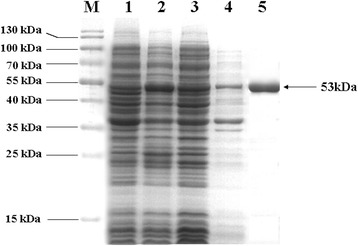
Mycoplasma synoviae is an avian pathogen that can lead to respiratory tract infections and arthritis in chickens and turkeys, resulting in serious economic losses to the poultry industry. Enolase reportedly plays important roles in several bacterial pathogens, but its role in M. synoviae has not been established. Therefore, in this study, the enolase encoding gene (eno) of M. synoviae was amplified from strain WVU1853 and expressed in E. coli BL21 cells. Then the enzymatic activity, immunogenicity and binding activity with chicken plasminogen (Plg) and human fibronectin (Fn) was evaluated.
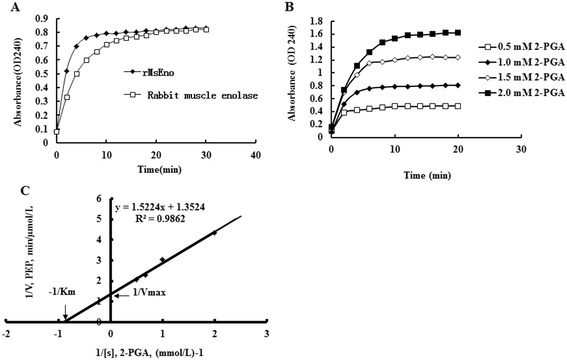
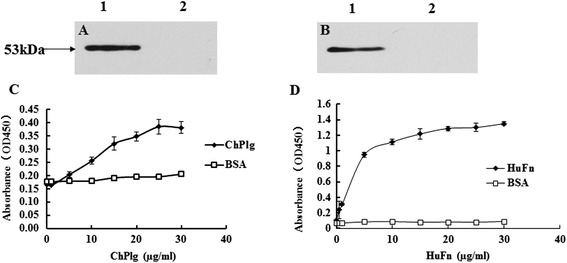
We demonstrated that the recombinant M. synoviae enolase protein (rMsEno) can catalyze the conversion of 2-phosphoglycerate (2-PGA) to phosphoenolpyruvate (PEP), the Km and Vmax values of rMsEno were 1.1 × 10(-3) M and 0.739 μmol/L/min, respectively. Western blot and immuno-electron microscopy analyses confirmed that enolase was distributed on the surface and within the cytoplasm of M. synoviae cells. The binding assays demonstrated that rMsEno was able to bind to chicken Plg and human Fn proteins. A complement-dependent mycoplasmacidal assay demonstrated that rabbit anti-rMsEno serum had distinct mycoplasmacidal efficacy in the presence of complement, which also confirmed that enolase was distributed on the surface of M. synoviae. An inhibition assay showed that the adherence of M. synoviae to DF-1 cells pre-treated with Plg could be effectively inhibited by treatment with rabbit anti-rMsEno serum.
These results reveal that M. synoviae enolase has good catalytic activity for conversion of 2-PGA to PEP, and binding activity with chicken Plg and human Fn. Rabbit anti-rMsEno serum displayed an obvious complement-dependent mycoplasmacidal effect and adherent inhibition effect. These results suggested that the M. synoviae enolase plays an important role in M. synoviae metabolism, and could potentially impact M. synoviae infection and immunity.
滑液支原体是一种禽类病原体,可导致鸡和火鸡呼吸道感染和关节炎,给家禽业造成严重的经济损失。烯醇酶据报道在几种细菌病原体中发挥重要作用,但在滑液支原体中的作用尚未确定。因此,在本研究中,从菌株 WVU1853 中扩增了滑液支原体烯醇酶编码基因(eno),并在大肠杆菌 BL21 细胞中表达。然后评估了酶活性、免疫原性以及与鸡纤溶酶原(Plg)和人纤维连接蛋白(Fn)的结合活性。
我们证明重组滑液支原体烯醇酶蛋白(rMsEno)可以催化 2-磷酸甘油酸(2-PGA)转化为磷酸烯醇丙酮酸(PEP),rMsEno 的 Km 和 Vmax 值分别为 1.1×10(-3) M 和 0.739 μmol/L/min。Western blot 和免疫电子显微镜分析证实烯醇酶分布在滑液支原体细胞的表面和细胞质内。结合实验表明 rMsEno 能够与鸡 Plg 和人 Fn 蛋白结合。补体依赖性杀支原体实验表明,在补体存在的情况下,兔抗 rMsEno 血清具有明显的杀支原体效果,这也证实了烯醇酶分布在滑液支原体的表面。抑制实验表明,Plg 预处理的 DF-1 细胞中滑液支原体的黏附可以通过兔抗 rMsEno 血清处理得到有效抑制。
这些结果表明,滑液支原体烯醇酶具有将 2-PGA 转化为 PEP 的良好催化活性,并且与鸡 Plg 和人 Fn 具有结合活性。兔抗 rMsEno 血清显示出明显的补体依赖性杀支原体效果和黏附抑制效果。这些结果表明,滑液支原体烯醇酶在滑液支原体代谢中发挥重要作用,可能影响滑液支原体感染和免疫。