Rosén Christoffer, Andersson Carl-Henrik, Andreasson Ulf, Molinuevo José L, Bjerke Maria, Rami Lorena, Lladó Albert, Blennow Kaj, Zetterberg Henrik
Clinical Neurochemistry Laboratory, Institute of Neuroscience and Physiology, Department of Psychiatry and Neurochemistry, the Sahlgrenska Academy, University of Gothenburg, Mölndal, Sweden.
Alzheimer's Disease and Other Cognitive Disorders Unit, Hospital Clinic, IDIBAPS, Barcelona, Spain.
Dement Geriatr Cogn Dis Extra. 2014 Jul 31;4(2):297-304. doi: 10.1159/000362164. eCollection 2014 May.
The cerebrospinal fluid (CSF) biomarkers total tau, abnormally phosphorylated tau and amyloid β 1-42 are strongly associated with Alzheimer's disease (AD). Apart from the pathologic hallmarks that these biomarkers represent, other processes such as inflammation and microglial activation are present in the brains of patients with AD. New biomarkers related to these processes could be valuable for the diagnosis and follow-up of AD patients and for the evaluation of inflammation-related pathologies.
The aim of this study was to evaluate the association of inflammatory CSF biomarkers with AD.
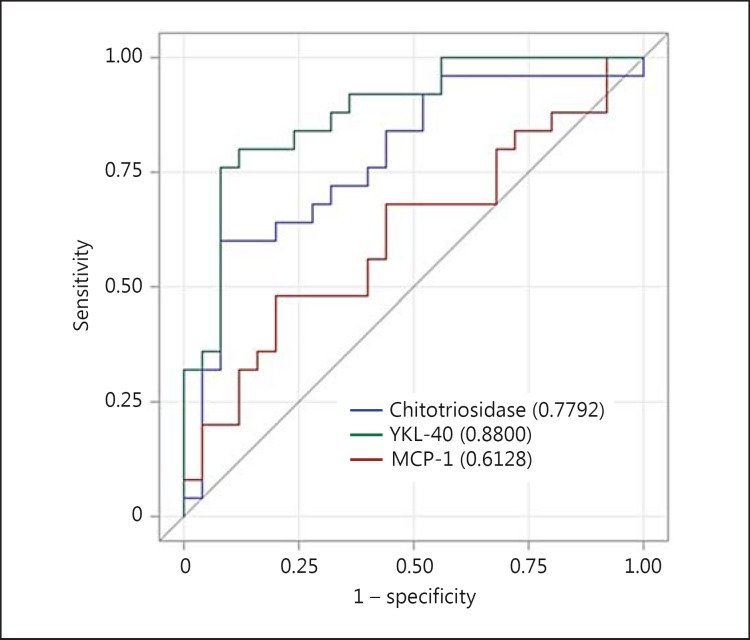
Twenty-five AD patients and 25 controls who had a pathological and normal CSF profile of the core AD biomarkers, respectively, were included in this study. CSF levels of chitotriosidase, YKL-40 (also known as chitinase-3-like protein 1) and monocyte chemoattractant protein-1 (MCP-1) were quantified and the levels compared between the groups.
AD patients had increased CSF levels of chitotriosidase and YKL-40 (both approximately twice higher than in controls), while the levels of MCP-1 were similar in the AD and control groups.
The results indicate that chitotriosidase and YKL-40 may be helpful for the evaluation of cerebral inflammatory activity in AD patients.
脑脊液(CSF)生物标志物总tau蛋白、异常磷酸化tau蛋白和淀粉样β蛋白1-42与阿尔茨海默病(AD)密切相关。除了这些生物标志物所代表的病理特征外,AD患者大脑中还存在其他过程,如炎症和小胶质细胞激活。与这些过程相关的新生物标志物可能对AD患者的诊断、随访以及炎症相关病理的评估具有重要价值。
本研究旨在评估脑脊液炎症生物标志物与AD的相关性。
本研究纳入了25例AD患者和25例对照,这些对照的核心AD生物标志物脑脊液检查结果分别为病理正常和正常。对壳三糖苷酶、YKL-40(也称为几丁质酶-3样蛋白1)和单核细胞趋化蛋白-1(MCP-1)的脑脊液水平进行定量,并比较两组之间的水平。
AD患者脑脊液中壳三糖苷酶和YKL-40水平升高(两者均比对照组高约两倍),而AD组和对照组的MCP-1水平相似。
结果表明,壳三糖苷酶和YKL-40可能有助于评估AD患者的脑炎性活动。