Loveland David, Driscoll Hilary
Human Service Center, 600 Fayette Street, Peoria, IL 61603, USA.
Subst Abuse Treat Prev Policy. 2014 Sep 25;9:41. doi: 10.1186/1747-597X-9-41.
Engaging individuals who have a substance use disorder (SUD) in treatment continues to be a challenge for the specialty addiction treatment field. Research has consistently revealed high rates of missed appointments at each step of the enrollment process: 1. between calling for services and assessment, 2. between assessment and enrollment, and 3. between enrollment and completion of treatment. Extensive research has examined each step of the process; however, there is limited research examining the overall attrition rate across all steps.
A single case study of a specialty addiction treatment agency was used to examine the attrition rates across the first three steps of the enrollment process. Attrition rates were tracked between August 1, 2011 and July 31, 2012. The cohort included 1822 unique individuals who made an initial request for addiction treatment services. Monthly retrospective reviews of medical records, phone logs, and billing data were used to calculate attrition rates. Attrition rates reported in the literature were collected and compared to the rates found at the target agency.
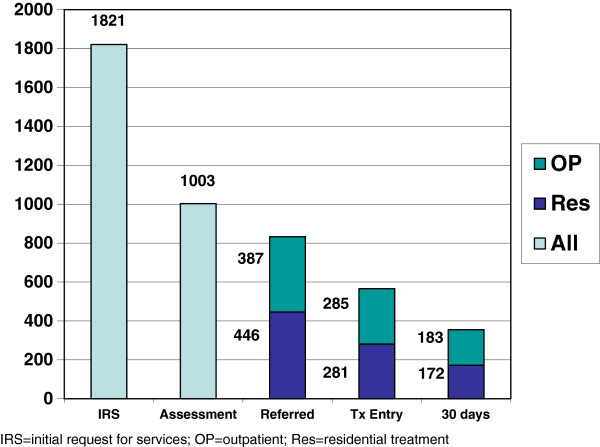
Median time between request for treatment and assessment was 6 days (mean 7.5) and between assessment and treatment enrollment was 8 days (mean 12.5). An overall attrition rate of 80% was observed, including 45% between call and assessment, 32% between assessment and treatment enrollment (another 17% could not be determined), and 37% left or were removed from treatment before 30 days. Women were less likely to complete 30 days of treatment compared to men. No other demographics were related to attrition rates.
One out of every five people who requested treatment completed a minimum of 30 days of a treatment. The attrition rate was high, yet similar to rates noted in the literature. Limitations of the single case study are noted.
Attrition rates in the U.S. are high with approximately 75% to 80% of treatment seekers disengaging at one of the multiple stages of the enrollment and treatment process. Significant changes in the system are needed to improve engagement rates.
让患有物质使用障碍(SUD)的人参与治疗,仍然是专业成瘾治疗领域面临的一项挑战。研究一直表明,在登记过程的每个阶段,失约率都很高:1. 在寻求服务与评估之间;2. 在评估与登记之间;3. 在登记与治疗结束之间。大量研究审视了该过程的每个步骤;然而,研究整体流失率(涵盖所有步骤)的研究却很有限。
采用一项针对专业成瘾治疗机构的单案例研究,来审视登记过程前三个步骤的流失率。在2011年8月1日至2012年7月31日期间追踪流失率。该队列包括1822名首次请求成瘾治疗服务的独特个体。通过每月对病历、电话记录和计费数据进行回顾性审查来计算流失率。收集文献中报告的流失率,并与目标机构的流失率进行比较。
从请求治疗到评估的中位时间为6天(平均7.5天),从评估到治疗登记的中位时间为8天(平均12.5天)。观察到的总体流失率为80%,包括在致电与评估之间为45%,在评估与治疗登记之间为32%(另有17%无法确定),以及在30天内离开或被终止治疗的为37%。与男性相比,女性完成30天治疗的可能性较小。没有其他人口统计学特征与流失率相关。
每五个请求治疗的人中,只有一人完成了至少30天的治疗。流失率很高,但与文献中指出的比率相似。指出了单案例研究的局限性。
美国的流失率很高,约75%至80%寻求治疗者在登记和治疗过程的多个阶段之一退出。需要对该系统进行重大变革以提高参与率。