Rahmioglu Nilufer, Fassbender Amelie, Vitonis Allison F, Tworoger Shelley S, Hummelshoj Lone, D'Hooghe Thomas M, Adamson G David, Giudice Linda C, Becker Christian M, Zondervan Krina T, Missmer Stacey A
Wellcome Trust Centre for Human Genetics, University of Oxford, Oxford, United Kingdom.
Organ Systems, Department of Development and Regeneration, Katholieke Universiteit Leuven, Leuven, Belgium; Department of Obstetrics and Gynaecology, Leuven University Fertility Centre, University Hospital Leuven, Leuven, Belgium.
Fertil Steril. 2014 Nov;102(5):1233-43. doi: 10.1016/j.fertnstert.2014.07.1208. Epub 2014 Sep 22.
To harmonize standard operating procedures (SOPs) and standardize the recording of associated data for collection, processing, and storage of fluid biospecimens relevant to endometriosis.
An international collaboration involving 34 clinical/academic centers and 3 industry collaborators from 16 countries on 5 continents.
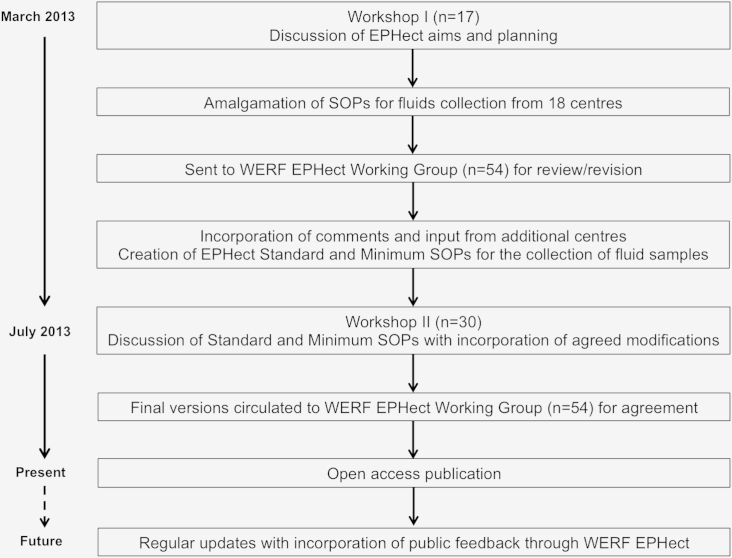
In 2013, 2 workshops were conducted, followed by global consultation, bringing together 54 leaders in endometriosis research and sample processing worldwide.
PATIENT(S): None.
INTERVENTION(S): Consensus SOPs were based on: [1] systematic comparison of SOPs from 18 global centers collecting fluid samples from women with and without endometriosis on a medium/large scale (publication on >100 cases), [2] literature evidence where available, or consultation with laboratory experts otherwise, and [3] several global consultation rounds.
MAIN OUTCOME MEASURE(S): Standard recommended and minimum required SOPs for biofluid collection, processing, and storage in endometriosis research.
RESULT(S): We developed recommended standard and minimum required SOPs for the collection, processing, and storage of plasma, serum, saliva, urine, endometrial/peritoneal fluid, and menstrual effluent, and a biospecimen data-collection form necessary for interpretation of sample-derived results.
CONCLUSION(S): The Endometriosis Phenome and Biobanking Harmonisation Project SOPs allow endometriosis research centers to decrease variability in biofluid sample results, facilitating between-center comparisons and collaborations. The procedures are also relevant to research into other female conditions involving biofluid samples subject to cyclic reproductive influences. The consensus SOPs are based on the best available evidence; areas with limited evidence are identified as requiring further pilot studies. The SOPs will be reviewed based on investigator feedback, and through systematic tri-annual follow-up. Updated versions will be made available at: endometriosisfoundation.org/ephect.
协调标准操作程序(SOP),规范与子宫内膜异位症相关的液体生物样本采集、处理及存储过程中相关数据的记录。
一项国际合作项目,涉及来自五大洲16个国家的34个临床/学术中心以及3个行业合作伙伴。
2013年举办了2次研讨会,随后进行全球咨询,汇聚了全球54位子宫内膜异位症研究及样本处理领域的领军人物。
无。
达成共识的SOP基于:[1]对18个全球中心的SOP进行系统比较,这些中心从中/大规模收集有或无子宫内膜异位症女性的液体样本(发表病例数>100例),[2]现有文献证据,若无则咨询实验室专家,以及[3]多次全球咨询回合。
子宫内膜异位症研究中生物样本采集、处理及存储的标准推荐和最低要求SOP。
我们制定了血浆、血清、唾液、尿液、子宫内膜/腹腔液及月经流出液采集、处理及存储的标准推荐和最低要求SOP,以及解读样本衍生结果所需的生物样本数据收集表。
子宫内膜异位症表型与生物样本库协调项目的SOP可使子宫内膜异位症研究中心减少生物样本结果的变异性,促进中心间的比较与合作。这些程序也适用于涉及受周期性生殖影响的生物样本的其他女性疾病研究。共识SOP基于现有最佳证据;证据有限的领域被确定需要进一步的试点研究。SOP将根据研究者反馈及每三年一次的系统随访进行审查。更新版本可在endometriosisfoundation.org/ephect获取。