Du Yahui, Lu Fei, Li Peng, Ye Jingjing, Ji Min, Ma Daoxin, Ji Chunyan
Department of Hematology, Qilu Hospital, Shandong University, Jinan 250012, China.
Int J Mol Sci. 2014 Sep 25;15(9):17065-76. doi: 10.3390/ijms150917065.
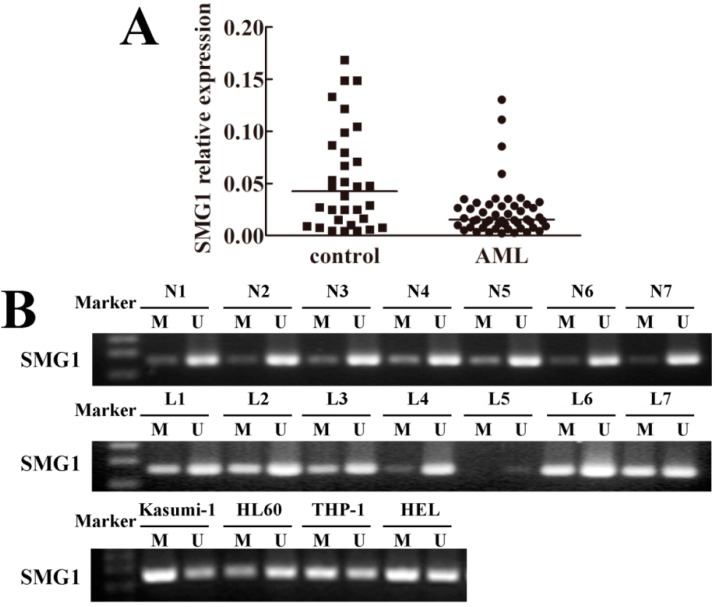
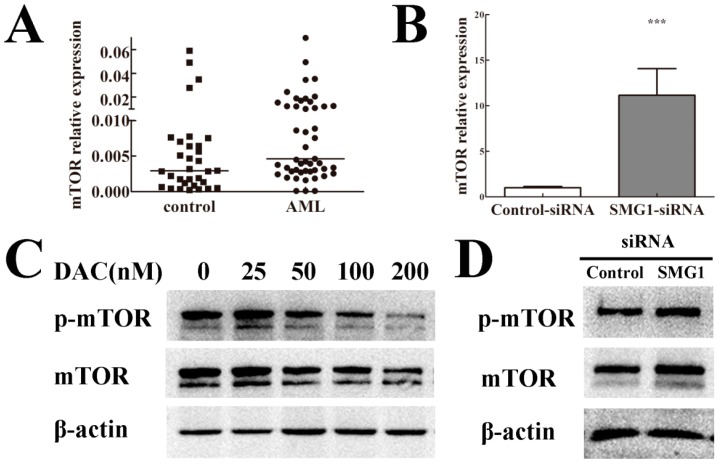
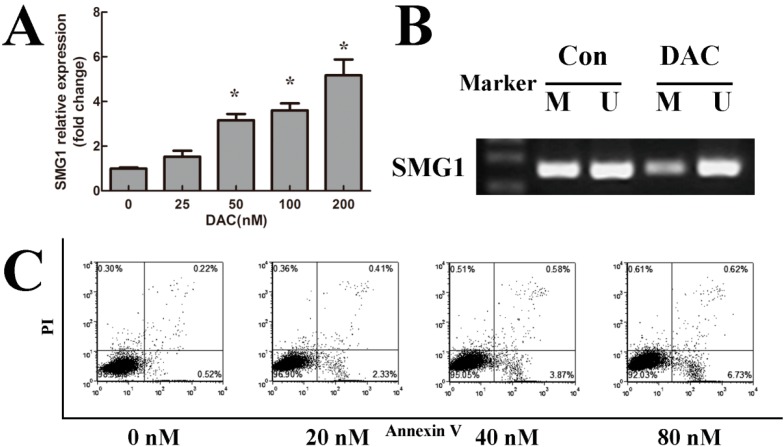
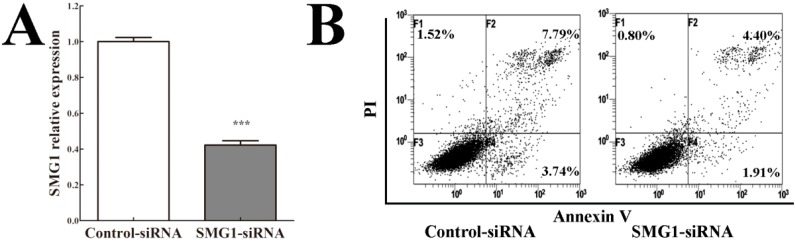
Suppressor with morphogenetic effect on genitalia family member (SMG1) belongs to a family of phosphoinositide 3-kinase-related kinases and is the main kinase involved in nonsense-mediated mRNA decay. Recently, SMG1 was suggested as a novel potential tumor suppressor gene, particularly in hypoxic tumors. To investigate the function of SMG1 in acute myeloid leukemia (AML), we performed methylation-specific polymerase chain reaction and found that SMG1 was hypermethylated in the promoter region. SMG1 hypermethylation was found in 66% (33/50) of AML samples compared with none (0/14) of the normal controls. SMG1 mRNA was down-regulated in AML patients with hypermethylation status whereas it was readily expressed in patients without methylation. Moreover, treatment of AML cells with demethylating agent 5-aza-2'-deoxycytidine (decitabine) inhibited AML cell growth and induced apoptosis by reversing SMG1 methylation status and restoring SMG1 expression. On the other hand, knockdown of SMG1 by RNA interference inhibited apoptosis. We also found that mTOR expression level was negatively correlated to SMG1 expression in AML patients which indicated that SMG1 and mTOR maybe act antagonistically to regulate AML cell growth. In conclusion, our results indicate that SMG1 acts as a potential tumor suppressor with epigenetic regulation in AML.
对生殖器有形态发生作用的抑制因子家族成员(SMG1)属于磷酸肌醇3激酶相关激酶家族,是无义介导的mRNA降解中涉及的主要激酶。最近,SMG1被认为是一种新型潜在肿瘤抑制基因,尤其是在缺氧肿瘤中。为了研究SMG1在急性髓系白血病(AML)中的功能,我们进行了甲基化特异性聚合酶链反应,发现SMG1在启动子区域发生了高甲基化。在66%(33/50)的AML样本中发现了SMG1高甲基化,而正常对照中无一例(0/14)出现。在甲基化状态高的AML患者中,SMG1 mRNA下调,而在未甲基化的患者中则易于表达。此外,用去甲基化剂5-氮杂-2'-脱氧胞苷(地西他滨)处理AML细胞可通过逆转SMG1甲基化状态和恢复SMG1表达来抑制AML细胞生长并诱导凋亡。另一方面,通过RNA干扰敲低SMG1可抑制凋亡。我们还发现,在AML患者中,mTOR表达水平与SMG1表达呈负相关,这表明SMG1和mTOR可能在调节AML细胞生长方面起拮抗作用。总之,我们的结果表明,SMG1在AML中作为一种具有表观遗传调控作用的潜在肿瘤抑制因子发挥作用。