Li Ying-Hui, Reif Jochen C, Jackson Scott A, Ma Yan-Song, Chang Ru-Zhen, Qiu Li-Juan
BMC Plant Biol. 2014 Sep 26;14:251. doi: 10.1186/s12870-014-0251-1.
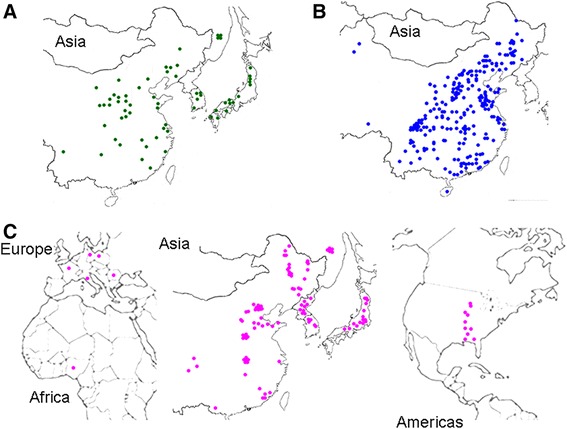
Cultivated soybean (Glycine max) experienced a severe genetic bottleneck during its domestication and a further loss in diversity during its subsequent selection. Here, a panel of 65 wild (G. soja) and 353 cultivated accessions was genotyped at 552 single-nucleotide polymorphism loci to search for signals of selection during and after domestication.
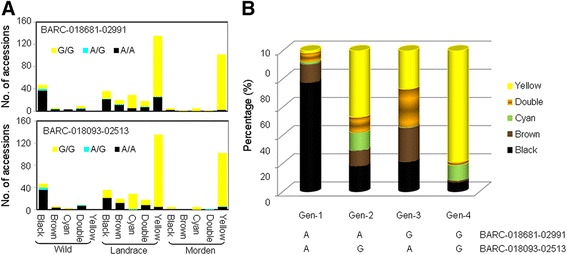
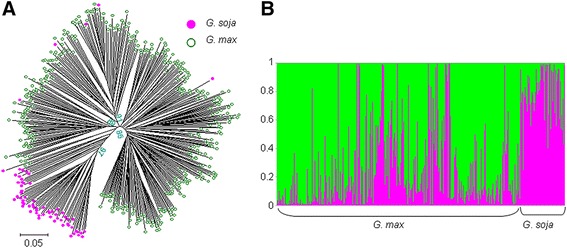
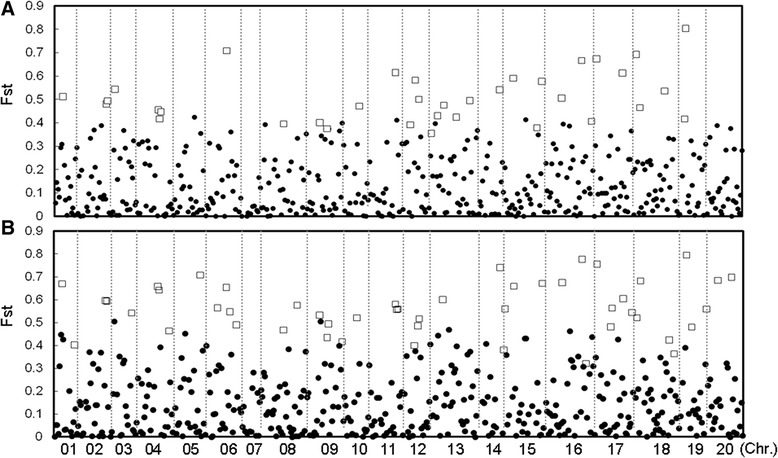
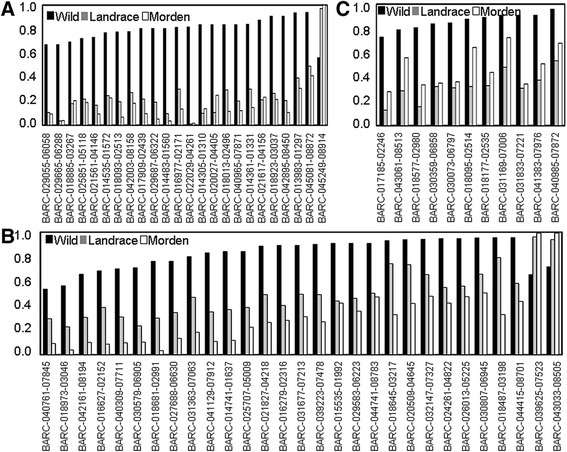
The wild and cultivated populations were well differentiated from one another. Application of the Fst outlier test revealed 64 loci showing evidence for selection. Of these, 35 related to selection during domestication, while the other 29 likely gradually became monomorphic as a result of prolonged selection during post domestication. Two of the SNP locus outliers were associated with testa color.
Identifying genes controlling domestication-related traits is important for maintaining the diversity of crops. SNP locus outliers detected by a combined forward genetics and population genetics approach can provide markers with utility for the conservation of wild accessions and for trait improvement in the cultivated genepool.
栽培大豆(Glycine max)在驯化过程中经历了严重的遗传瓶颈,并且在随后的选择过程中多样性进一步丧失。在此,对一组由65份野生大豆(G. soja)和353份栽培品种组成的样本在552个单核苷酸多态性位点进行了基因分型,以寻找驯化过程中和驯化后选择的信号。
野生种群和栽培种群彼此之间有明显分化。Fst异常值检验显示有64个位点有选择的证据。其中,35个与驯化过程中的选择有关,而另外29个可能由于驯化后长期选择而逐渐变得单态。两个单核苷酸多态性位点异常值与种皮颜色有关。
鉴定控制驯化相关性状的基因对于维持作物多样性很重要。通过正向遗传学和群体遗传学相结合的方法检测到的单核苷酸多态性位点异常值可为保护野生种质和改良栽培基因库中的性状提供有用的标记。