Johansson Henrik, Jones Harriet J, Foreman Julia, Hemsted Joseph R, Stewart Kelly, Grima Ramon, Halliday Karen J
Synthetic and Systems Biology (SynthSys), University of Edinburgh, CH Waddington Building, Mayfield Road, Edinburgh EH9 3JD, UK.
Nat Commun. 2014 Sep 26;5:4848. doi: 10.1038/ncomms5848.
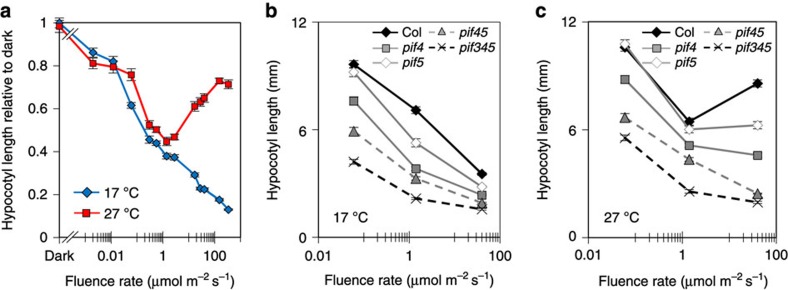
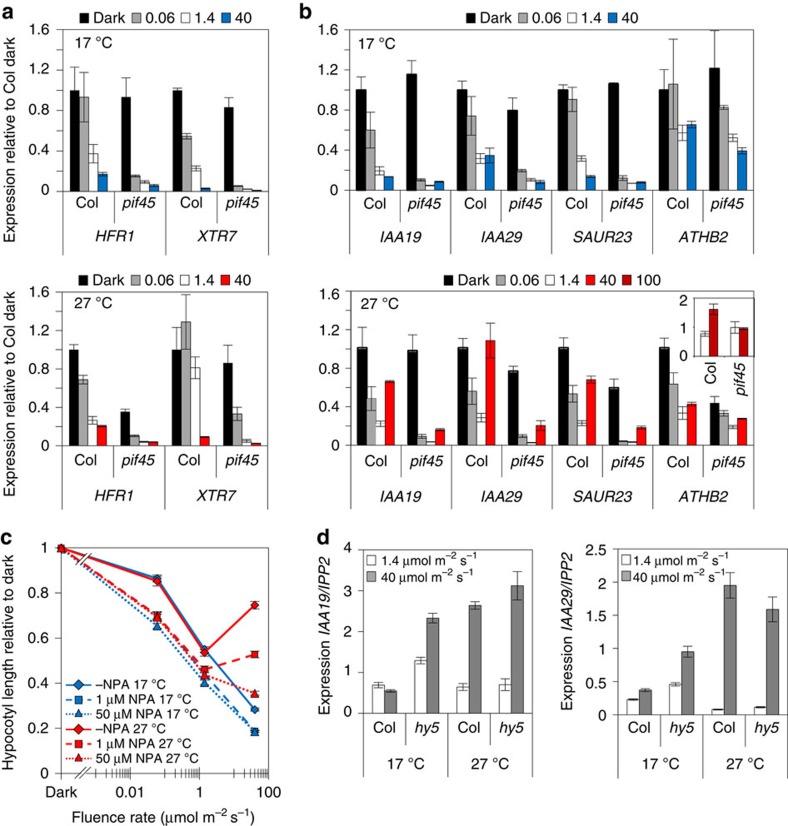
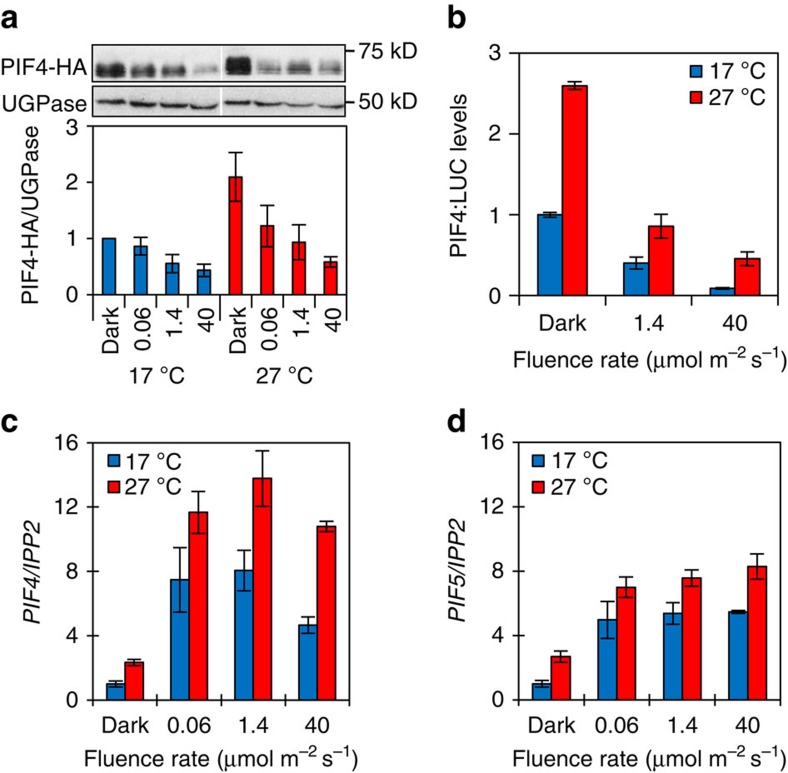
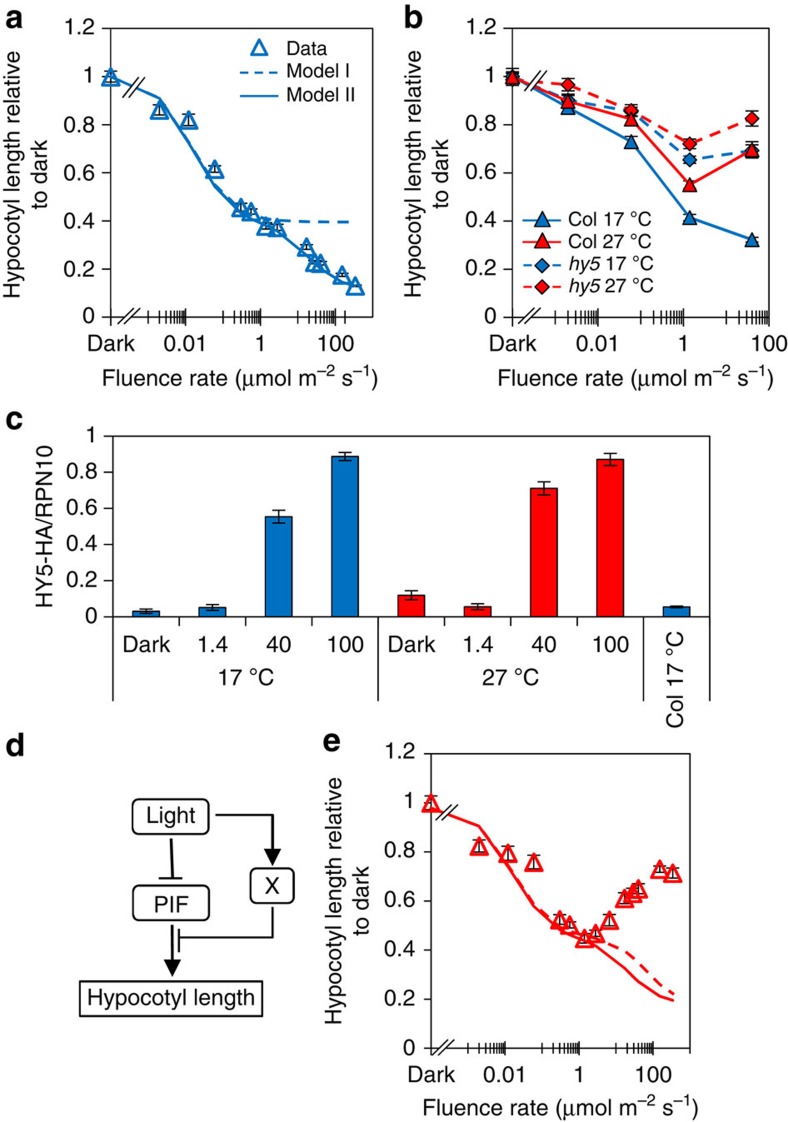
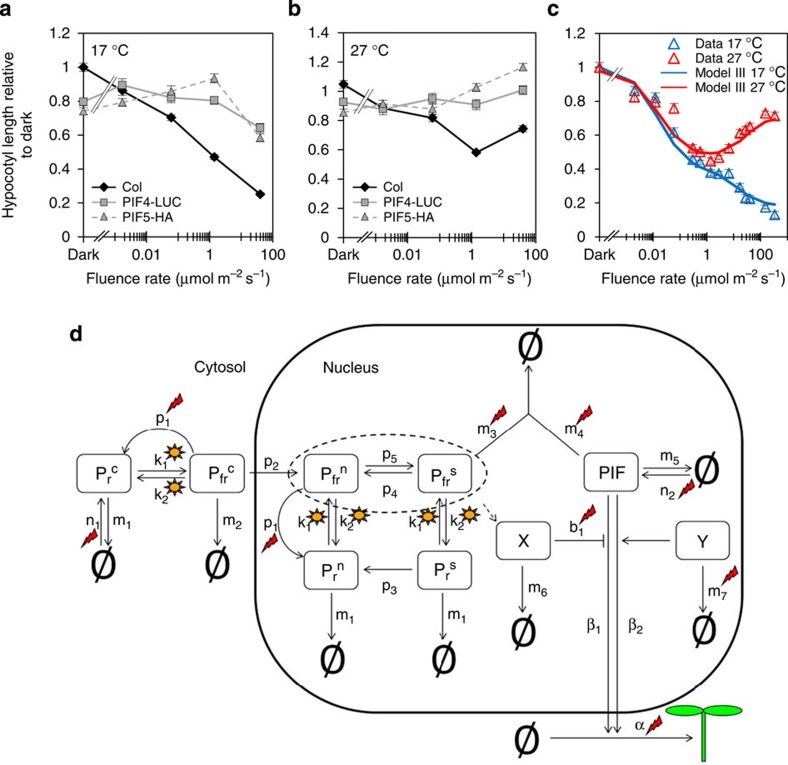
In Arabidopsis, the seedling hypocotyl has emerged as an exemplar model system to study light and temperature control of cell expansion. Light sensitivity of this organ is epitomized in the fluence rate response where suppression of hypocotyl elongation increases incrementally with light intensity. This finely calibrated response is controlled by the photoreceptor, phytochrome B, through the deactivation and proteolytic destruction of phytochrome-interacting factors (PIFs). Here we show that this classical light response is strictly temperature dependent: a shift in temperature induces a dramatic reversal of response from inhibition to promotion of hypocotyl elongation by light. Applying an integrated experimental and mathematical modelling approach, we show how light and temperature coaction in the circuitry drives a molecular switch in PIF activity and control of cell expansion. This work provides a paradigm to understand the importance of signal convergence in evoking different or non-intuitive alterations in molecular signalling.
在拟南芥中,幼苗下胚轴已成为研究光和温度对细胞扩张控制的典型模型系统。该器官的光敏感性在光通量率响应中得到体现,即随着光强度的增加,下胚轴伸长的抑制作用逐渐增强。这种精确校准的响应由光受体phytochrome B通过phytochrome相互作用因子(PIFs)的失活和蛋白水解破坏来控制。在这里,我们表明这种经典的光响应严格依赖于温度:温度的变化会导致光对下胚轴伸长的响应从抑制急剧逆转到促进。应用综合实验和数学建模方法,我们展示了光和温度在该信号通路中的共同作用如何驱动PIF活性的分子开关以及对细胞扩张的控制。这项工作提供了一个范例,以理解信号汇聚在引发分子信号中不同或非直观变化方面的重要性。