Nakamura Kazuhito, Watanabe Norio, Ohkawa Hiroshi, Ando Michiyasu, Ogura Yukio, Funabiki Sumito, Kume Akito, Urano Kimihiko, Osada Takashi, Yamamura Keiko
Department of Clinical Pharmacy, School of Pharmacy, Aichi Gakuin University, Aichi, Japan ; Koyo Pharmacy, Aichi, Japan.
Department of Clinical Pharmacy, School of Pharmacy, Aichi Gakuin University, Aichi, Japan.
Patient Prefer Adherence. 2014 Sep 15;8:1223-8. doi: 10.2147/PPA.S69750. eCollection 2014.
In this study, we evaluated changes in functioning and caregiver burden in Alzheimer's disease (AD) patients after a dosage increase that was made based on pharmacists' evaluation of AD patients' behavior in daily life.
Pharmacists used a checklist, a questionnaire, and the Repetitive Saliva Swallowing Test (RSST) to gather data on the daily life of AD patients taking donepezil 5 mg/day and their caregivers. In 27 cases, pharmacists suggested a dosage change to 10 mg/day to AD patients' physicians. Pharmacists then evaluated these patients for 16 weeks after the increase to determine changes in functional assessment staging, caregiver burden, and swallowing function.
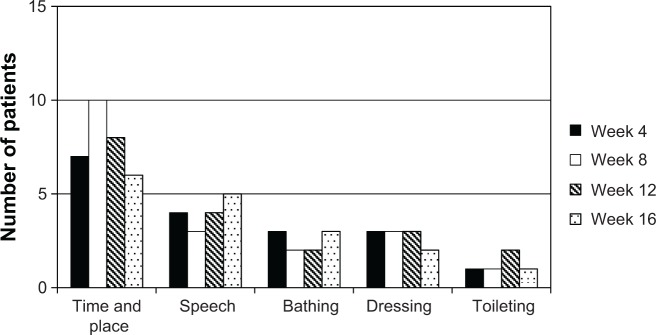
During the 16-week study, 20 of the 27 patients showed at least one-stage improvement in relation to the five assessed aspects of daily life (time/place, speech, bathing, dressing, and toileting). The mean score for caregiver burden due to personal strain was significantly lower after the dosage increase than before (5.15±3.76 at baseline; from 3.89±3.42 at week 4 to 3.59±3.90 at week 16; P<0.05), as was the mean score due to role strain (2.19±2.80 at baseline; 1.56±2.64 at week 8; P<0.05). After the dosage increase, the impaired swallowing function that accompanies AD was improved in the patients with swallowing problems, as indicated by a higher mean RSST score (1.22±0.67 at baseline; from 2.78±1.72 at week 4 to 2.78±1.79 at week 16; P<0.05).
The dosage increase not only decreased caregiver burden, but also appeared to improve impaired swallowing function. Medication therapy management by pharmacists of AD patients, including the use of a checklist, contributed to the correct use of donepezil and improved quality of life for caregivers.
在本研究中,我们评估了基于药剂师对阿尔茨海默病(AD)患者日常生活行为的评估而增加剂量后,AD患者的功能及照料者负担的变化。
药剂师使用清单、问卷以及重复性唾液吞咽测试(RSST)收集服用多奈哌齐5毫克/天的AD患者及其照料者日常生活的数据。在27例患者中,药剂师向AD患者的医生建议将剂量增至10毫克/天。剂量增加后,药剂师对这些患者进行了16周的评估,以确定功能评估分期、照料者负担和吞咽功能的变化。
在为期16周的研究中,27例患者中有20例在日常生活的五个评估方面(时间/地点、言语、洗澡、穿衣和如厕)至少有一个阶段的改善。剂量增加后,因个人压力导致的照料者负担平均得分显著低于增加前(基线时为5.15±3.76;第4周时为3.89±3.42,第16周时为3.59±3.90;P<0.05),因角色压力导致的平均得分也是如此(基线时为2.19±2.80;第8周时为1.56±2.64;P<0.05)。剂量增加后,有吞咽问题的患者中,伴随AD出现的吞咽功能受损情况得到改善,RSST平均得分更高表明了这一点(基线时为1.22±0.67;第4周时为2.78±1.72,第16周时为2.78±1.79;P<0.05)。
剂量增加不仅减轻了照料者负担,而且似乎还改善了吞咽功能受损情况。药剂师对AD患者的药物治疗管理,包括使用清单,有助于多奈哌齐的正确使用,并改善了照料者的生活质量。