Karo Jenny M, Schatz David G, Sun Joseph C
Immunology Program and Gerstner Sloan Kettering Graduate School of Biomedical Sciences, Memorial Sloan Kettering Cancer Center, New York, NY 10065, USA.
Department of Immunobiology and the Howard Hughes Medical Institute, Yale University School of Medicine, New Haven, CT 06510, USA.
Cell. 2014 Sep 25;159(1):94-107. doi: 10.1016/j.cell.2014.08.026.
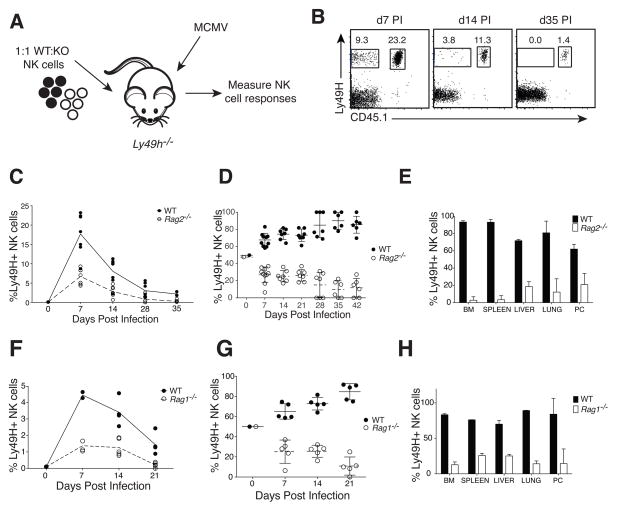
The emergence of recombination-activating genes (RAGs) in jawed vertebrates endowed adaptive immune cells with the ability to assemble a diverse set of antigen receptor genes. In contrast, innate lymphocytes, such as natural killer (NK) cells, are not believed to require RAGs. Here, we report that NK cells unable to express RAGs or RAG endonuclease activity during ontogeny exhibit a cell-intrinsic hyperresponsiveness but a diminished capacity to survive following virus-driven proliferation, a reduced expression of DNA damage response mediators, and defects in the repair of DNA breaks. Evidence for this novel function of RAG has also been observed in T cells and innate lymphoid cells (ILCs), revealing an unexpected role for RAG proteins beyond V(D)J recombination. We propose that DNA cleavage events mediated by RAG endow developing adaptive and innate lymphocytes with a cellular "fitness" that safeguards their persistence later in life during episodes of rapid proliferation or cellular stress.
颌口脊椎动物中重组激活基因(RAGs)的出现,赋予了适应性免疫细胞组装多种抗原受体基因的能力。相比之下,天然淋巴细胞,如自然杀伤(NK)细胞,被认为不需要RAGs。在此,我们报告称,在个体发育过程中无法表达RAGs或RAG内切酶活性的NK细胞表现出细胞内在的高反应性,但在病毒驱动的增殖后存活能力减弱,DNA损伤反应介质的表达降低,以及DNA断裂修复缺陷。在T细胞和先天性淋巴细胞(ILC)中也观察到了RAG这一新功能的证据,揭示了RAG蛋白在V(D)J重组之外的意外作用。我们提出,由RAG介导的DNA切割事件赋予发育中的适应性和先天性淋巴细胞一种细胞“适应性”,从而在生命后期快速增殖或细胞应激期间保障它们的持续存在。