Horn Frederike, Habekuß Antje, Stich Benjamin
Max Planck Institute for Plant Breeding Research, Carl-von-Linné-Weg 10, 50829, Cologne, Germany.
Theor Appl Genet. 2014 Dec;127(12):2575-84. doi: 10.1007/s00122-014-2400-1. Epub 2014 Sep 28.
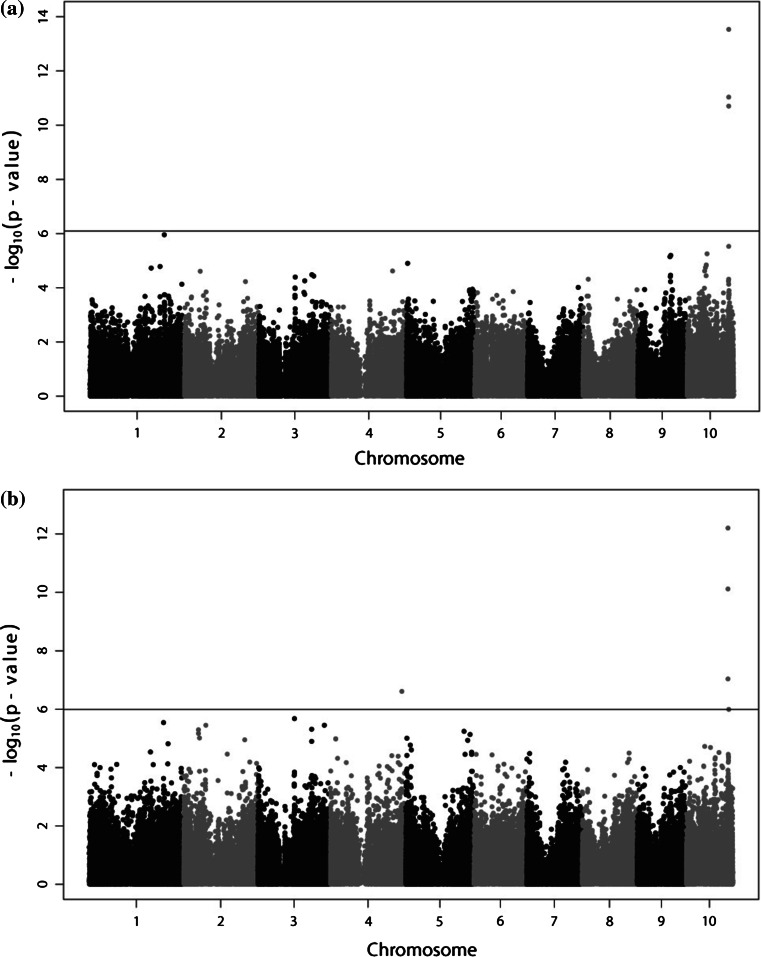
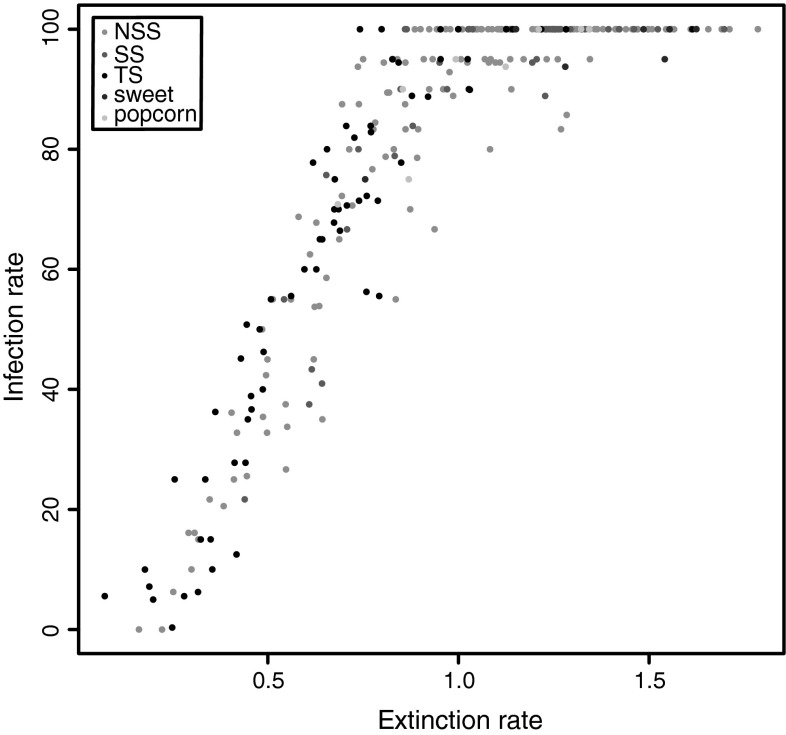
The results of our study suggest that genes involved in general resistance mechanisms of plants contribute to variation of BYDV resistance in maize. With increasing winter temperatures in Europe, Barley yellow dwarf virus (BYDV) is expected to become a prominent problem in maize cultivation. Breeding for resistance is the best strategy to control the disease and break the transmission cycle of the virus. The objectives of our study were (1) to determine genetic variation with respect to BYDV resistance in a broad germplasm set and (2) to identify single nucleotide polymorphism (SNP) markers linked to genes that are involved in BYDV resistance. An association mapping population with 267 genotypes representing the world's maize gene pool was grown in the greenhouse. Plants were inoculated with BYDV-PAV using viruliferous Rhopalosiphum padi. In the association mapping population, we observed considerable genotypic variance for the trait virus extinction as measured by double antibody sandwich enzyme-linked immunosorbent assay (DAS-ELISA) and the infection rate. In a genome-wide association study, we observed three SNPs significantly [false discovery rate (FDR) = 0.05] associated with the virus extinction on chromosome 10 explaining together 25 % of the phenotypic variance and five SNPs for the infection rate on chromosomes 4 and 10 explaining together 33 % of the phenotypic variance. The SNPs significantly associated with BYDV resistance can be used in marker assisted selection and will accelerate the breeding process for the development of BYDV resistant maize genotypes. Furthermore, these SNPs were located within genes which were in other organisms described to play a role in general resistance mechanisms. This suggests that these genes contribute to variation of BYDV resistance in maize.
我们的研究结果表明,参与植物一般抗性机制的基因导致了玉米对大麦黄矮病毒(BYDV)抗性的变异。随着欧洲冬季气温升高,预计大麦黄矮病毒将成为玉米种植中的一个突出问题。培育抗性品种是控制该病并打破病毒传播周期的最佳策略。我们研究的目的是:(1)在广泛的种质资源中确定与BYDV抗性相关的遗传变异;(2)鉴定与参与BYDV抗性的基因连锁的单核苷酸多态性(SNP)标记。在温室中种植了一个包含267个基因型、代表世界玉米基因库的关联作图群体。使用带毒的禾谷缢管蚜对植株接种BYDV-PAV。在该关联作图群体中,我们通过双抗体夹心酶联免疫吸附测定(DAS-ELISA)和感染率测量,观察到性状病毒清除方面存在相当大的基因型变异。在全基因组关联研究中,我们在第10号染色体上观察到3个与病毒清除显著相关(错误发现率FDR = 0.05)的SNP,它们共同解释了25%的表型变异,在第4号和第10号染色体上观察到5个与感染率相关的SNP,它们共同解释了33%的表型变异。与BYDV抗性显著相关的SNP可用于标记辅助选择,并将加速培育抗BYDV玉米基因型的育种进程。此外,这些SNP位于其他生物体中描述的参与一般抗性机制的基因内。这表明这些基因导致了玉米对BYDV抗性的变异。