Araujo-Pires Ana Claudia, Vieira Andreia Espindola, Francisconi Carolina Favaro, Biguetti Claudia Cristina, Glowacki Andrew, Yoshizawa Sayuri, Campanelli Ana Paula, Trombone Ana Paula Favaro, Sfeir Charles S, Little Steven R, Garlet Gustavo Pompermaier
Department of Biological Sciences, School of Dentistry of Bauru, Sao Paulo University (FOB/USP), Bauru, SP, Brazil.
J Bone Miner Res. 2015 Mar;30(3):412-22. doi: 10.1002/jbmr.2376.
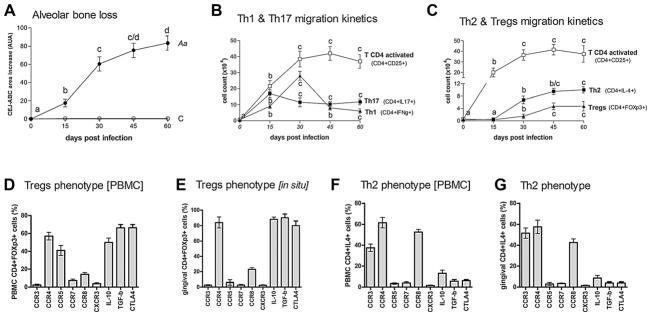
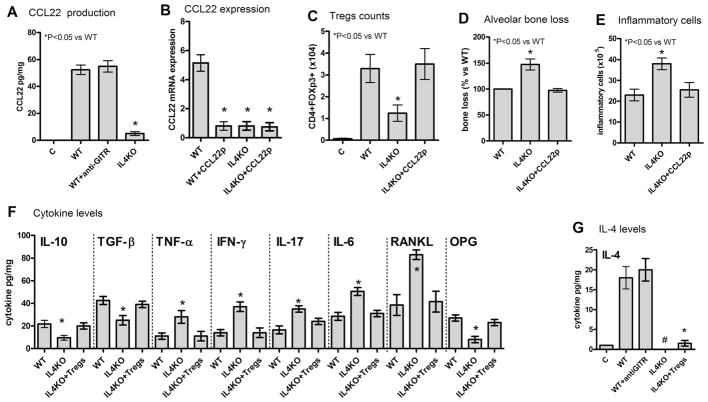
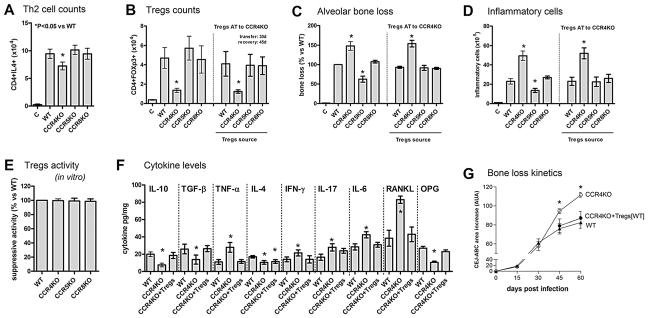
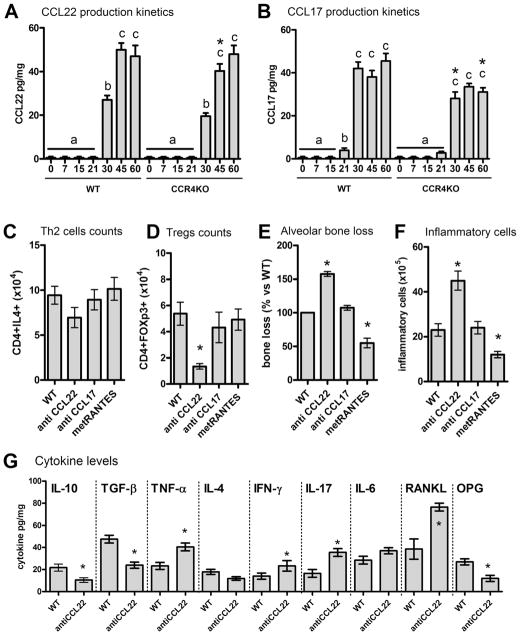
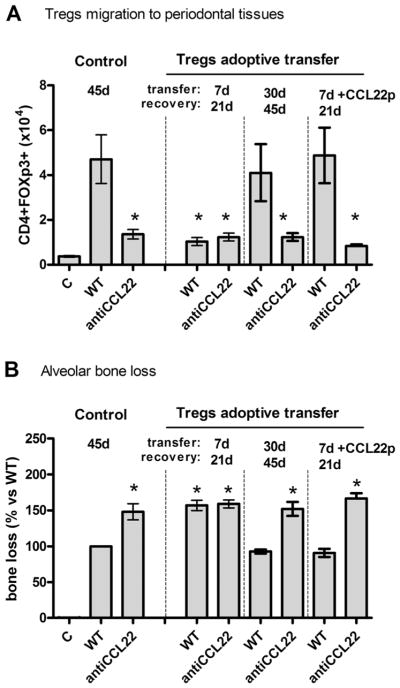
Inflammatory bone resorption is a hallmark of periodontitis, and Tregs and Th2 cells are independently associated with disease progression attenuation. In this study, we employed an infection-triggered inflammatory osteolysis model to investigate the mechanisms underlying Treg and Th2 cell migration and the impact on disease outcome. Aggregatibacter actinomycetemcomitans-infected C57Bl/6 (wild-type [WT]) mice develop an intense inflammatory reaction and alveolar bone resorption, and Treg and Th2 cell migration is temporally associated with disease progression attenuation. Tregs extracted from the lesions preferentially express CCR4 and CCR8, whereas Th2 cells express CCR3, CCR4, and CCR8. The absence of CCR5 and CCR8 did not significantly impact the migration of Tregs and Th2 cells or affect the disease outcome. CCR4KO mice presented a minor reduction in Th2 cells in parallel with major impairment of Treg migration, which was associated with increased inflammatory bone loss and higher proinflammatory and osteoclastogenic cytokine levels. The blockade of the CCR4 ligand CCL22 in WT mice resulted in an increased inflammatory bone loss phenotype similar to that in the CCR4KO strain. Adoptive transfer of CCR4(+) Tregs to the CCR4KO strain revert the increased disease phenotype to WT mice-like levels; also, the in situ production of CCL22 in the lesions is mandatory for Tregs migration and the consequent bone loss arrest. The local release of exogenous CCL22 provided by poly(lactic-co-glycolic acid) (PLGA) microparticles promotes migration of Tregs and disease arrest in the absence of endogenous CCL22 in the IL-4KO strain, characterized by the lack of endogenous CCL22 production, defective migration of Tregs, and exacerbated bone loss. In summary, our results show that the IL-4/CCL22/CCR4 axis is involved in the migration of Tregs to osteolytic lesion sites, and attenuates development of lesions by inhibiting inflammatory migration and the production of proinflammatory and osteoclastogenic mediators.
炎症性骨吸收是牙周炎的一个标志,调节性T细胞(Tregs)和辅助性T2细胞(Th2细胞)分别与疾病进展的减缓有关。在本研究中,我们采用感染引发的炎症性骨溶解模型,以探究Treg和Th2细胞迁移的潜在机制及其对疾病结局的影响。牙龈卟啉单胞菌感染的C57Bl/6(野生型[WT])小鼠会产生强烈的炎症反应和牙槽骨吸收,并且Treg和Th2细胞的迁移在时间上与疾病进展的减缓相关。从病变部位提取的Tregs优先表达CCR4和CCR8,而Th2细胞则表达CCR3、CCR4和CCR8。CCR5和CCR8的缺失对Tregs和Th2细胞的迁移没有显著影响,也不影响疾病结局。CCR4基因敲除(CCR4KO)小鼠的Th2细胞略有减少,同时Treg迁移严重受损,这与炎症性骨丢失增加以及促炎和破骨细胞生成细胞因子水平升高有关。在野生型小鼠中阻断CCR4配体CCL22会导致炎症性骨丢失表型增加,类似于CCR4KO品系中的表型。将CCR4(+) Tregs过继转移到CCR4KO品系可使增加的疾病表型恢复到野生型小鼠的水平;此外,病变部位原位产生CCL22对于Tregs迁移和随后的骨丢失停止是必需的。聚乳酸-乙醇酸共聚物(PLGA)微粒提供的外源性CCL22的局部释放可促进Tregs迁移,并在IL-4基因敲除(IL-4KO)品系中缺乏内源性CCL22的情况下阻止疾病发展,该品系的特征是缺乏内源性CCL22产生、Tregs迁移缺陷和骨丢失加剧。总之,我们的结果表明,IL-4/CCL22/CCR4轴参与Tregs向溶骨性病变部位的迁移,并通过抑制炎症迁移以及促炎和破骨细胞生成介质的产生来减轻病变的发展。