Auger Anamarie, Reich Stephanie M, Penner Emily K
School of Education, University of California, Irvine.
J Appl Dev Psychol. 2014 Jul;35(4):337-346. doi: 10.1016/j.appdev.2014.05.007.
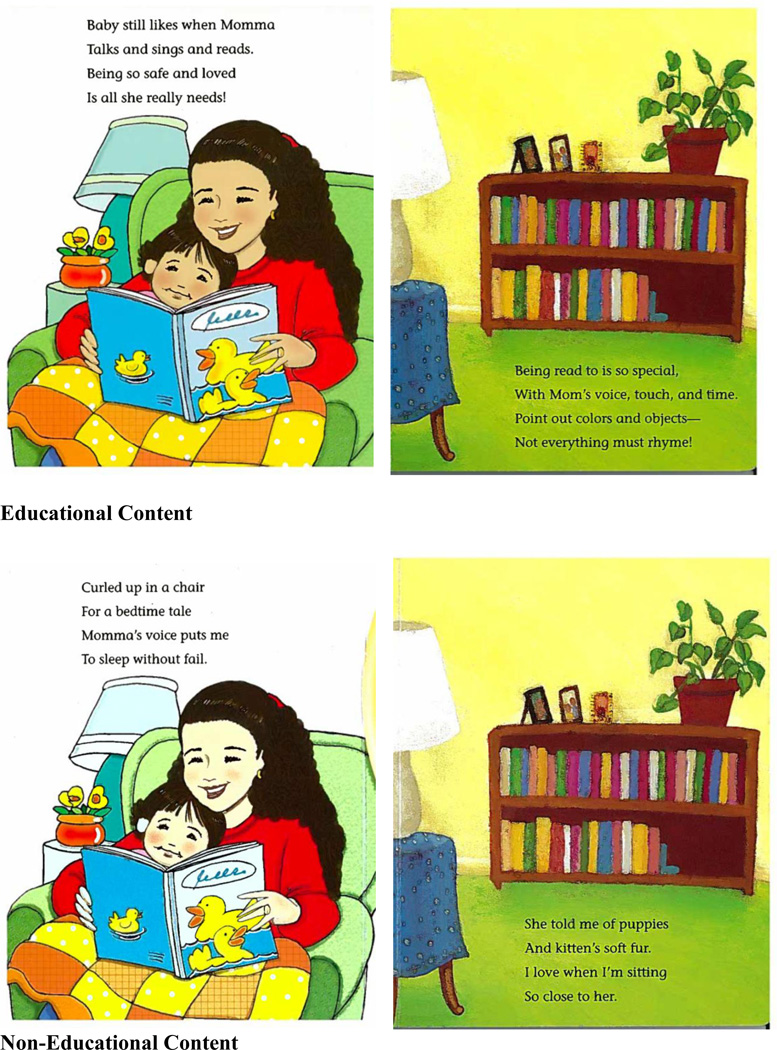
The impact of a baby book intervention on promoting positive reading beliefs and increasing reading frequency for low-income, new mothers ( = 167) was examined. The Baby Books Project randomly assigned low-income, first-time mothers to one of three study conditions, receiving educational books, non-educational books, or no books, during pregnancy and over the first year of parenthood. Home-based data collection occurred through pregnancy until 18 months post-partum. Mothers who received free baby books had higher beliefs about the importance of reading, the value of having resources to support reading, and the importance of verbal participation during reading. The results showed that providing any type of baby books to mothers positively influenced maternal reading beliefs, but did not increase infant-mother reading practices. Maternal reading beliefs across all three groups were significantly associated with self-reported reading frequency when children were at least 12 months of age.
研究了婴儿图书干预对促进低收入新妈妈(n = 167)形成积极阅读观念及提高阅读频率的影响。“婴儿图书项目”将低收入初产妇随机分为三个研究组之一,在孕期及为人父母的第一年分别给予教育类图书、非教育类图书或不给予图书。从孕期到产后18个月进行家庭数据收集。收到免费婴儿图书的妈妈们对阅读的重要性、拥有支持阅读资源的价值以及阅读过程中语言参与的重要性有更高的认识。结果表明,向妈妈们提供任何类型的婴儿图书都会对其阅读观念产生积极影响,但不会增加母婴阅读行为。当孩子至少12个月大时,所有三组妈妈的阅读观念都与自我报告的阅读频率显著相关。