Doran Anthony G, Berry Donagh P, Creevey Christopher J
Teagasc Animal and Bioscience Research Department, Animal & Grassland Research and Innovation Centre, Teagasc, Grange, Dunsany, Co, Meath, Ireland.
BMC Genomics. 2014 Oct 1;15(1):837. doi: 10.1186/1471-2164-15-837.
Four traits related to carcass performance have been identified as economically important in beef production: carcass weight, carcass fat, carcass conformation of progeny and cull cow carcass weight. Although Holstein-Friesian cattle are primarily utilized for milk production, they are also an important source of meat for beef production and export. Because of this, there is great interest in understanding the underlying genomic structure influencing these traits. Several genome-wide association studies have identified regions of the bovine genome associated with growth or carcass traits, however, little is known about the mechanisms or underlying biological pathways involved. This study aims to detect regions of the bovine genome associated with carcass performance traits (employing a panel of 54,001 SNPs) using measures of genetic merit (as predicted transmitting abilities) for 5,705 Irish Holstein-Friesian animals. Candidate genes and biological pathways were then identified for each trait under investigation.
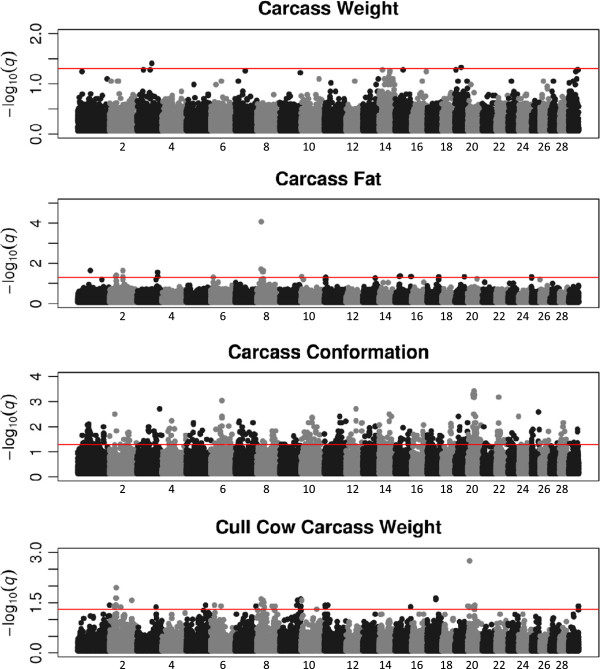
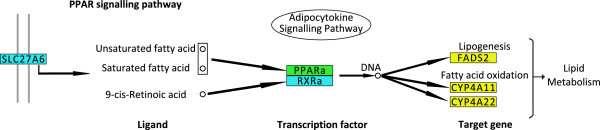
Following adjustment for false discovery (q-value < 0.05), 479 quantitative trait loci (QTL) were associated with at least one of the four carcass traits using a single SNP regression approach. Using a Bayesian approach, 46 QTL were associated (posterior probability > 0.5) with at least one of the four traits. In total, 557 unique bovine genes, which mapped to 426 human orthologs, were within 500kbs of QTL found associated with a trait using the Bayesian approach. Using this information, 24 significantly over-represented pathways were identified across all traits. The most significantly over-represented biological pathway was the peroxisome proliferator-activated receptor (PPAR) signaling pathway.
A large number of genomic regions putatively associated with bovine carcass traits were detected using two different statistical approaches. Notably, several significant associations were detected in close proximity to genes with a known role in animal growth such as glucagon and leptin. Several biological pathways, including PPAR signaling, were shown to be involved in various aspects of bovine carcass performance. These core genes and biological processes may form the foundation for further investigation to identify causative mutations involved in each trait. Results reported here support previous findings suggesting conservation of key biological processes involved in growth and metabolism.
在牛肉生产中,已确定与胴体性能相关的四个性状具有重要经济意义:胴体重、胴体脂肪、后代胴体形态以及淘汰母牛胴体重。尽管荷斯坦 - 弗里生牛主要用于牛奶生产,但它们也是牛肉生产和出口的重要肉类来源。因此,人们对了解影响这些性状的潜在基因组结构非常感兴趣。多项全基因组关联研究已确定了牛基因组中与生长或胴体性状相关的区域,然而,对于其中涉及的机制或潜在生物学途径却知之甚少。本研究旨在利用5705头爱尔兰荷斯坦 - 弗里生牛的遗传价值指标(如预测传递能力),检测牛基因组中与胴体性能性状相关的区域(使用一组54001个单核苷酸多态性)。然后针对每个研究性状确定候选基因和生物学途径。
在对错误发现进行校正后(q值 < 0.05),使用单核苷酸多态性回归方法,479个数量性状基因座(QTL)与四个胴体性状中的至少一个相关。使用贝叶斯方法,46个QTL与四个性状中的至少一个相关(后验概率 > 0.5)。使用贝叶斯方法发现,共有557个独特的牛基因(映射到426个人类直系同源基因)位于与性状相关的QTL的500kb范围内。利用这些信息,在所有性状中确定了24条显著富集的途径。最显著富集的生物学途径是过氧化物酶体增殖物激活受体(PPAR)信号通路。
使用两种不同的统计方法检测到大量可能与牛胴体性状相关的基因组区域。值得注意的是,在与动物生长中已知起作用的基因(如胰高血糖素和瘦素)附近检测到了几个显著关联。包括PPAR信号通路在内的几种生物学途径被证明参与了牛胴体性能的各个方面。这些核心基因和生物学过程可能为进一步研究确定每个性状中涉及的致病突变奠定基础。此处报告的结果支持了先前的研究发现,表明参与生长和代谢的关键生物学过程具有保守性。