Shen Shun-Li, Fu Shun-Jun, Huang Xiong-Qing, Chen Bin, Kuang Ming, Li Shao-Qiang, Hua Yun-Peng, Liang Li-Jian, Peng Bao-Gang
Department of Hepatobiliary Surgery, The First Affiliated Hospital, Sun Yat-sen University, Guangzhou 510080, China.
BMC Cancer. 2014 Oct 3;14:744. doi: 10.1186/1471-2407-14-744.
Peripheral blood monocyte count is an easily assessable parameter of systemic inflammatory response. The aim of this study was to determine whether monocyte count was prognostic in hepatocellular carcinoma (HCC) following hepatic resection.
We retrospectively reviewed 351 patients with HCC treated with hepatic resection from 2006 to 2009. Preoperative absolute peripheral monocyte count, demographics, and clinical and pathological data were analyzed.
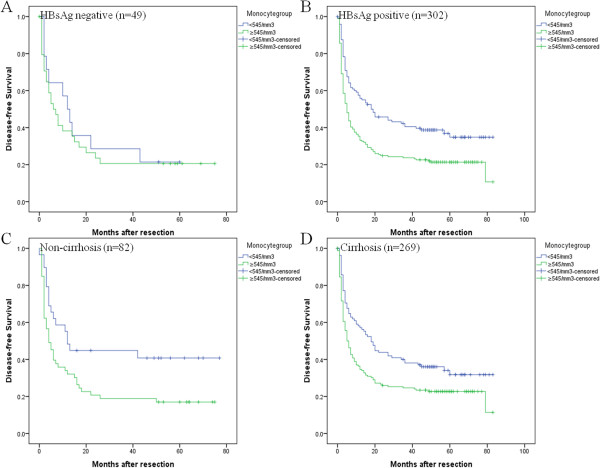
On univariate and multivariate analysis, elevated monocyte counts (≥ 545/mm(3)), tumor size ≥ 5 cm, non-capsulation, and multiple tumors were associated with poor disease-free survival (DFS) and overall survival (OS). The 1-, 3- and 5-year DFS rates were 58%, 41% and 35%, respectively, for patients with monocyte counts <545/mm(3), and 36%, 23% and 21% for patients with monocyte counts ≥ 545/mm(3). Correspondingly, the 1-, 3- and 5-year OS rates were 79%, 53% and 46% for monocyte counts <545/mm(3), and 64%, 36% and 29% for monocyte counts ≥ 545/mm(3). Subgroup analysis indicated that DFS after hepatic resection in hepatitis B virus (HBV)-infected patients was significantly better in those with a peripheral blood monocyte counts <545/mm(3), but it did not differ between patients without HBV infection. In addition, DFS was significantly better for patients with a peripheral blood monocyte count <545/mm(3), whether or not cirrhosis was present. Patients with elevated monocyte counts tended to have larger tumors.
Elevated preoperative monocyte count is an independent predictor of worse prognosis for patients with HCC after hepatic resection, especially for those with HBV infection. Postoperative adjuvant treatment might be considered for patients with elevated preoperative monocyte counts.
外周血单核细胞计数是全身炎症反应的一个易于评估的参数。本研究的目的是确定单核细胞计数在肝切除术后肝细胞癌(HCC)中是否具有预后价值。
我们回顾性分析了2006年至2009年接受肝切除治疗的351例HCC患者。分析术前外周血单核细胞绝对计数、人口统计学资料以及临床和病理数据。
单因素和多因素分析显示,单核细胞计数升高(≥545/mm³)、肿瘤大小≥5 cm、无包膜和多发肿瘤与无病生存期(DFS)和总生存期(OS)较差相关。单核细胞计数<545/mm³的患者1年、3年和5年DFS率分别为58%、41%和35%,而单核细胞计数≥545/mm³的患者分别为36%、23%和21%。相应地,单核细胞计数<545/mm³的患者1年、3年和5年OS率分别为79%、53%和46%,而单核细胞计数≥545/mm³的患者分别为64%、36%和29%。亚组分析表明,乙型肝炎病毒(HBV)感染患者肝切除术后外周血单核细胞计数<5,45/mm³者的DFS明显更好,但未感染HBV的患者之间无差异。此外,无论是否存在肝硬化,外周血单核细胞计数<545/mm³的患者DFS均明显更好。单核细胞计数升高的患者往往肿瘤更大。
术前单核细胞计数升高是肝切除术后HCC患者预后较差的独立预测因素,尤其是对于HBV感染患者。术前单核细胞计数升高的患者可考虑术后辅助治疗。