Department of Hepatobiliary Surgery, Sun Yat-sen University Cancer Center, Guangzhou, People's Republic of China.
PLoS One. 2013;8(3):e58184. doi: 10.1371/journal.pone.0058184. Epub 2013 Mar 14.
An elevated preoperative neutrophil-to-lymphocyte ratio (NLR) has been reported to be a prognostic factor for hepatocellular carcinoma (HCC) patients after treatment. However, the clinical implication of postoperative NLR change remains unclear.
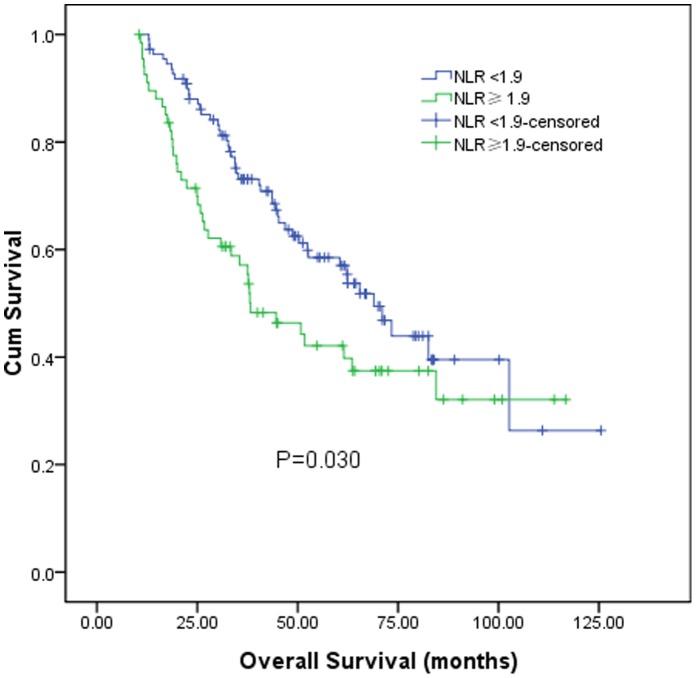
From May 2005 to Aug 2008, a cohort of consecutive 178 small HCC patients treated with radiofrequency ablation (RFA) was retrospectively reviewed. The NLR was recorded within 3 days before and 1 month after RFA. Baseline characteristics, overall survival (OS) and recurrence free survival (RFS) were compared according to preoperative NLR and/or postoperative NLR change. Prognostic factors were assessed by multivariate analysis.
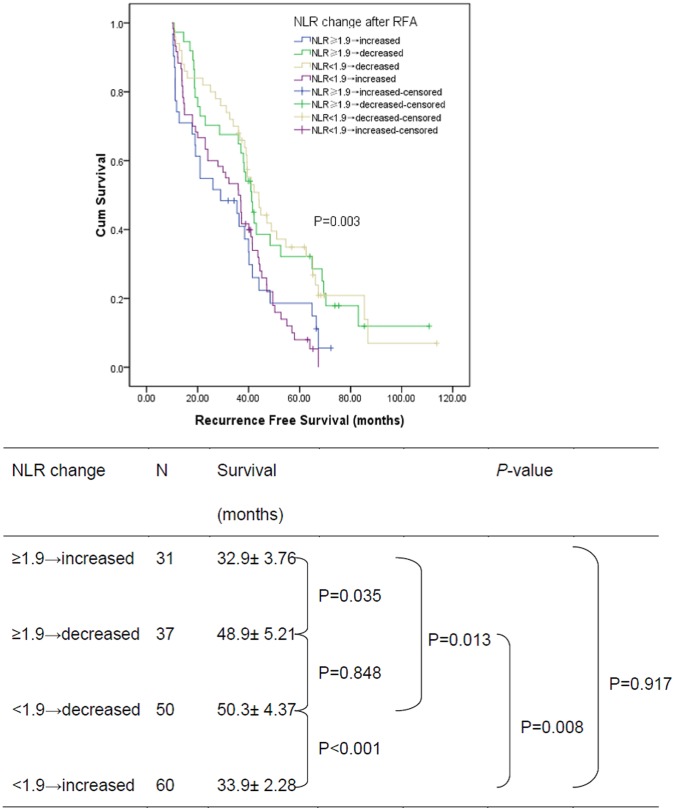
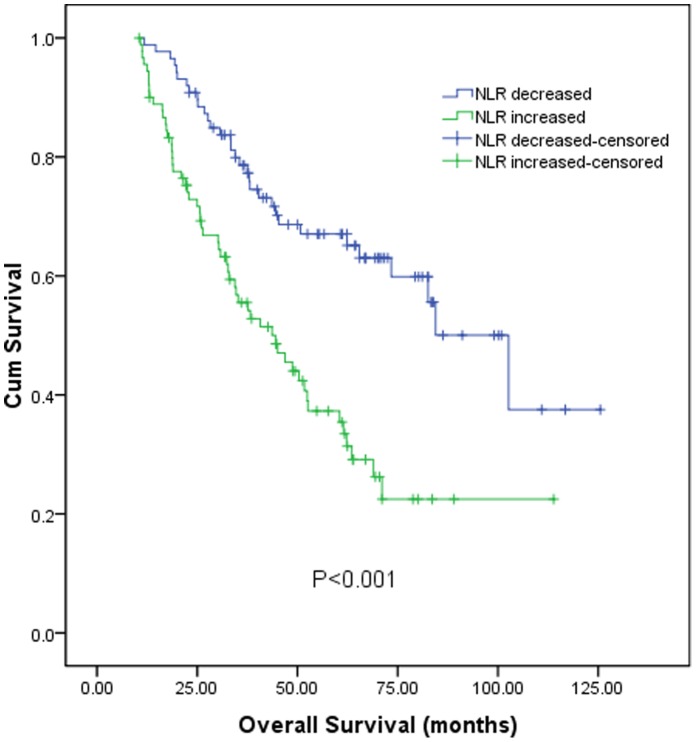
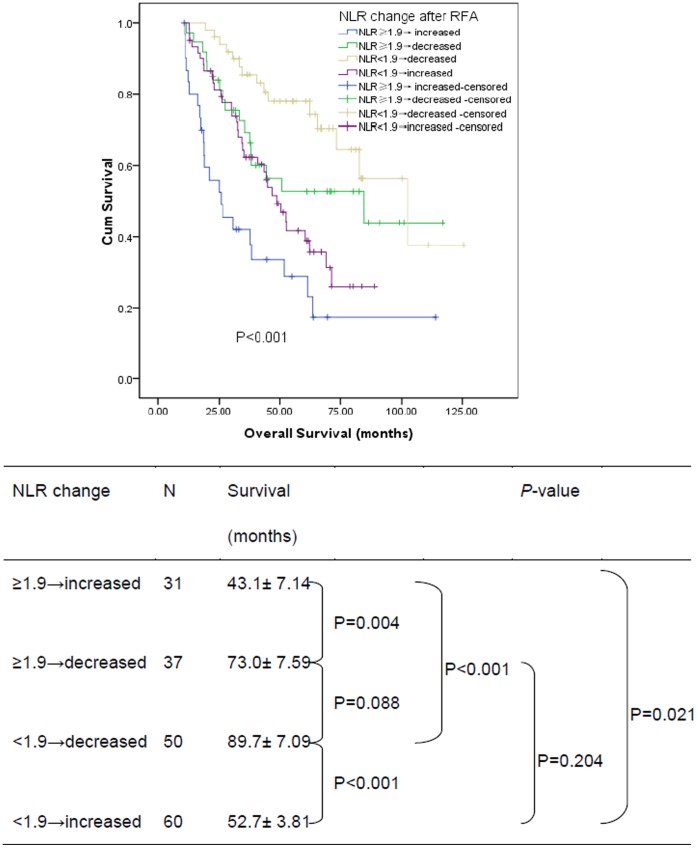
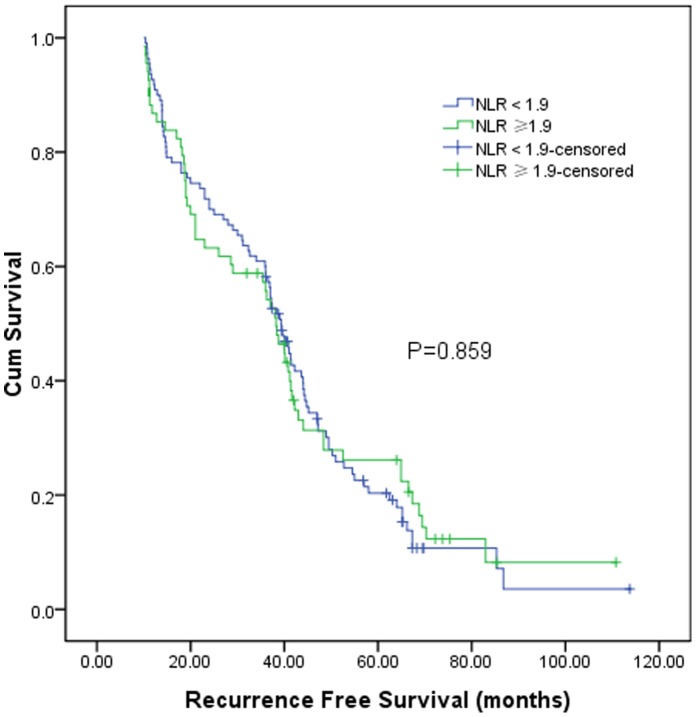
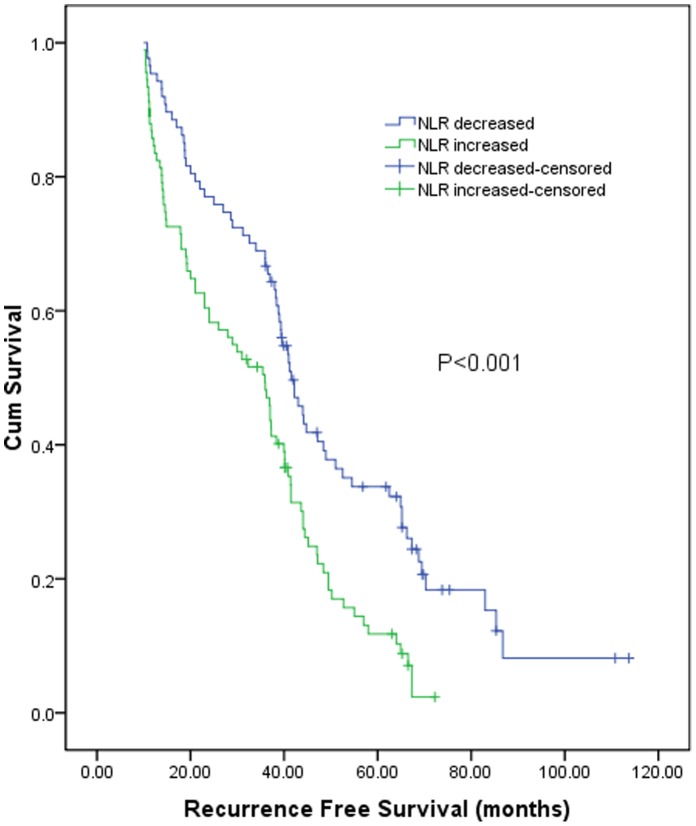
Compared with preoperative NLR level, postoperative NLR decreased in 87 patients and increased in 91 patients after RFA. No significant differences were identified between two groups in commonly used clinic-pathologic features. The 1, 3, 5 years OS was 98.8%, 78.6%, 67.1% for NLR decreased group, and 92.2%, 55.5%, 35.4% for NLR increased group respectively (P<0.001); the corresponding RFS was 94.2%, 65.2%, 33.8% and 81.7%, 46.1%, 12.4% respectively (P<0.001). In subgroup analysis, the survival of patients with lower or higher preoperative NLR can be distinguished more accurate by postoperative NLR change. Multivariate analysis showed that postoperative NLR change, but not preoperative NLR, was an independent prognostic factor for both OS (P<0.001, HR = 2.39, 95%CI 1.53-3.72) and RFS (P = 0.003, HR = 1.69, 95%CI 1.87-8.24).
The postoperative NLR change was an independent prognostic factor for small HCC patient undergoing RFA, and patients with decreased NLR indicated better survival than those with increased NLR.
术前中性粒细胞与淋巴细胞比值(NLR)升高已被报道为肝癌(HCC)患者治疗后的预后因素。然而,术后 NLR 变化的临床意义尚不清楚。
回顾性分析 2005 年 5 月至 2008 年 8 月连续接受射频消融(RFA)治疗的 178 例小 HCC 患者的队列。在 RFA 前 3 天内和 RFA 后 1 个月内记录 NLR。根据术前 NLR 和/或术后 NLR 变化比较基线特征、总生存期(OS)和无复发生存期(RFS)。通过多变量分析评估预后因素。
与术前 NLR 水平相比,RFA 后 87 例患者 NLR 降低,91 例患者 NLR 升高。两组在常用的临床病理特征方面无显著差异。NLR 降低组的 1、3、5 年 OS 分别为 98.8%、78.6%、67.1%,NLR 升高组分别为 92.2%、55.5%、35.4%(P<0.001);相应的 RFS 分别为 94.2%、65.2%、33.8%和 81.7%、46.1%、12.4%(P<0.001)。亚组分析显示,通过术后 NLR 变化可以更准确地区分术前 NLR 较低或较高的患者的生存情况。多变量分析显示,术后 NLR 变化而不是术前 NLR 是 OS(P<0.001,HR=2.39,95%CI 1.53-3.72)和 RFS(P=0.003,HR=1.69,95%CI 1.87-8.24)的独立预后因素。
术后 NLR 变化是接受 RFA 的小 HCC 患者的独立预后因素,NLR 降低的患者比 NLR 升高的患者生存更好。