Newton K, Jorgensen N M, Wallace A J, Buchanan D D, Lalloo F, McMahon R F T, Hill J, Evans D G
Department of General Surgery, Manchester Royal Infirmary, Central Manchester University Hospitals NHS Trust, Manchester, UK.
Genomic Diagnostics Laboratory, Manchester Centre for Genomic Medicine, Central Manchester University Hospitals NHS Foundation Trust, Saint Mary's Hospital, Manchester, UK.
J Med Genet. 2014 Dec;51(12):789-96. doi: 10.1136/jmedgenet-2014-102552. Epub 2014 Oct 3.
Lynch syndrome (LS) patients have DNA mismatch repair deficiency and up to 80% lifetime risk of colorectal cancer (CRC). Screening of mutation carriers reduces CRC incidence and mortality. Selection for constitutional mutation testing relies on family history (Amsterdam and Bethesda Guidelines) and tumour-derived biomarkers. Initial biomarker analysis uses mismatch repair protein immunohistochemistry and microsatellite instability. Abnormalities in either identify mismatch repair deficiency but do not differentiate sporadic epigenetic defects, due to MLH1 promoter region methylation (13% of CRCs) from LS (4% of CRCs). A diagnostic biomarker capable of making this distinction would be valuable. This study compared two biomarkers in tumours with mismatch repair deficiency; quantification of methylation of the MLH1 promoter region using a novel assay and BRAF c.1799T>A, p.(Val600Glu) mutation status in the identification of constitutional mutations.
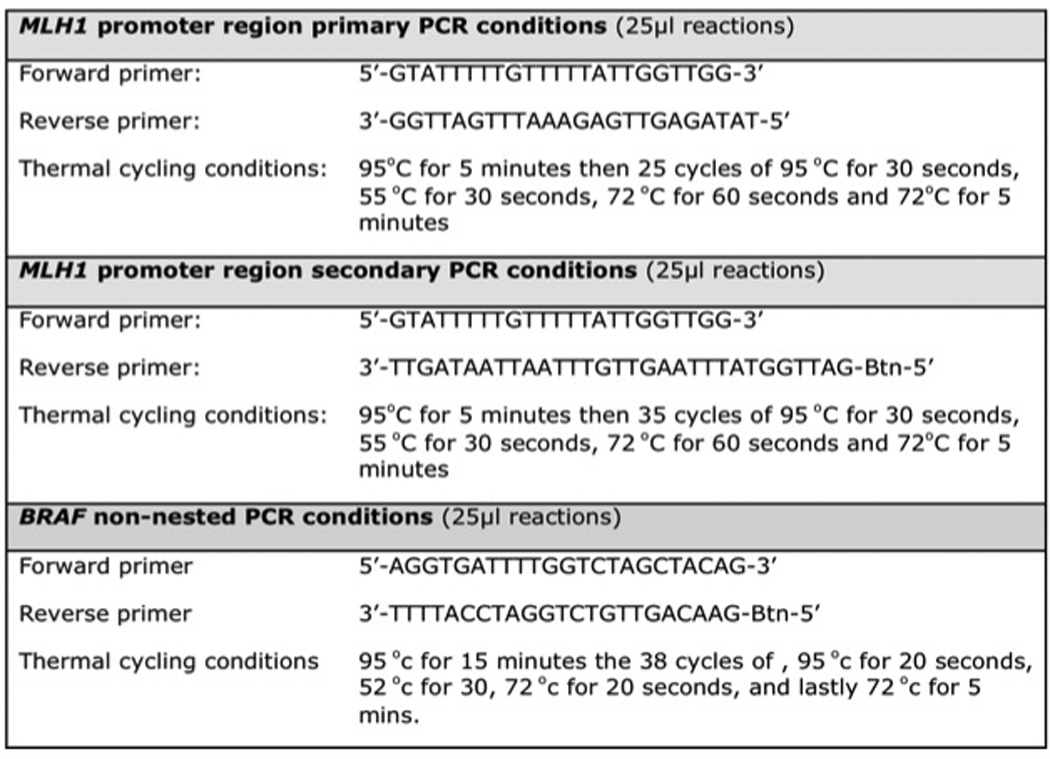
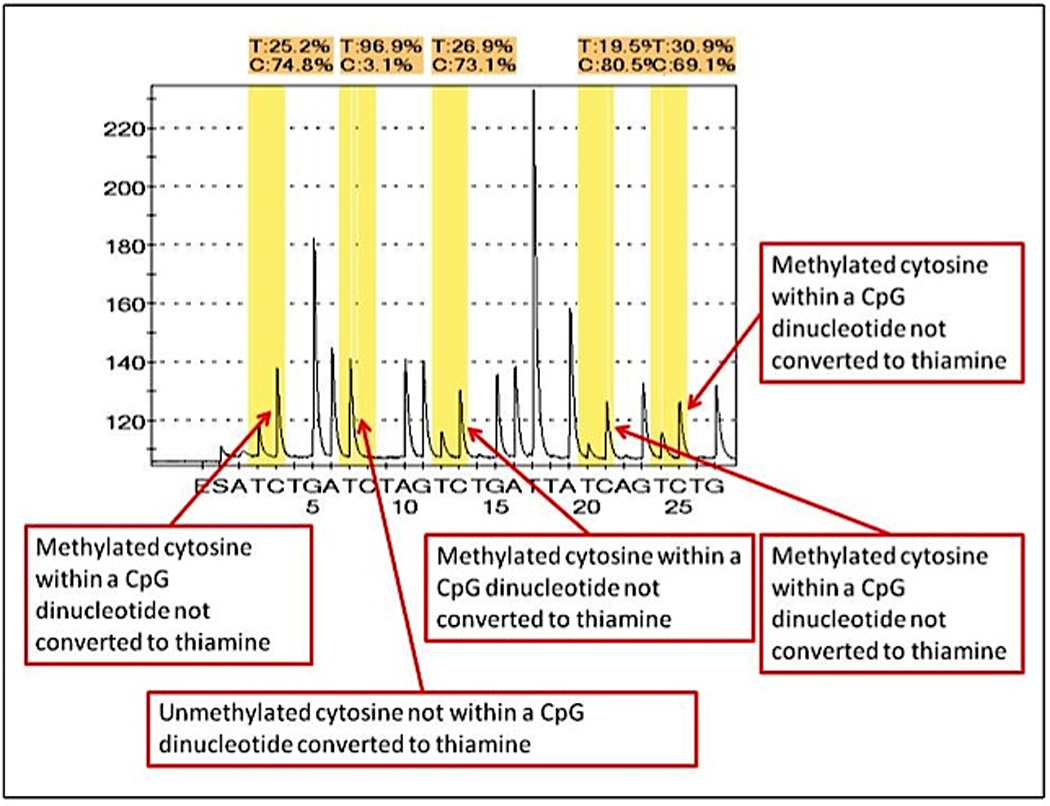
Tumour DNA was extracted (formalin fixed, paraffin embedded, FFPE tissue) and pyrosequencing used to test for MLH1 promoter methylation and presence of the BRAF c.1799T>A, p.(Val600Glu) mutation 71 CRCs from individuals with pathogenic MLH1 mutations and 73 CRCs with sporadic MLH1 loss. Specificity and sensitivity was compared.
Unmethylated MLH1 promoter: sensitivity 94.4% (95% CI 86.2% to 98.4%), specificity 87.7% (95% CI 77.9% to 94.2%), Wild-type BRAF (codon 600): sensitivity 65.8% (95% CI 53.7% to 76.5%), specificity 98.6% (95% CI 92.4% to 100.0%) for the identification of those with pathogenic MLH1 mutations.
Quantitative MLH1 promoter region methylation using pyrosequencing is superior to BRAF codon 600 mutation status in identifying constitutional mutations in mismatch repair deficient tumours.
林奇综合征(LS)患者存在DNA错配修复缺陷,患结直肠癌(CRC)的终生风险高达80%。对突变携带者进行筛查可降低CRC的发病率和死亡率。进行胚系突变检测的选择依赖于家族史(阿姆斯特丹和贝塞斯达指南)和肿瘤来源的生物标志物。初始生物标志物分析采用错配修复蛋白免疫组化和微卫星不稳定性检测。二者中的异常均表明存在错配修复缺陷,但无法区分散发性表观遗传缺陷(由于MLH1启动子区域甲基化导致,占CRC的13%)和林奇综合征(占CRC的4%)。一种能够进行这种区分的诊断生物标志物将很有价值。本研究比较了错配修复缺陷肿瘤中的两种生物标志物;使用一种新型检测方法对MLH1启动子区域甲基化进行定量分析,以及BRAF基因c.1799T>A、p.(Val600Glu)突变状态在胚系突变识别中的作用。
提取肿瘤DNA(福尔马林固定、石蜡包埋的FFPE组织),并采用焦磷酸测序法检测71例携带致病性MLH1突变个体的71例CRC以及73例散发性MLH1缺失的CRC中MLH1启动子甲基化情况和BRAF基因c.1799T>A、p.(Val600Glu)突变的存在情况。比较二者的特异性和敏感性。
MLH1启动子未甲基化:敏感性94.4%(95%CI 86.2%至98.4%),特异性87.7%(95%CI 77.9%至94.2%);BRAF野生型(密码子600):识别致病性MLH1突变个体的敏感性65.8%(95%CI 53.7%至76.5%),特异性98.6%(95%CI 92.4%至100.0%)。
在识别错配修复缺陷肿瘤中的胚系突变方面,采用焦磷酸测序法对MLH1启动子区域进行甲基化定量分析优于BRAF密码子600突变状态检测。