Neuroscience Training Program, University of Wisconsin Madison, WI, USA.
Department of Anesthesiology, School of Medicine and Public Health, University of Wisconsin Madison, WI, USA ; Department of Anesthesiology, Rabin Medical Center, Petah-Tikva, Israel, affiliated with Sackler School of Medicine, Tel Aviv University Tel Aviv, Israel.
Front Syst Neurosci. 2014 Sep 19;8:170. doi: 10.3389/fnsys.2014.00170. eCollection 2014.
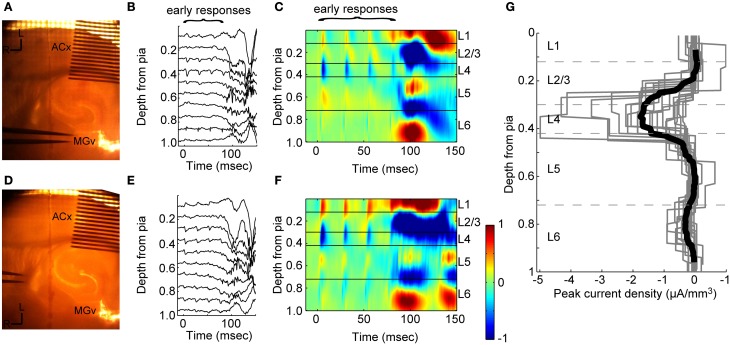
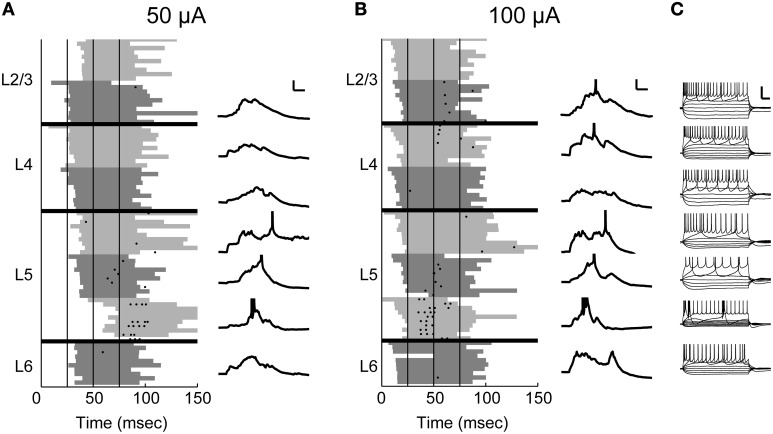
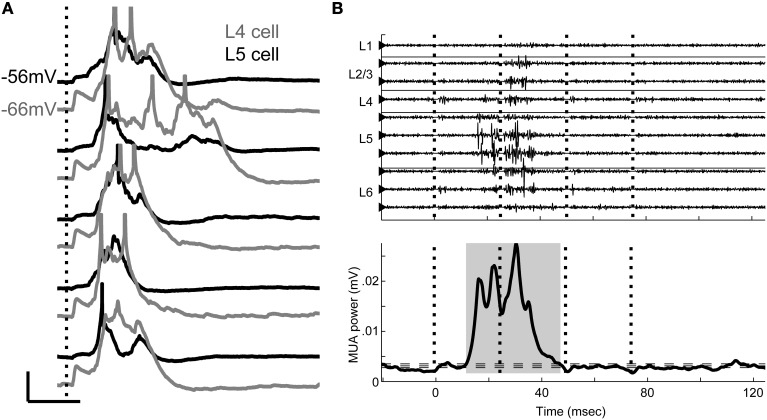
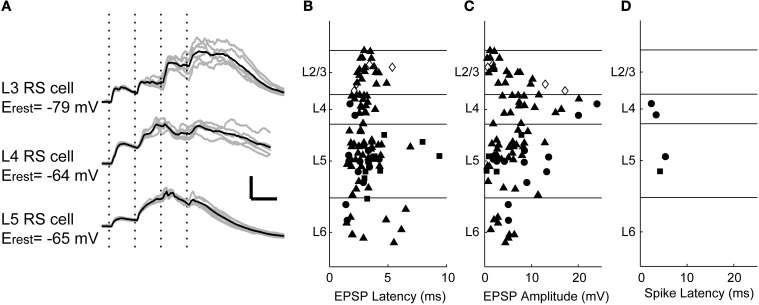
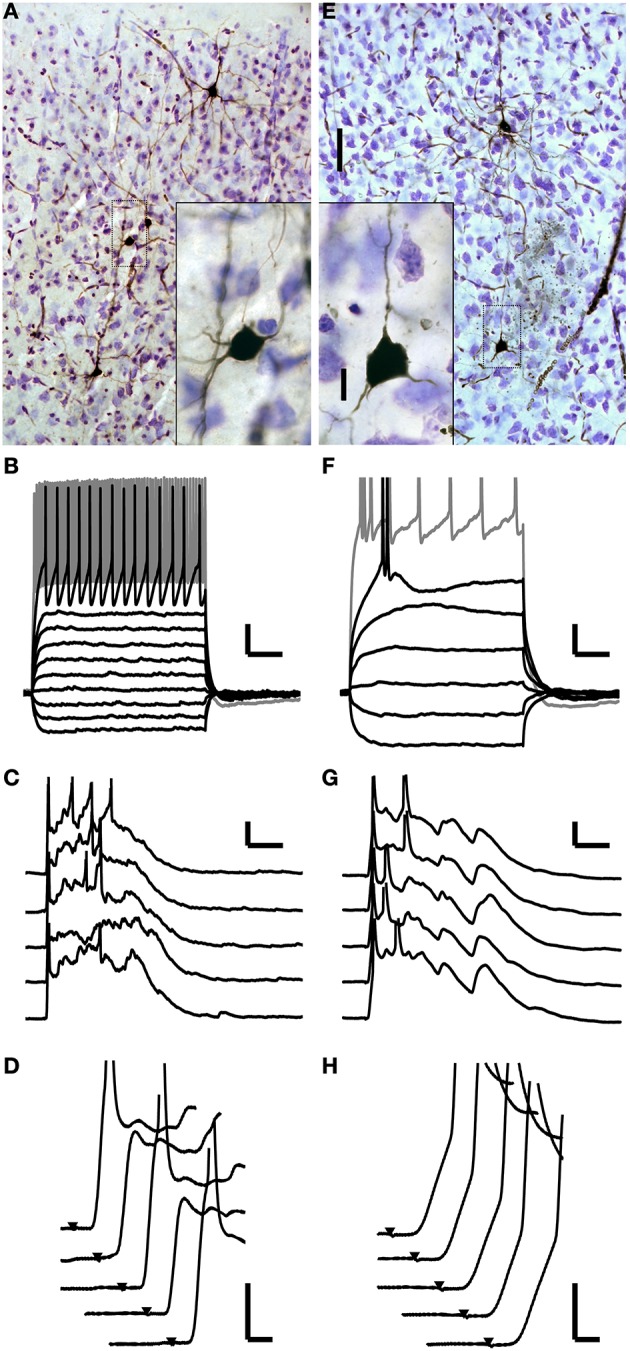
The state of the sensory cortical network can have a profound impact on neural responses and perception. In rodent auditory cortex, sensory responses are reported to occur in the context of network events, similar to brief UP states, that produce "packets" of spikes and are associated with synchronized synaptic input (Bathellier et al., 2012; Hromadka et al., 2013; Luczak et al., 2013). However, traditional models based on data from visual and somatosensory cortex predict that ascending sensory thalamocortical (TC) pathways sequentially activate cells in layers 4 (L4), L2/3, and L5. The relationship between these two spatio-temporal activity patterns is unclear. Here, we used calcium imaging and electrophysiological recordings in murine auditory TC brain slices to investigate the laminar response pattern to stimulation of TC afferents. We show that although monosynaptically driven spiking in response to TC afferents occurs, the vast majority of spikes fired following TC stimulation occurs during brief UP states and outside the context of the L4>L2/3>L5 activation sequence. Specifically, monosynaptic subthreshold TC responses with similar latencies were observed throughout layers 2-6, presumably via synapses onto dendritic processes located in L3 and L4. However, monosynaptic spiking was rare, and occurred primarily in L4 and L5 non-pyramidal cells. By contrast, during brief, TC-induced UP states, spiking was dense and occurred primarily in pyramidal cells. These network events always involved infragranular layers, whereas involvement of supragranular layers was variable. During UP states, spike latencies were comparable between infragranular and supragranular cells. These data are consistent with a model in which activation of auditory cortex, especially supragranular layers, depends on internally generated network events that represent a non-linear amplification process, are initiated by infragranular cells and tightly regulated by feed-forward inhibitory cells.
感觉皮层网络的状态对神经反应和感知有深远的影响。在啮齿动物听觉皮层中,据报道,感觉反应发生在网络事件的背景下,类似于短暂的 UP 状态,这些 UP 状态产生“脉冲包”,并与同步的突触输入相关联(Bathellier 等人,2012 年;Hromadka 等人,2013 年;Luczak 等人,2013 年)。然而,基于视觉和体感皮层数据的传统模型预测,上升的感觉丘脑皮质(TC)通路依次激活 L4、L2/3 和 L5 层的细胞。这两种时空活动模式之间的关系尚不清楚。在这里,我们使用钙成像和电生理记录在小鼠听觉 TC 脑片中,研究了 TC 传入刺激的分层反应模式。我们表明,尽管 TC 传入刺激引发的单突触驱动尖峰发生,但 TC 刺激后绝大多数尖峰发生在短暂的 UP 状态中,并且不在 L4>L2/3>L5 激活序列的背景下。具体来说,在 L2-6 层中观察到具有相似潜伏期的单突触亚阈 TC 反应,推测是通过位于 L3 和 L4 的树突过程中的突触发生的。然而,单突触尖峰很少发生,主要发生在 L4 和 L5 非锥体细胞中。相比之下,在短暂的 TC 诱导的 UP 状态期间,尖峰密集发生,主要发生在锥体细胞中。这些网络事件总是涉及颗粒下层,而颗粒上层的参与则是可变的。在 UP 状态期间,颗粒下和颗粒上层细胞的尖峰潜伏期相当。这些数据与听觉皮层的激活,尤其是颗粒上层的激活依赖于内部产生的网络事件的模型一致,这些网络事件代表非线性放大过程,由颗粒下层细胞发起,并受前馈抑制细胞的紧密调节。