Mutters Nico T, Hägele Ulrike, Hagenfeld Daniel, Hellwig Elmar, Frank Uwe
Heidelberg University Hospital, Department of Infectious Diseases, Medical Microbiology and Hygiene, Heidelberg, Germany.
Centre for Dental Medicine, Department of Operative Dentistry and Periodontology, University Medical Center Freiburg, Germany.
GMS Hyg Infect Control. 2014 Sep 30;9(3):Doc18. doi: 10.3205/dgkh000238. eCollection 2014.
Compliance with infection control practices is the key to quality care and excellence in dentistry. Infection control remains one of the most cost-beneficial interventions available. However, implementing control procedures requires full compliance of the whole dental team. The aim of our study was to measure the compliance in daily clinical practice.
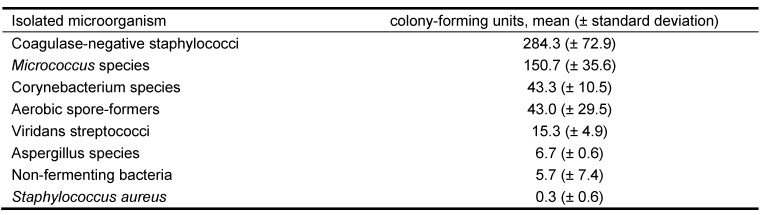
The compliance with infection control practices in dentistry by dental health care personnel (DHCP) in a German university dental clinic was observed during clinical work. In addition, a survey was conducted to assess the individual knowledge about infection control procedures. Contamination of the workplace during invasive dental procedures was tested, as well.
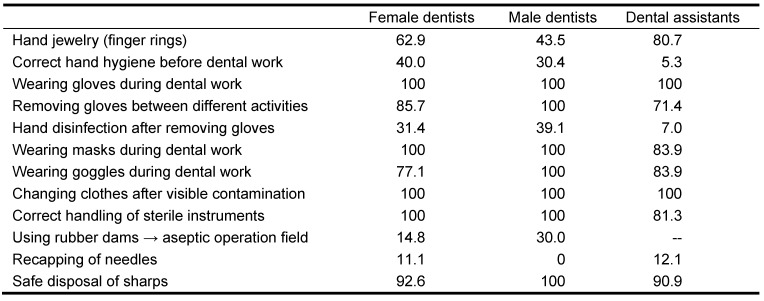
A total of 58 invasive dental treatments implying close contacts between HCWs and patients were scrutinized. All HCWs (100%) wore gloves during dental work, but in some cases (female dentists: 14.3%; dental assistants: 28.6%) gloves were neither changed nor hands were disinfected between different activities or patient contacts (female dentists: 68.6%; male dentists: 60.9%; dental assistants: 93%). Only 31.4% of female and 39.1% of male dentists carried out adequate hygienic hand disinfection after removing gloves. Male dentists wore significantly more often (100%) protective eyewear compared to 77.1% of female dentists (p<0.05). In addition, most of female dentists (62.9%) and dental assistants (80.7%) wore jewelry during dental procedures.
Despite the knowledge of distinct hygiene procedures only a small percentage of dental staff performs hygiene practices according to recommended guidelines. Strict audit is clearly needed in the dental setting to ensure compliance with infection control guidelines to prevent transmission of pathogens. Our results provide insights for the development of a targeted education and training strategy to enhance compliance of dental staff especially of dental assistants with infection control procedures.
遵守感染控制措施是牙科优质护理和卓越服务的关键。感染控制仍然是最具成本效益的干预措施之一。然而,实施控制程序需要整个牙科团队的全面遵守。我们研究的目的是衡量日常临床实践中的依从性。
在临床工作期间,观察了德国一所大学牙科诊所的牙科医护人员(DHCP)对牙科感染控制措施的遵守情况。此外,还进行了一项调查,以评估个人对感染控制程序的了解。同时,对侵入性牙科操作期间工作场所的污染情况也进行了检测。
共仔细检查了58项涉及医护人员与患者密切接触的侵入性牙科治疗。所有医护人员(100%)在牙科工作时都戴了手套,但在某些情况下(女牙医:14.3%;牙科助理:28.6%),在不同活动或患者接触之间既没有更换手套,也没有对手部进行消毒(女牙医:68.6%;男牙医:60.9%;牙科助理:93%)。只有31.4%的女牙医和39.1%的男牙医在摘除手套后进行了充分的手部卫生消毒。与77.1%的女牙医相比,男牙医佩戴防护眼镜的比例显著更高(100%)(p<0.05)。此外,大多数女牙医(62.9%)和牙科助理(80.7%)在牙科操作期间佩戴了首饰。
尽管了解不同的卫生程序,但只有一小部分牙科工作人员按照推荐指南进行卫生操作。在牙科环境中显然需要进行严格的审核,以确保遵守感染控制指南,防止病原体传播。我们的结果为制定有针对性的教育和培训策略提供了见解,以提高牙科工作人员尤其是牙科助理对感染控制程序的依从性。