Khalid Usman, Gislason Gunnar Hilmar, Hansen Peter Riis
Department of Cardiology, Gentofte Hospital University of Copenhagen, Hellerup, Denmark.
Department of Cardiology, Gentofte Hospital University of Copenhagen, Hellerup, Denmark; Faculty of Health Sciences, University of Copenhagen, Copenhagen, Denmark; National Institute of Public Health, University of Southren Denmark, Copenhagen, Denmark.
PLoS One. 2014 Oct 6;9(10):e109632. doi: 10.1371/journal.pone.0109632. eCollection 2014.
Psoriasis is a chronic inflammatory disease characterized by a systemic immunological response which is mainly driven by activated T helper (Th) 1 and Th17 lymphocytes. Like psoriasis, sarcoidosis is a chronic inflammatory disorder with Th1/Th17-driven inflammation. Therefore, we investigated the risk of sarcoidosis in patients with psoriasis compared to the background population in a nationwide cohort.
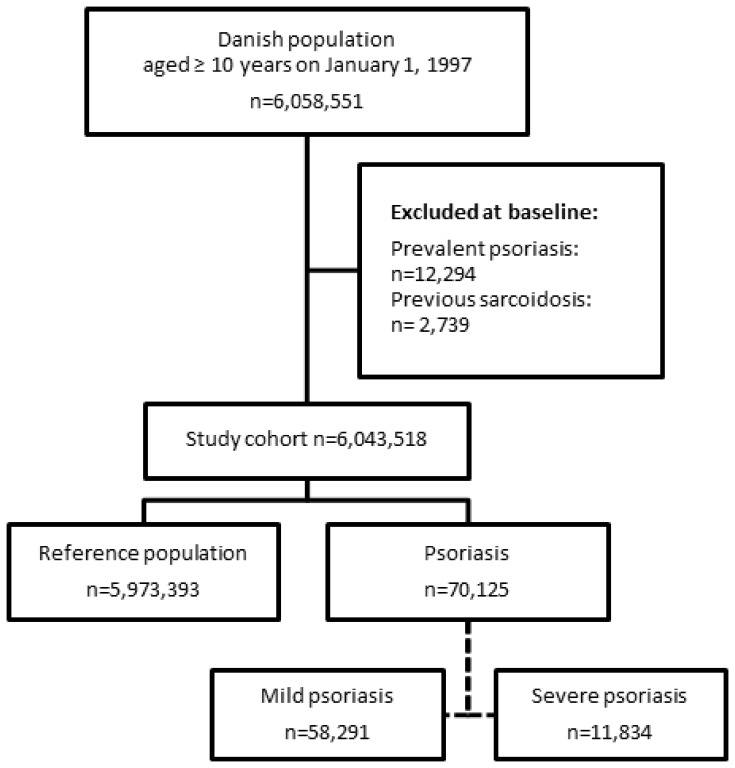
The study included the entire Danish population aged ≥10 years followed from 1st January 1997 until diagnosis of sarcoidosis, death or 31st December 2011. Patients with a history of psoriasis and/or sarcoidosis at baseline were excluded. Information on comorbidity and concomitant medication was identified by individual-level linkage of administrative registers. Incidence rates of sarcoidosis were calculated and adjusted hazard ratios (HRs) were estimated by multivariable Cox regression models adjusted for age, gender, comorbidity, medications and socioeconomic status.
A total of 6,043,518 subjects were eligible for analysis. In the study period 70,125 patients with new-onset psoriasis, including 11,834 patients with severe psoriasis, were identified. The overall incidence rates of sarcoidosis were 1.18, 2.22, and 4.06 per 10,000 person-years for the reference population (9,717 cases), mild psoriasis (78 cases) and severe psoriasis (22 cases), respectively. Compared to the reference population, the age- and gender-adjusted HRs for sarcoidosis were increased in patients with psoriasis with HR 1.49 (95% confidence interval [CI] 1.18-1.87) and HR 2.51 (CI 1.64-3.85) for those with mild and severe disease, respectively.
In this nationwide cohort, psoriasis was associated with a disease severity-dependent increased risk of sarcoidosis.
银屑病是一种慢性炎症性疾病,其特征为主要由活化的辅助性T(Th)1和Th17淋巴细胞驱动的全身性免疫反应。与银屑病一样,结节病是一种由Th1/Th17驱动炎症的慢性炎症性疾病。因此,我们在全国范围内的队列研究中,调查了银屑病患者与普通人群相比患结节病的风险。
该研究纳入了从1997年1月1日起至结节病确诊、死亡或2011年12月31日期间,年龄≥10岁的全体丹麦人群。排除基线时有银屑病和/或结节病史的患者。通过行政登记册的个体层面链接确定合并症和伴随用药信息。计算结节病的发病率,并通过对年龄、性别、合并症、用药情况和社会经济状况进行调整的多变量Cox回归模型估计调整后的风险比(HRs)。
共有6,043,518名受试者符合分析条件。在研究期间,共识别出70,125例新发银屑病患者,其中包括11,834例重度银屑病患者。参考人群(9,717例)、轻度银屑病患者(78例)和重度银屑病患者(22例)的结节病总体发病率分别为每10,000人年1.18例、2.22例和4.06例。与参考人群相比,银屑病患者结节病的年龄和性别调整后HRs升高,轻度和重度疾病患者的HR分别为1.49(95%置信区间[CI] 1.18 - 1.87)和2.51(CI 1.64 - 3.85)。
在这个全国性队列中,银屑病与结节病的患病风险增加相关,且这种风险与疾病严重程度有关。