Wong Chi Wah, Olafsson Valur, Plank Markus, Snider Joseph, Halgren Eric, Poizner Howard, Liu Thomas T
Center for Functional Magnetic Resonance Imaging, University of California San Diego, La Jolla, CA, United States of America; Department of Radiology, University of California San Diego, La Jolla, CA, United States of America.
Neuroscience Imaging Center, University of Pittsburgh, Pittsburgh, PA, United States of America.
PLoS One. 2014 Oct 6;9(10):e109622. doi: 10.1371/journal.pone.0109622. eCollection 2014.
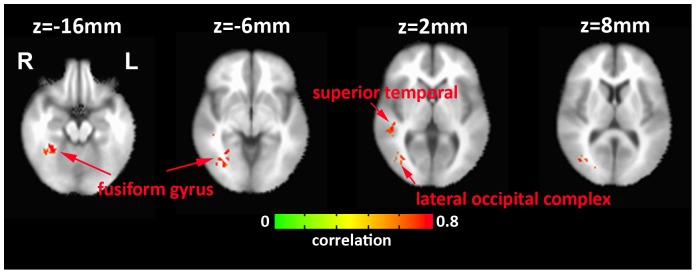
In the real world, learning often proceeds in an unsupervised manner without explicit instructions or feedback. In this study, we employed an experimental paradigm in which subjects explored an immersive virtual reality environment on each of two days. On day 1, subjects implicitly learned the location of 39 objects in an unsupervised fashion. On day 2, the locations of some of the objects were changed, and object location recall performance was assessed and found to vary across subjects. As prior work had shown that functional magnetic resonance imaging (fMRI) measures of resting-state brain activity can predict various measures of brain performance across individuals, we examined whether resting-state fMRI measures could be used to predict object location recall performance. We found a significant correlation between performance and the variability of the resting-state fMRI signal in the basal ganglia, hippocampus, amygdala, thalamus, insula, and regions in the frontal and temporal lobes, regions important for spatial exploration, learning, memory, and decision making. In addition, performance was significantly correlated with resting-state fMRI connectivity between the left caudate and the right fusiform gyrus, lateral occipital complex, and superior temporal gyrus. Given the basal ganglia's role in exploration, these findings suggest that tighter integration of the brain systems responsible for exploration and visuospatial processing may be critical for learning in a complex environment.
在现实世界中,学习通常以无监督的方式进行,没有明确的指导或反馈。在本研究中,我们采用了一种实验范式,让受试者在两天中的每一天都探索一个沉浸式虚拟现实环境。在第一天,受试者以无监督的方式隐性学习39个物体的位置。在第二天,一些物体的位置发生了变化,我们评估了物体位置回忆表现,发现不同受试者之间存在差异。由于先前的研究表明,静息态脑活动的功能磁共振成像(fMRI)测量可以预测个体间各种脑功能指标,我们研究了静息态fMRI测量是否可用于预测物体位置回忆表现。我们发现,表现与基底神经节、海马体、杏仁核、丘脑、脑岛以及额叶和颞叶区域(对空间探索、学习、记忆和决策很重要的区域)的静息态fMRI信号变异性之间存在显著相关性。此外,表现与左侧尾状核和右侧梭状回、外侧枕叶复合体以及颞上回之间的静息态fMRI连接性显著相关。鉴于基底神经节在探索中的作用,这些发现表明,负责探索和视觉空间处理的脑系统之间更紧密的整合可能对在复杂环境中的学习至关重要。