Center for Quality of Care Research, Baystate Medical Center, Springfield, Massachusetts2Division of General Medicine, Baystate Medical Center, Springfield, Massachusetts3Tufts University School of Medicine, Boston, Massachusetts.
Section of General Internal Medicine and the Robert Wood Johnson Clinical Scholars Program, Department of Internal Medicine, Yale University School of Medicine, New Haven, Connecticut5Center for Outcomes Research and Evaluation, Yale-New Haven Hospital, N.
JAMA Intern Med. 2014 Dec;174(12):1904-11. doi: 10.1001/jamainternmed.2014.5161.
Public reporting of quality is considered a key strategy for stimulating improvement efforts at US hospitals; however, little is known about the attitudes of hospital leaders toward existing quality measures.
To describe US hospital leaders' attitudes toward hospital quality measures found on the Centers for Medicare & Medicaid Services' Hospital Compare website, assess use of these measures for quality improvement, and examine the association between leaders' attitudes and hospital quality performance.
DESIGN, SETTING, AND PARTICIPANTS: We mailed a 21-item questionnaire from January 1 through September 31, 2012, to senior hospital leaders from a stratified random sample of 630 US hospitals, including equal numbers with better-than-expected, as-expected, and worse-than-expected performance on mortality and readmission measures.
We assessed levels of agreement with statements concerning quality measures, examined use of measures for improvement activities, and analyzed the association between leaders' attitudes and hospital performance.
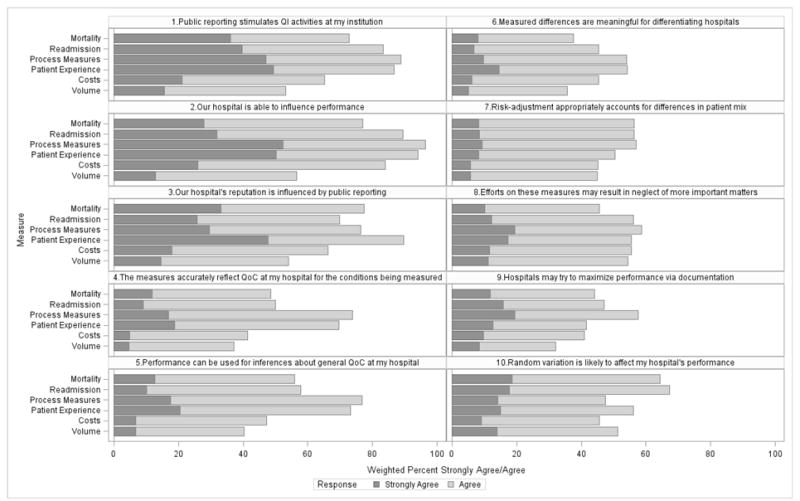
Of 630 hospitals surveyed, 380 (60.3%) responded. For each of the mortality, readmission, process, and patient experience measures, more than 70% of hospitals agreed with the statement that "public reporting stimulates quality improvement activity at my institution"; agreement for measures of cost and volume was 65.2% and 53.3%, respectively. A similar pattern was observed for the statement that "our hospital is able to influence performance on this measure"; agreement for processes of care and patient experience measures was 96.4% and 94.2%, respectively. A total of 89.7% of hospitals agreed that the hospital's reputation was influenced by patient experience measures; agreement was 77.4% for mortality, 69.9% for readmission, 76.3% for process measures, 66.1% for cost measures, and 54.0% for volume measures. A total of 87.1% of hospitals reported incorporating performance on publicly reported measures into their hospital's annual goals, whereas 90.2% reported regularly reviewing the results with the hospital's board of trustees and 94.3% with senior clinical and administrative leaders. When compared with chief executive officers and chief medical officers, respondents who identified themselves as chief quality officers or vice presidents of quality were less likely to agree that public reporting stimulates quality improvement and that measured differences are large enough to differentiate among hospitals.
Hospital leaders indicated that the measures reported on the Hospital Compare website exert strong influence over local planning and improvement efforts. However, they expressed concerns about the clinical meaningfulness, unintended consequences, and methods of public reporting.
公众报告质量被认为是刺激美国医院改进努力的关键策略; 然而,对于医院领导对现有质量措施的态度知之甚少。
描述美国医院领导对医疗保险和医疗补助服务中心医院比较网站上发现的医院质量措施的态度,评估这些措施在质量改进中的使用情况,并研究领导者态度与医院质量绩效之间的关系。
设计、地点和参与者:我们于 2012 年 1 月 1 日至 9 月 31 日通过分层随机抽样向 630 家美国医院的高级医院领导邮寄了一份 21 项的调查问卷,其中包括死亡率和再入院率措施表现优于预期、与预期一致和表现不佳的医院数量相等。
我们评估了对有关质量措施的陈述的同意程度,检查了措施在改进活动中的使用情况,并分析了领导者态度与医院绩效之间的关系。
在接受调查的 630 家医院中,有 380 家(60.3%)做出了回应。对于死亡率、再入院率、过程和患者体验措施中的每一项,超过 70%的医院同意“公开报告刺激了我院的质量改进活动”这一说法; 对成本和数量措施的同意率分别为 65.2%和 53.3%。对于“我们医院能够影响该措施的绩效”这一说法,也出现了类似的模式; 对护理过程和患者体验措施的同意率分别为 96.4%和 94.2%。共有 89.7%的医院同意医院的声誉受到患者体验措施的影响; 对死亡率的同意率为 77.4%,对再入院率的同意率为 69.9%,对流程措施的同意率为 76.3%,对成本措施的同意率为 66.1%,对数量措施的同意率为 54.0%。共有 87.1%的医院报告将公开报告措施的绩效纳入医院的年度目标,而 90.2%的医院报告定期与医院董事会和 94.3%的高级临床和行政领导审查结果。与首席执行官和首席医疗官相比,将自己确定为首席质量官或质量副总裁的受访者不太可能同意公开报告刺激质量改进,并且测量的差异足以区分医院。
医院领导表示,医院比较网站上报告的措施对当地规划和改进工作具有强大的影响力。然而,他们对临床意义、意外后果和公开报告的方法表示担忧。