DU Xue, Li Yongmei, Jing Xu, Zhao Lina
Department of Obstetrics and Gynecology, General Hospital, Tianjin Medical University, Tianjin 300052, P.R. China.
Department of Microbiology and Immunology, Tianjin Medical University, Tianjin 300052, P.R. China.
Exp Ther Med. 2014 Nov;8(5):1559-1564. doi: 10.3892/etm.2014.1930. Epub 2014 Aug 22.
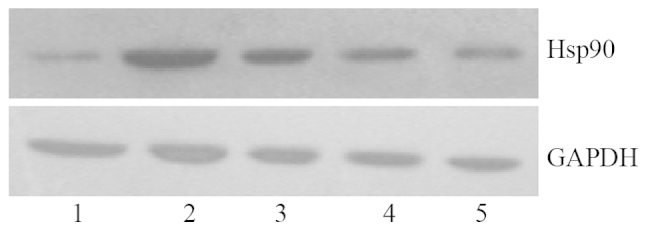
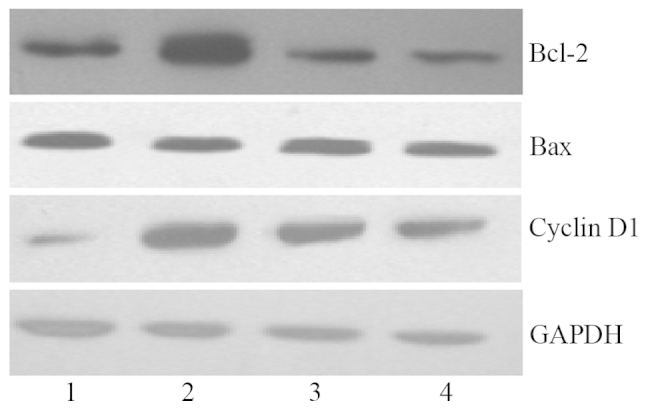
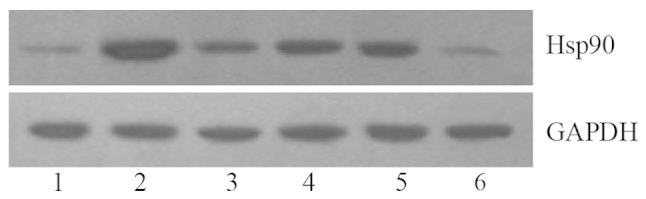
The aim of the present study was to investigate the effect of heat shock protein 90 (Hsp90)-specific inhibitor geldanamycin (GA) on the proliferation and apoptosis induced by vascular endothelial growth factor-C (VEGF-C) in cervical cancer cells. HeLa cells (1×10/ml) in the logarithmic growth phase were incubated without serum for 24 h. The cells were pretreated with kinase insert domain receptor antibody (KDR)-Ab (20 μg/ml), phosphatidylinositol 3-kinase (PI3K) inhibitor LY294002 (3 μmol/l), mitogen-activated protein kinase (MAPK) inhibitor PD98059 (30 μmol/l) or Hsp90-specific inhibitor GA (10 μmol/l) for 30 min, and then treated with VEGF-C (50 ng/μl) for a further 24 h. The cells were harvested for MTT analysis, annexin V-FITC/propidium iodide double staining for early apoptosis and SDS-PAGE and western blot analysis in order to determine Hsp90, B-cell lymphoma 2 (Bcl-2), Bcl-2-associated X protein (Bax) and cyclin D1 expression. Treatment with VEGF-C alone induced Hsp90 protein expression in HeLa cells at all time-points. Hsp90 expression was increased 3.31-fold in VEGF-C treated HeLa cells, and this increase was attenuated in the treatment groups (2.17-, 1.69-, 1.82-fold in VEGF-C + KDR-Ab, VEGF-C + PD98059 and VEGF-C + LY294002, respectively). The proliferation of the VEGF-C-treated HeLa cells was increased ~2.13-fold, while that of the VEGF-C + GA-treated HeLa cells decreased 0.87-fold (P<0.05). Even low concentrations of GA (0.02 μmol/l) were found to inhibit the Bcl-2 and cyclin D1 protein expression induced by VEGF-C. Therefore, the results indicate that the Hsp90-specific inhibitor GA has a critical role in the proliferation and apoptosis induced by VEGF-C in cervical cancer cells.
本研究的目的是探讨热休克蛋白90(Hsp90)特异性抑制剂格尔德霉素(GA)对血管内皮生长因子-C(VEGF-C)诱导的宫颈癌细胞增殖和凋亡的影响。将对数生长期的HeLa细胞(1×10/ml)无血清培养24小时。细胞先用激酶插入结构域受体抗体(KDR)-Ab(20μg/ml)、磷脂酰肌醇3-激酶(PI3K)抑制剂LY294002(3μmol/l)、丝裂原活化蛋白激酶(MAPK)抑制剂PD98059(30μmol/l)或Hsp90特异性抑制剂GA(10μmol/l)预处理30分钟,然后再用VEGF-C(50ng/μl)处理24小时。收集细胞进行MTT分析、膜联蛋白V-FITC/碘化丙啶双染以检测早期凋亡,并进行SDS-PAGE和蛋白质印迹分析以确定Hsp90、B细胞淋巴瘤2(Bcl-2)、Bcl-2相关X蛋白(Bax)和细胞周期蛋白D1的表达。单独用VEGF-C处理在所有时间点均诱导HeLa细胞中Hsp90蛋白表达。在VEGF-C处理的HeLa细胞中Hsp90表达增加了3.31倍,而在各治疗组中这种增加有所减弱(在VEGF-C + KDR-Ab、VEGF-C + PD98059和VEGF-C + LY294002组中分别增加2.17倍、1.69倍和1.82倍)。VEGF-C处理的HeLa细胞的增殖增加了约2.13倍,而VEGF-C + GA处理的HeLa细胞的增殖降低了0.87倍(P<0.05)。甚至低浓度的GA(0.02μmol/l)也被发现可抑制VEGF-C诱导的Bcl-2和细胞周期蛋白D1蛋白表达。因此,结果表明Hsp90特异性抑制剂GA在VEGF-C诱导的宫颈癌细胞增殖和凋亡中起关键作用。