Pessetto Ziyan Y, Chen Bin, Alturkmani Hani, Hyter Stephen, Flynn Colleen A, Baltezor Michael, Ma Yan, Rosenthal Howard G, Neville Kathleen A, Weir Scott J, Butte Atul J, Godwin Andrew K
Departments of Pathology and Laboratory Medicine, Toxicology and Therapeutics, University of Kansas Medical Center, Kansas City, KS, USA.
Institute for Computational Health Sciences, University of California, San Francisco, San Francisco, CA, USA.
Oncotarget. 2017 Jan 17;8(3):4079-4095. doi: 10.18632/oncotarget.13385.
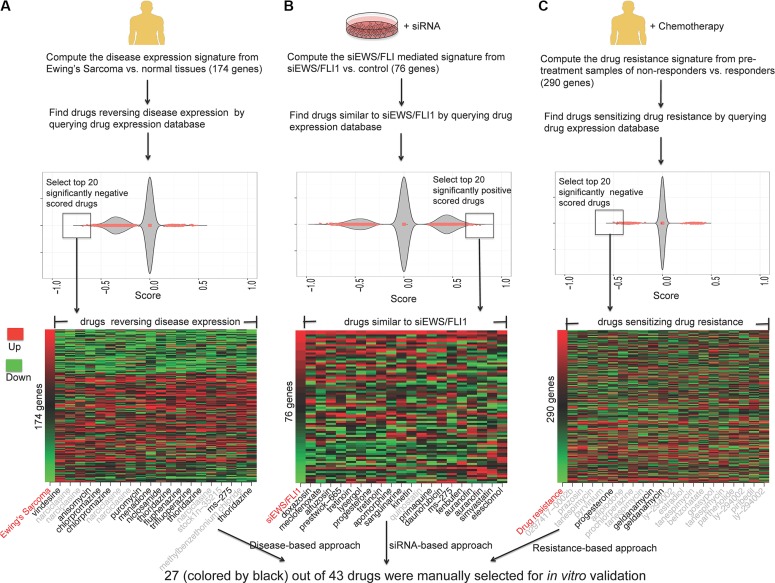
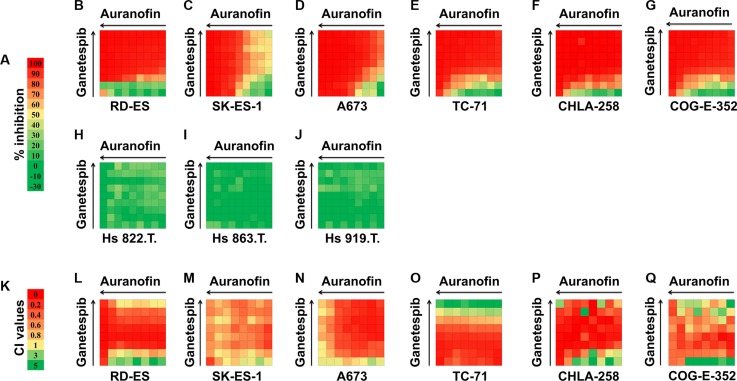
The long-term overall survival of Ewing sarcoma (EWS) patients remains poor; less than 30% of patients with metastatic or recurrent disease survive despite aggressive combinations of chemotherapy, radiation and surgery. To identify new therapeutic options, we employed a multi-pronged approach using in silico predictions of drug activity via an integrated bioinformatics approach in parallel with an in vitro screen of FDA-approved drugs. Twenty-seven drugs and forty-six drugs were identified, respectively, to have anti-proliferative effects for EWS, including several classes of drugs in both screening approaches. Among these drugs, 30 were extensively validated as mono-therapeutic agents and 9 in 14 various combinations in vitro. Two drugs, auranofin, a thioredoxin reductase inhibitor, and ganetespib, an HSP90 inhibitor, were predicted to have anti-cancer activities in silico and were confirmed active across a panel of genetically diverse EWS cells. When given in combination, the survival rate in vivo was superior compared to auranofin or ganetespib alone. Importantly, extensive formulations, dose tolerance, and pharmacokinetics studies demonstrated that auranofin requires alternative delivery routes to achieve therapeutically effective levels of the gold compound. These combined screening approaches provide a rapid means to identify new treatment options for patients with a rare and often-fatal disease.
尤因肉瘤(EWS)患者的长期总体生存率仍然很低;尽管采用了化疗、放疗和手术的积极联合治疗,转移性或复发性疾病患者的生存率仍不到30%。为了确定新的治疗方案,我们采用了多管齐下的方法,通过综合生物信息学方法对药物活性进行计算机模拟预测,同时对FDA批准的药物进行体外筛选。分别有27种药物和46种药物被确定对EWS具有抗增殖作用,两种筛选方法中都包括几类药物。在这些药物中,有30种被广泛验证为单一治疗剂,9种在14种不同组合中得到体外验证。两种药物,金诺芬(一种硫氧还蛋白还原酶抑制剂)和ganetespib(一种HSP90抑制剂),在计算机模拟中被预测具有抗癌活性,并在一组基因多样的EWS细胞中被证实具有活性。联合使用时,体内生存率优于单独使用金诺芬或ganetespib。重要的是,广泛的制剂、剂量耐受性和药代动力学研究表明,金诺芬需要通过替代给药途径才能达到金化合物的治疗有效水平。这些联合筛选方法为罕见且往往致命疾病的患者快速确定新的治疗方案提供了一种手段。