Thurtle Natalie, Greig Jane, Cooney Lauren, Amitai Yona, Ariti Cono, Brown Mary Jean, Kosnett Michael J, Moussally Krystel, Sani-Gwarzo Nasir, Akpan Henry, Shanks Leslie, Dargan Paul I
Médecins Sans Frontières, Amsterdam, Holland.
Médecins Sans Frontières, London, United Kingdom.
PLoS Med. 2014 Oct 7;11(10):e1001739. doi: 10.1371/journal.pmed.1001739. eCollection 2014 Oct.
In 2010, Médecins Sans Frontières (MSF) discovered extensive lead poisoning impacting several thousand children in rural northern Nigeria. An estimated 400 fatalities had occurred over 3 mo. The US Centers for Disease Control and Prevention (CDC) confirmed widespread contamination from lead-rich ore being processed for gold, and environmental management was begun. MSF commenced a medical management programme that included treatment with the oral chelating agent 2,3-dimercaptosuccinic acid (DMSA, succimer). Here we describe and evaluate the changes in venous blood lead level (VBLL) associated with DMSA treatment in the largest cohort of children ≤ 5 y of age with severe paediatric lead intoxication reported to date to our knowledge.
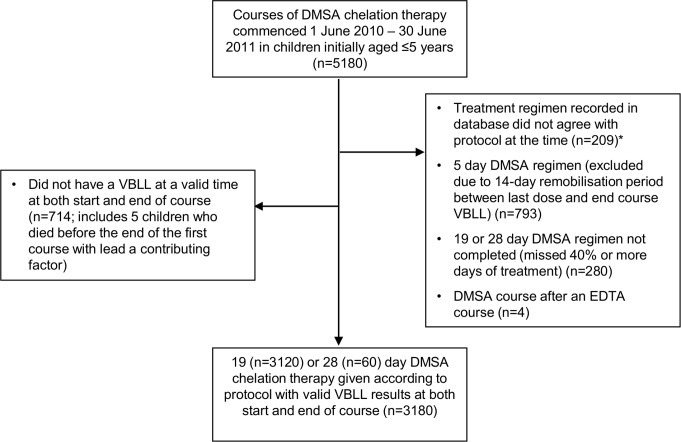
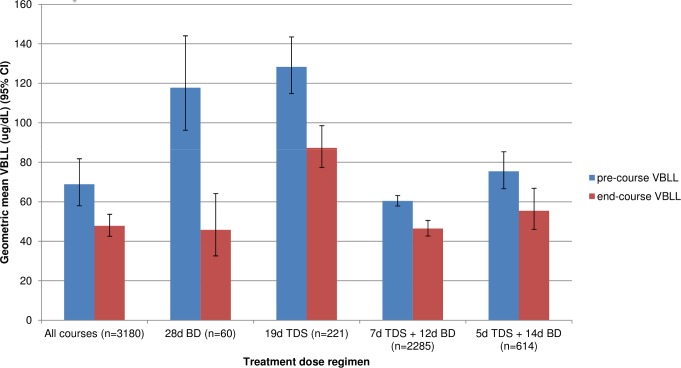
In a retrospective analysis of programme data, we describe change in VBLL after DMSA treatment courses in a cohort of 1,156 children ≤ 5 y of age who underwent between one and 15 courses of chelation treatment. Courses of DMSA of 19 or 28 d duration administered to children with VBLL ≥ 45 µg/dl were included. Impact of DMSA was calculated as end-course VBLL as a percentage of pre-course VBLL (ECP). Mixed model regression with nested random effects was used to evaluate the relative associations of covariates with ECP. Of 3,180 treatment courses administered, 36% and 6% of courses commenced with VBLL ≥ 80 µg/dl and ≥ 120 µg/dl, respectively. Overall mean ECP was 74.5% (95% CI 69.7%-79.7%); among 159 inpatient courses, ECP was 47.7% (95% CI 39.7%-57.3%). ECP after 19-d courses (n = 2,262) was lower in older children, first-ever courses, courses with a longer interval since a previous course, courses with more directly observed doses, and courses with higher pre-course VBLLs. Low haemoglobin was associated with higher ECP. Twenty children aged ≤ 5 y who commenced chelation died during the period studied, with lead poisoning a primary factor in six deaths. Monitoring of alanine transaminase (ALT), creatinine, and full blood count revealed moderate ALT elevation in <2.5% of courses. No clinically severe adverse drug effects were observed, and no laboratory findings required discontinuation of treatment. Limitations include that this was a retrospective analysis of clinical data, and unmeasured variables related to environmental exposures could not be accounted for.
Oral DMSA was a pharmacodynamically effective chelating agent for the treatment of severe childhood lead poisoning in a resource-limited setting. Re-exposure to lead, despite efforts to remediate the environment, and non-adherence may have influenced the impact of outpatient treatment. Please see later in the article for the Editors' Summary.
2010年,无国界医生组织(MSF)发现尼日利亚北部农村地区有数千名儿童受到广泛的铅中毒影响。在3个月内估计有400人死亡。美国疾病控制与预防中心(CDC)证实,用于淘金的富铅矿石造成了广泛污染,环境管理工作随即展开。无国界医生组织启动了一项医疗管理计划,其中包括使用口服螯合剂2,3-二巯基丁二酸(DMSA,二巯基琥珀酸)进行治疗。在此,我们描述并评估了在我们所知的迄今为止报告的最大规模的5岁及以下重度儿童铅中毒队列中,与DMSA治疗相关的静脉血铅水平(VBLL)变化。
在对项目数据的回顾性分析中,我们描述了1156名5岁及以下儿童队列在接受1至15个疗程螯合治疗后VBLL的变化。纳入了对VBLL≥45μg/dl的儿童给予19天或28天疗程的DMSA治疗。DMSA的影响以疗程结束时的VBLL占疗程开始前VBLL(ECP)的百分比来计算。使用具有嵌套随机效应的混合模型回归来评估协变量与ECP的相对关联。在3180个治疗疗程中,分别有36%和6%的疗程开始时VBLL≥80μg/dl和≥120μg/dl。总体平均ECP为74.5%(95%CI 69.7%-79.7%);在159个住院疗程中,ECP为47.7%(95%CI 39.7%-57.3%)。19天疗程(n = 2262)后的ECP在年龄较大的儿童、首次疗程、自上次疗程间隔较长的疗程、直接观察剂量较多的疗程以及疗程开始前VBLL较高的疗程中较低。血红蛋白水平低与较高的ECP相关。在研究期间,开始螯合治疗的20名5岁及以下儿童死亡,其中6例死亡的主要因素是铅中毒。对丙氨酸转氨酶(ALT)、肌酐和全血细胞计数的监测显示,<2.5% 的疗程中ALT有中度升高。未观察到临床严重的药物不良反应,也没有实验室检查结果要求停止治疗。局限性包括这是对临床数据的回顾性分析,无法考虑与环境暴露相关的未测量变量。
在资源有限的环境中,口服DMSA是治疗重度儿童铅中毒药效学有效的螯合剂。尽管努力进行环境修复,但再次接触铅以及不依从可能影响了门诊治疗的效果。请参阅本文后面的编辑总结。