Department of Public Health and Environment, World Health Organization, Geneva, Switzerland.
Environ Health Perspect. 2009 Oct;117(10):1535-40. doi: 10.1289/ehp.0900696. Epub 2009 May 14.
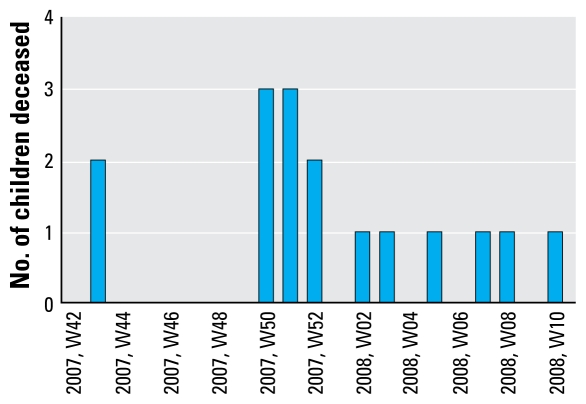
Between November 2007 and March 2008, 18 children died from a rapidly progressive central nervous system disease of unexplained origin in a community involved in the recycling of used lead-acid batteries (ULAB) in the suburbs of Dakar, Senegal. We investigated the cause of these deaths.
Because autopsies were not possible, the investigation centered on clinical and laboratory assessments performed on 32 siblings of deceased children and 23 mothers and on 18 children and 8 adults living in the same area, complemented by environmental health investigations.
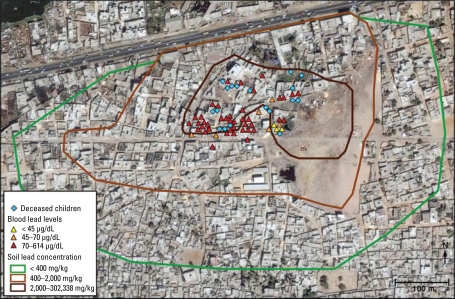
All 81 individuals investigated were poisoned with lead, some of them severely. The blood lead level of the 50 children tested ranged from 39.8 to 613.9 microg/dL with a mean of 129.5 microg/dL. Seventeen children showed severe neurologic features of toxicity. Homes and soil in surrounding areas were heavily contaminated with lead (indoors, up to 14,000 mg/kg; outdoors, up to 302,000 mg/kg) as a result of informal ULAB recycling.
Our investigations revealed a mass lead intoxication that occurred through inhalation and ingestion of soil and dust heavily contaminated with lead as a result of informal and unsafe ULAB recycling. Circumstantial evidence suggested that most or all of the 18 deaths were due to encephalopathy resulting from severe lead intoxication. Findings also suggest that most habitants of the contaminated area, estimated at 950, are also likely to be poisoned. This highlights the severe health risks posed by informal ULAB recycling, in particular in developing countries, and emphasizes the need to strengthen national and international efforts to address this global public health problem.
2007 年 11 月至 2008 年 3 月期间,塞内加尔达喀尔郊区一个参与废旧铅酸电池(ULAB)回收的社区发生了一起原因不明的中枢神经系统迅速进展性疾病,导致 18 名儿童死亡。我们对这些死亡病例的病因进行了调查。
由于无法进行尸检,调查主要集中在对 32 名死亡儿童的兄弟姐妹、23 名母亲以及居住在同一地区的 18 名儿童和 8 名成年人进行临床和实验室评估,并辅以环境卫生调查。
所有 81 名接受调查的个体均受到铅中毒的影响,其中一些人病情严重。50 名接受检测的儿童的血铅水平范围为 39.8 至 613.9μg/dL,平均值为 129.5μg/dL。17 名儿童出现严重的毒性神经学特征。由于非正式的 ULAB 回收,家庭和周围地区的土壤受到严重铅污染(室内高达 14000mg/kg;室外高达 302000mg/kg)。
我们的调查显示,由于非正式和不安全的 ULAB 回收导致土壤和灰尘受到严重铅污染,从而导致大规模的铅中毒事件。间接证据表明,18 例死亡病例中的大多数或全部可能是由于严重铅中毒引起的脑病所致。研究结果还表明,受污染地区的大部分(估计约为 950 人)居民也可能受到铅中毒的影响。这突显了非正式 ULAB 回收带来的严重健康风险,特别是在发展中国家,强调了加强国家和国际努力解决这一全球性公共卫生问题的必要性。