Vahabi Nasim, Gohari Mahmood Reza, Azarbar Ali, Salehi Masoud
1. PhD Student of Biostatistics, Department of Biostatistics, Faculty of Medical Sciences, Tarbiat Modares University, Tehran, Iran.
2. Associated Professor of Biostatistics, Department of Biostatistics, Faculty of Public Health, Member of Hospital Management Research Center, Iran University of Medical Sciences, Tehran, Iran.
Med J Islam Repub Iran. 2014 May 7;28:28. eCollection 2014.
Background Quality of life evaluates the general well-being of individuals and it can be considered as one of the important aspects in programming and giving service to disabled people. Blindness is one of the most important kinds of physical disability that has a direct effect on quality of life, so this study aimed to explore how war blindness influences the quality of life.
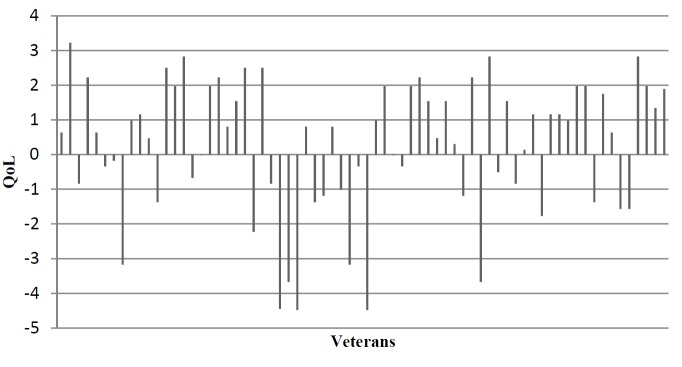
In this cross-sectional study, data from 71 blind war (Iran-Iraq) veterans in 2010 were collected using the Short Form Health Survey instrument (SF36). Rasch model was fitted by running WINSTEPS software and then item parameter (β), i.e. difficulty of items, and person parameter ([Formula: see text] ), i.e. the ability or attainment level of respondents, were estimated.
In a total of 71 cases, 69 cases (97 %) were male with a mean (±SD ) age and blindness duration range of 48.97 (±10.655) yrs and 25.74 (±3.692) yrs, respectively. Item difficulty ranged from 2.962 to 4.441. Comparison of the SF36 scores and Rasch measurements showed that standard error of Rasch model estimates in physical and total scores are less than SF36 scores.
Due to the advantages and higher accuracy of the Rasch model, using this model can be a good alternative for the traditional models. With due regard to the relative low quality of life of blind war veterans in this study and other similar study, further investigation are recommended to be carried out to this group of society.
背景 生活质量评估个体的总体幸福感,它可被视为为残疾人制定规划和提供服务的重要方面之一。失明是对生活质量有直接影响的最重要身体残疾类型之一,因此本研究旨在探讨战争致盲如何影响生活质量。
在这项横断面研究中,2010年使用简短健康调查问卷(SF36)收集了71名失明战争(伊朗 - 伊拉克战争)退伍军人的数据。通过运行WINSTEPS软件拟合拉施模型,然后估计项目参数(β),即项目难度,以及人员参数([公式:见正文]),即受访者的能力或成就水平。
总共71例中,69例(97%)为男性,平均(±标准差)年龄和失明持续时间分别为48.97(±10.655)岁和25.74(±3.692)年。项目难度范围为2.962至4.441。SF36评分与拉施测量结果的比较表明,拉施模型在身体和总分估计中的标准误差小于SF36评分。
由于拉施模型的优势和更高的准确性,使用该模型可以成为传统模型的良好替代方案。鉴于本研究及其他类似研究中失明战争退伍军人生活质量相对较低,建议对这一社会群体进行进一步调查。