Grund Christian, Steglich Constanze, Huthmann Eva, Beer Martin, Mettenleiter Thomas C, Römer-Oberdörfer Angela
Institute of Diagnostic Virology, Friedrich-Loeffler-Institut, Federal Research Institute for Animal Health, Südufer 10, D-17493 Greifswald-Insel Riems, Germany.
Virol J. 2014 Oct 8;11:179. doi: 10.1186/1743-422X-11-179.
Protection against infection by Newcastle disease virus (NDV), also designated as avian paramyxovirus subtype-1 (APMV-1), is mediated by immune responses to the two surface glycoproteins, hemagglutinin-neuraminidase (HN) and fusion (F) protein. Thus, a chimeric APMV-1 based vaccine that encodes APMV-8 HN- and F-proteins and expresses the hemagglutinin of avian influenza virus (AIV) H5N1, is able to protect against HPAIV H5N1 but fails to protect against NDV [PLoS One8:e72530, 2013]. However, it is unclear whether avirulent APMV-subtypes, like APMV-8 can induce subtype-specific immunity and protect from a homologous challenge.
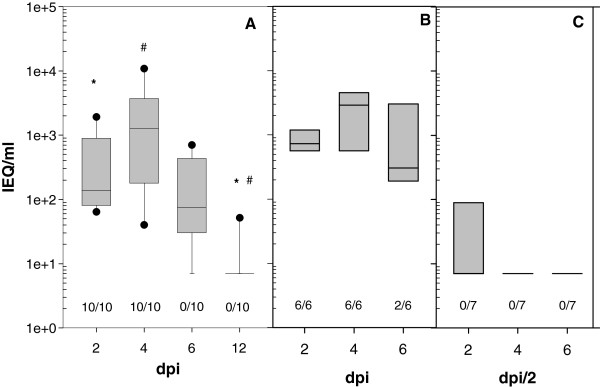
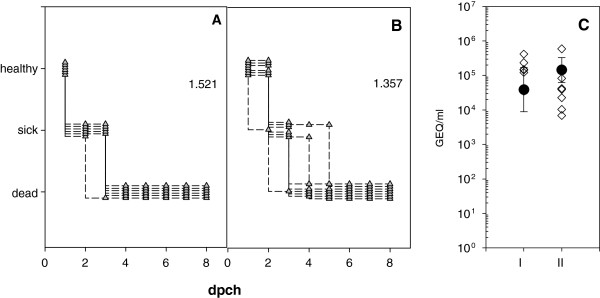
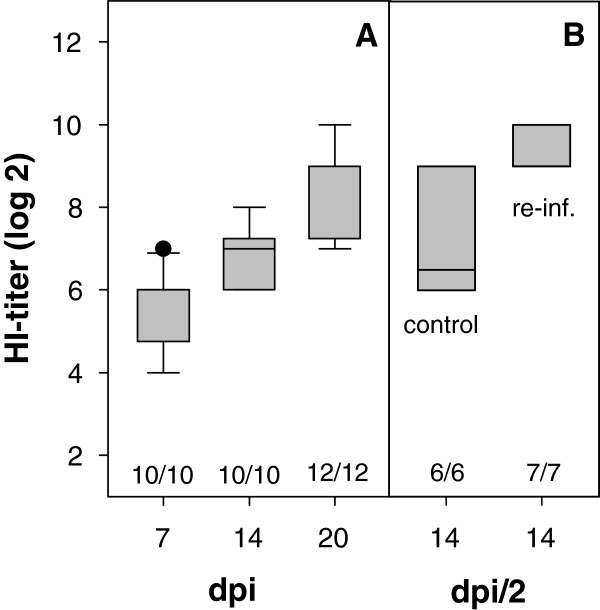
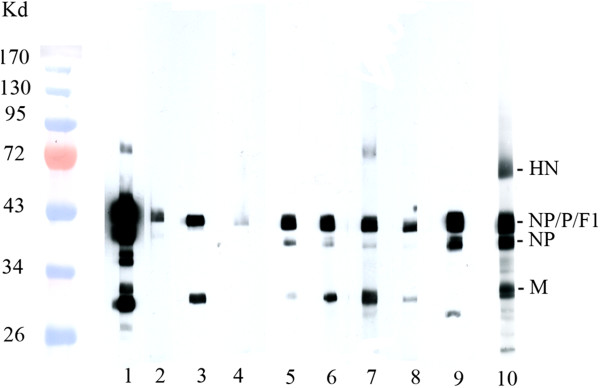
APMV-8 infections of 3- and 6-weeks-old specific pathogen free (SPF)-chickens did not induce any clinical signs but was associated with virus shedding for up to 6 days. Viral replication was only detected in oropharyngeal- and never in cloacal swabs. Upon reinfection with homologous APMV-8, viral shedding was restricted to day 2 and in contrast to naive SPF-chickens, only RNA but no infectious virus was recovered. No protection was induced against virulent NDV challenge, although morbidity and mortality was delayed in APMV-8 primed chickens. This lack of protection is in line with a lack of reactivity of APMV-8 specific sera to APMV-1 HN-protein: Neither by hemagglutin-inhibition (HI) test nor immunoblot analyses, cross-reactivity was detected, despite reactivity to internal proteins.
Immune responses mounted during asymptomatic APMV-8 infection limit secondary infection against homologues reinfection and facilitates a delay in the onset of disease in a subtype independent manner but is unable to protect against Newcastle disease, a heterologous APMV-subtype.
新城疫病毒(NDV),也被称为禽副粘病毒1型(APMV-1),对其感染的防护是由针对两种表面糖蛋白,即血凝素神经氨酸酶(HN)和融合(F)蛋白的免疫反应介导的。因此,一种基于嵌合APMV-1的疫苗,其编码APMV-8的HN和F蛋白并表达禽流感病毒(AIV)H5N1的血凝素,能够预防高致病性禽流感病毒H5N1,但不能预防新城疫病毒[《公共科学图书馆·综合》8:e72530,2013年]。然而,尚不清楚无毒力的APMV亚型,如APMV-8是否能诱导亚型特异性免疫并抵御同源攻击。
3周龄和6周龄的无特定病原体(SPF)鸡感染APMV-8后未出现任何临床症状,但与长达6天的病毒 shedding 有关。病毒复制仅在口咽拭子中检测到,泄殖腔拭子中从未检测到。再次用同源APMV-8感染后,病毒 shedding 仅限于第2天,与未接触过病毒的SPF鸡相比,仅回收了RNA但未回收感染性病毒。尽管接种APMV-8的鸡的发病率和死亡率有所延迟,但对强毒新城疫病毒攻击未诱导出保护作用。这种缺乏保护作用与APMV-8特异性血清对APMV-1 HN蛋白缺乏反应性一致:通过血凝抑制(HI)试验或免疫印迹分析,均未检测到交叉反应性,尽管对内部蛋白有反应性。
无症状APMV-8感染期间产生的免疫反应以亚型独立的方式限制了对同源再感染的二次感染,并有助于延迟疾病的发作,但无法抵御新城疫,即一种异源APMV亚型。