Ivanov Stoyan, Paget Christophe, Trottein François
Institut Pasteur de Lille, Centre d'Infection et d'Immunité de Lille, Lille, France; Institut National de la Santé et de la Recherche Médicale, U1019, Lille, France; Centre National de la Recherche Scientifique, UMR 8204, Lille, France; Université Lille Nord de France, Lille, France.
PLoS Pathog. 2014 Oct 9;10(10):e1004300. doi: 10.1371/journal.ppat.1004300. eCollection 2014 Oct.
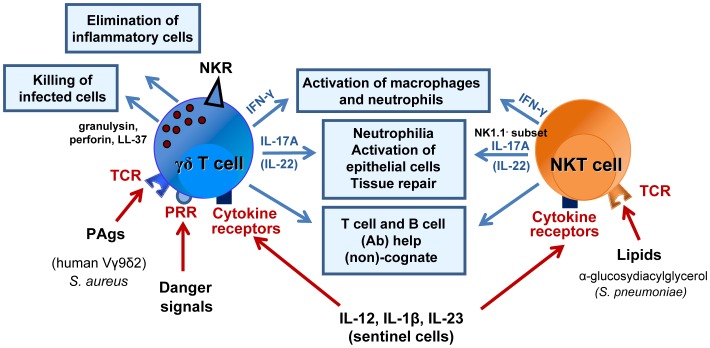
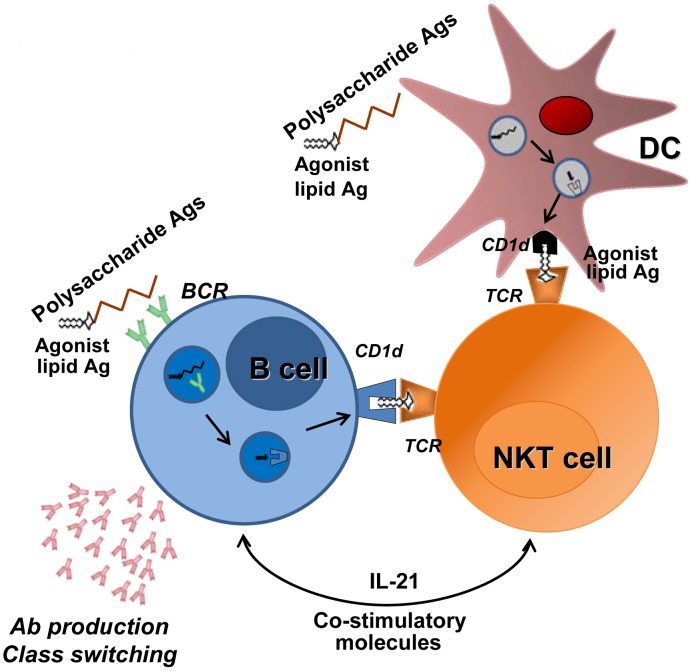
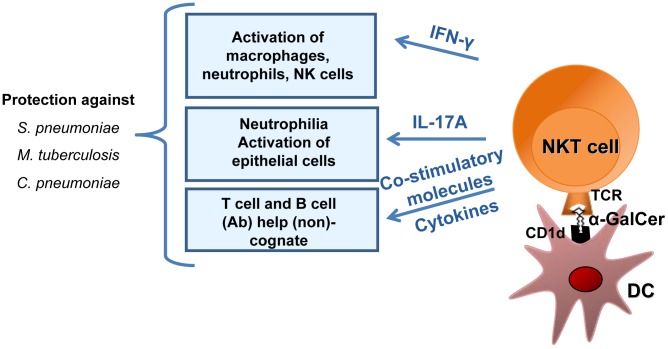
Non-conventional T lymphocytes constitute a special arm of the immune system and act as sentinels against pathogens at mucosal surfaces. These non-conventional T cells (including mucosal-associated invariant T [MAIT] cells, gamma delta [γδ] T cells, and natural killer T [NKT] cells) display several innate cell-like features and are rapidly activated by the recognition of conserved, stress-induced, self, and microbial ligands. Here, we review the role of non-conventional T cells during respiratory infections, with a particular focus on the encapsulated extracellular pathogen Streptococcus pneumoniae, the leading cause of bacterial pneumonia worldwide. We consider whether MAIT cells, γδ T cells, and NKT cells might offer opportunities for preventing and/or treating human pneumococcus infections.
非常规T淋巴细胞构成免疫系统的一个特殊分支,在黏膜表面充当抵御病原体的哨兵。这些非常规T细胞(包括黏膜相关恒定T细胞[MAIT细胞]、γδT细胞和自然杀伤T细胞[NKT细胞])具有一些类似先天免疫细胞的特征,通过识别保守的、应激诱导的、自身和微生物配体而迅速被激活。在此,我们综述非常规T细胞在呼吸道感染中的作用,特别关注包膜细胞外病原体肺炎链球菌,它是全球细菌性肺炎的主要病因。我们探讨MAIT细胞、γδT细胞和NKT细胞是否有可能为预防和/或治疗人类肺炎球菌感染提供机会。