Hong Jiangtao, Wang Xiaodan, Wu Jianbo
Institute of Mountain Hazards and Environment, Chinese Academy of Sciences, Chengdu, China; University of Chinese Academy of Sciences, Beijing, China.
Institute of Mountain Hazards and Environment, Chinese Academy of Sciences, Chengdu, China.
PLoS One. 2014 Oct 9;9(10):e109052. doi: 10.1371/journal.pone.0109052. eCollection 2014.
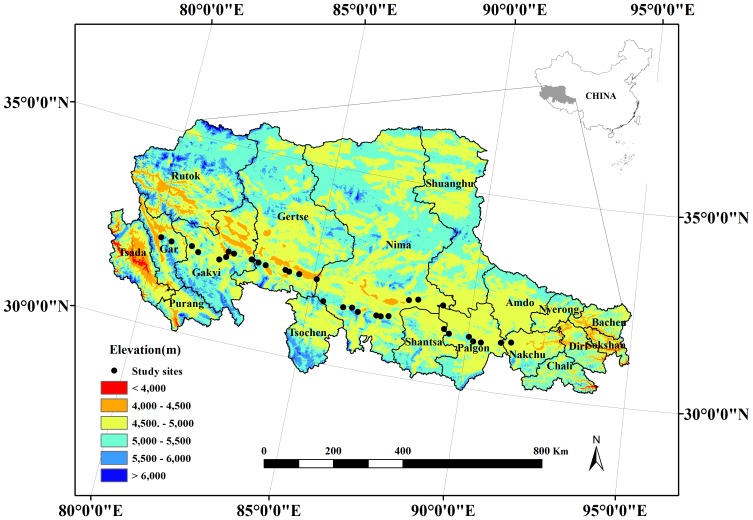
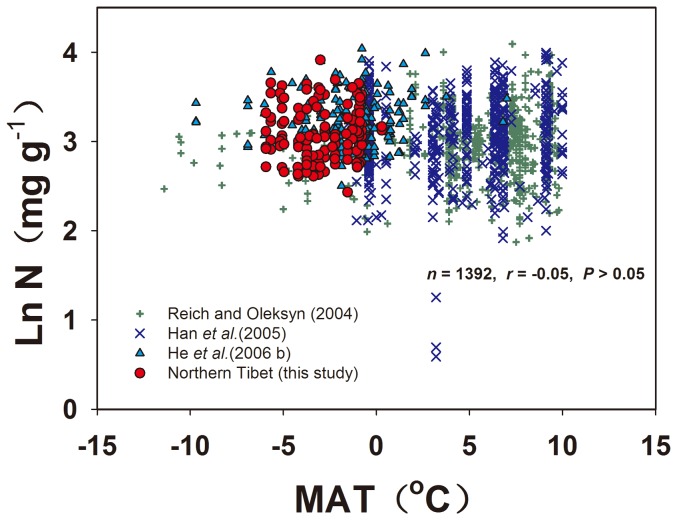
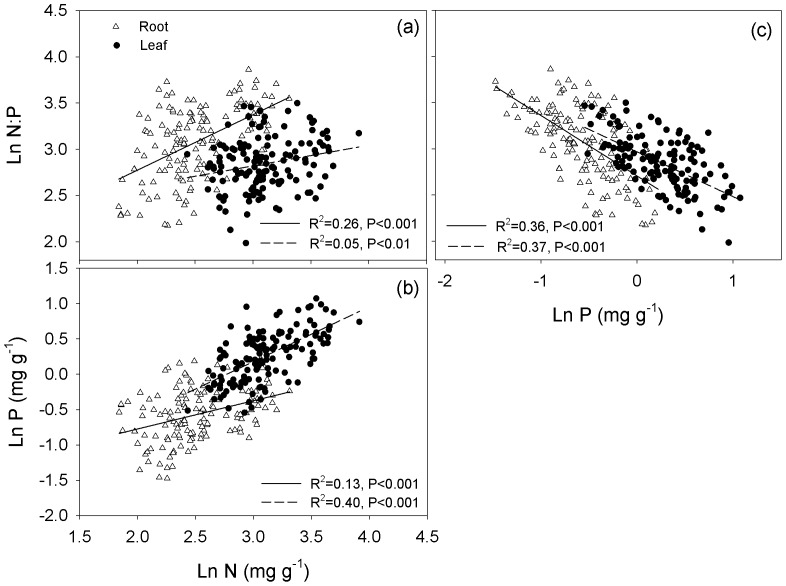
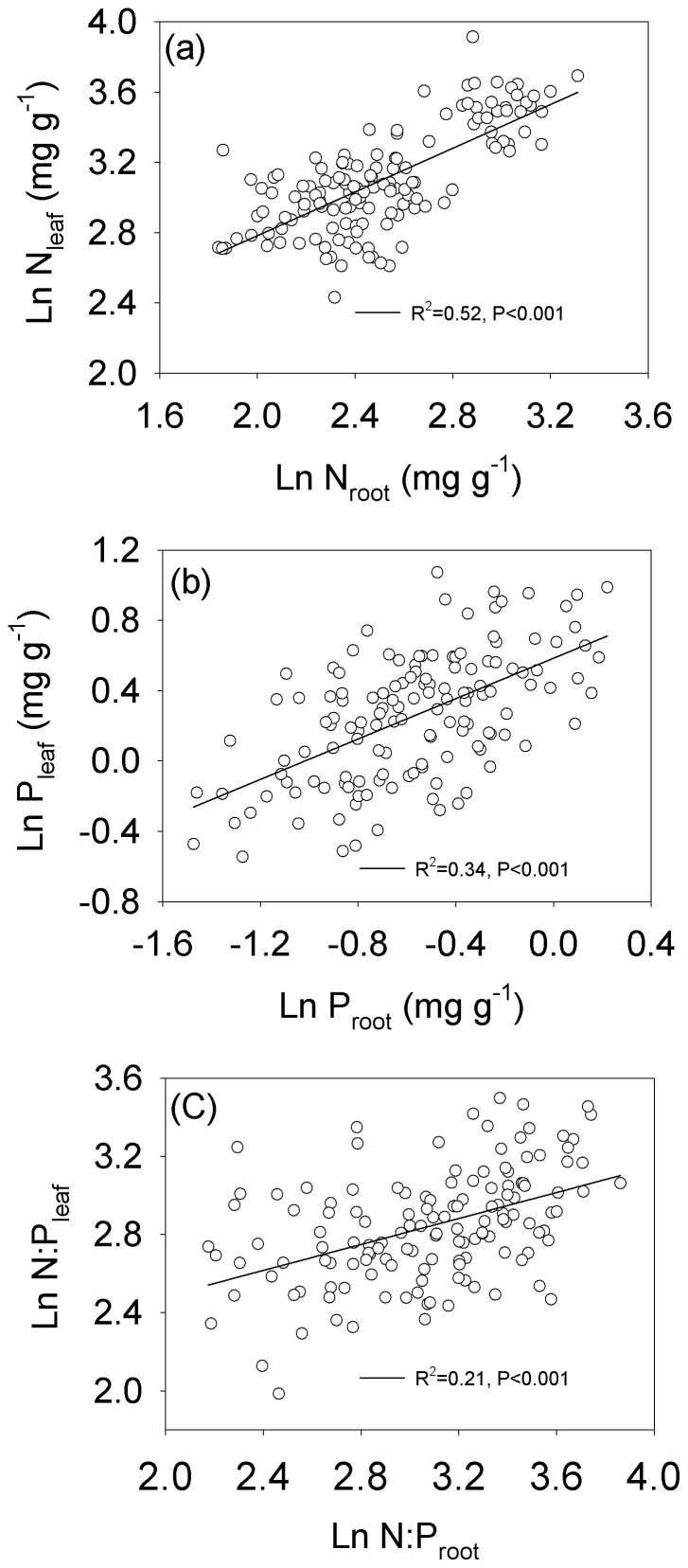
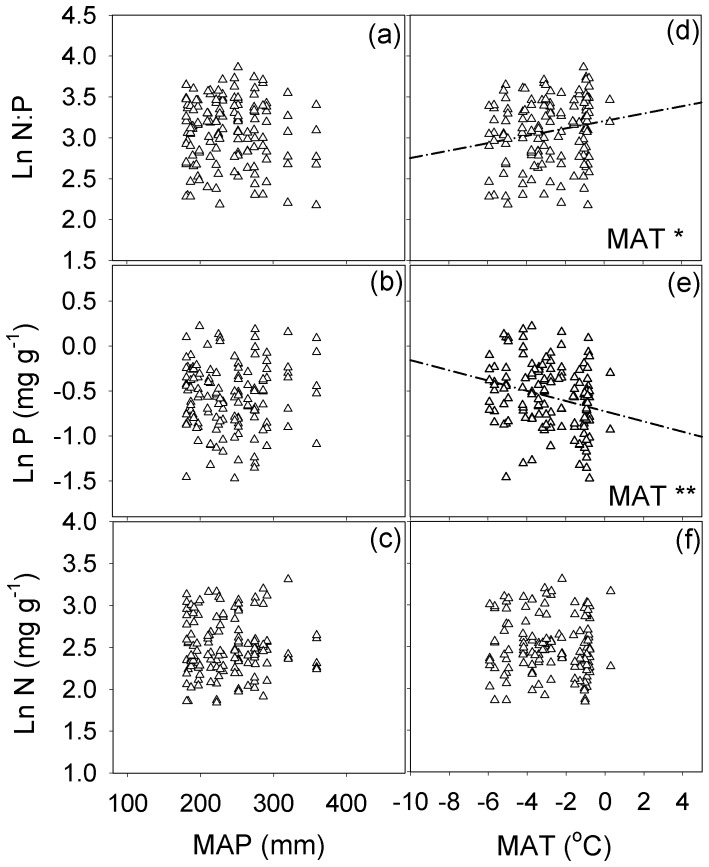
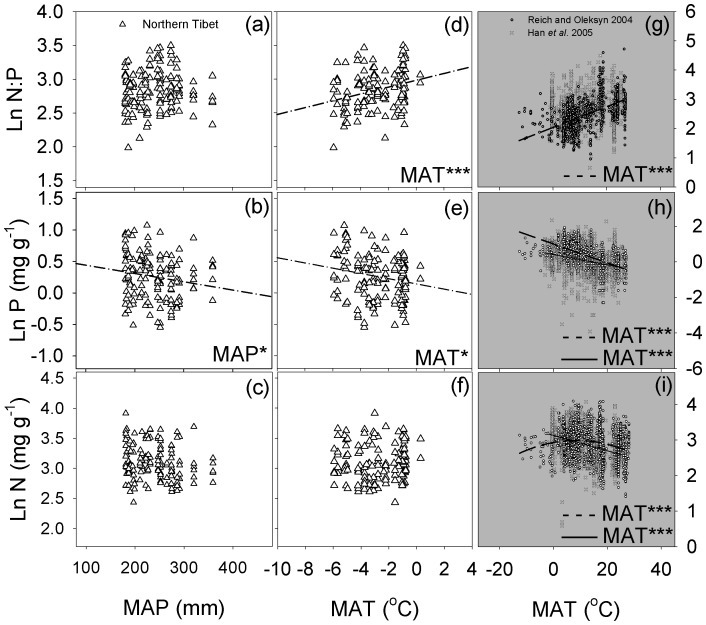
Leaf nitrogen (N) and phosphorus (P) have been used widely in the ecological stoichiometry to understand nutrient limitation in plant. However,few studies have focused on the relationship between root nutrients and environmental factors. The main objective of this study was to clarify the pattern of root and leaf N and P concentrations and the relationships between plant nitrogen (N) and phosphorus (P) concentrations with climatic factors under low temperature conditions in the northern Tibetan Plateau of China. We conducted a systematic census of N and P concentrations, and the N∶P ratio in leaf and root for 139 plant samples, from 14 species and 7 families in a dry Stipa purpurea alpine steppe on the northern Tibetan Plateau of China. The results showed that the mean root N and P concentrations and the N∶P ratios across all species were 13.05 mg g-1, 0.60 mg g-1 and 23.40, respectively. The mean leaf N and P concentrations and the N∶P ratio were 23.20 mg g-1, 1.38 mg g-1, and 17.87, respectively. Compared to global plant nutrients concentrations, plants distributing in high altitude area have higher N concentrations and N∶P, but lower P concentrations, which could be used to explain normally-observed low growth rate of plant in the cold region. Plant N concentrations were unrelated to the mean annual temperature (MAT). The root and leaf P concentrations were negatively correlated with the MAT, but the N∶P ratios were positively correlated with the MAT. It is highly possible this region is not N limited, it is P limited, thus the temperature-biogeochemical hypothesis (TBH) can not be used to explain the relationship between plant N concentrations and MAT in alpine steppe. The results were valuable to understand the bio-geographic patterns of root and leaf nutrients traits and modeling ecosystem nutrient cycling in cold and dry environments.
叶片氮(N)和磷(P)已被广泛应用于生态化学计量学中,以了解植物中的养分限制。然而,很少有研究关注根系养分与环境因素之间的关系。本研究的主要目的是阐明中国青藏高原北部低温条件下根系和叶片氮、磷浓度的模式,以及植物氮(N)和磷(P)浓度与气候因子之间的关系。我们对中国青藏高原北部干旱的紫花针茅高寒草原中7科14种植物的139个植物样本的氮、磷浓度以及叶片和根系中的N∶P比进行了系统普查。结果表明,所有物种的平均根系氮、磷浓度和N∶P比分别为13.05 mg g-1、0.60 mg g-1和23.40。平均叶片氮、磷浓度和N∶P比分别为23.20 mg g-1、1.38 mg g-1和17.87。与全球植物养分浓度相比,分布在高海拔地区的植物具有较高的氮浓度和N∶P比,但磷浓度较低,这可以用来解释寒冷地区植物通常生长速率较低的现象。植物氮浓度与年均温度(MAT)无关。根系和叶片磷浓度与MAT呈负相关,但N∶P比与MAT呈正相关。该地区极有可能不受氮限制,而是受磷限制,因此温度-生物地球化学假说(TBH)不能用于解释高寒草原中植物氮浓度与MAT之间的关系。这些结果对于理解根系和叶片养分特征的生物地理模式以及模拟寒冷干燥环境中的生态系统养分循环具有重要价值。