Harding Mark Geoffrey, Zhang Kunyan, Conly John, Kubes Paul
The Calvin, Phoebe, and Joan Snyder Institute for Chronic Diseases, University of Calgary, Calgary, Alberta, Canada.
The Calvin, Phoebe, and Joan Snyder Institute for Chronic Diseases, University of Calgary, Calgary, Alberta, Canada; Department of Microbiology, Immunology and Infectious Diseases, Cumming School of Medicine, University of Calgary, Calgary, Alberta, Canada; Department of Medicine, Cumming School of Medicine, University of Calgary, Calgary, Alberta, Canada; Department of Pathology and Laboratory Medicine, University of Calgary, Calgary, Alberta, Canada.
PLoS Pathog. 2014 Oct 9;10(10):e1004379. doi: 10.1371/journal.ppat.1004379. eCollection 2014 Oct.
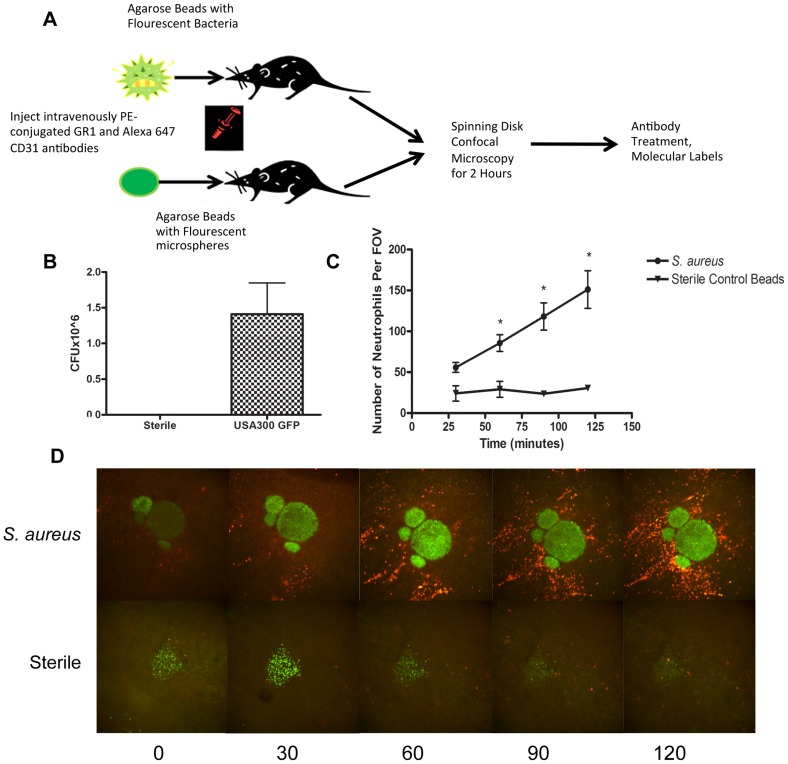
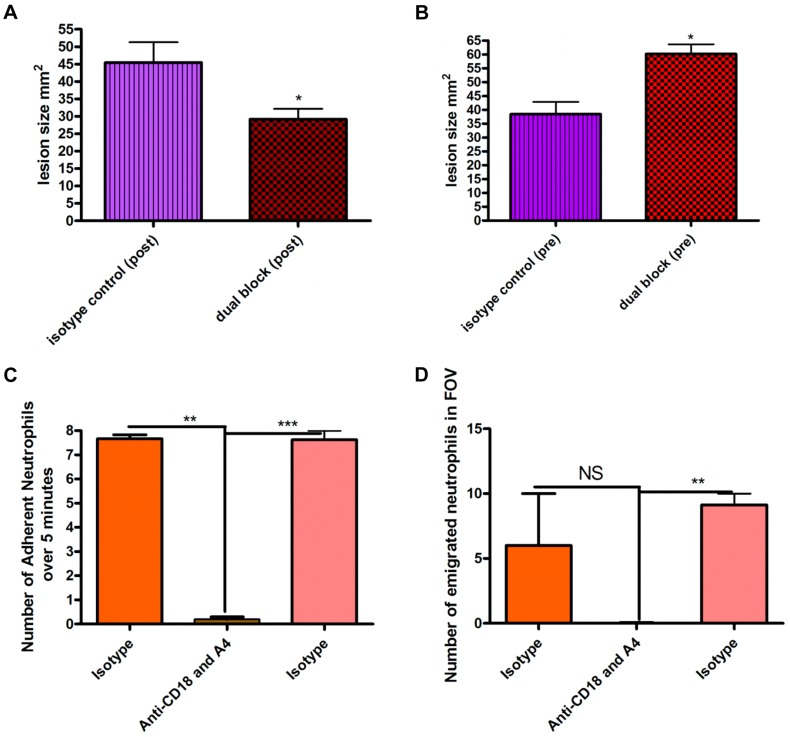
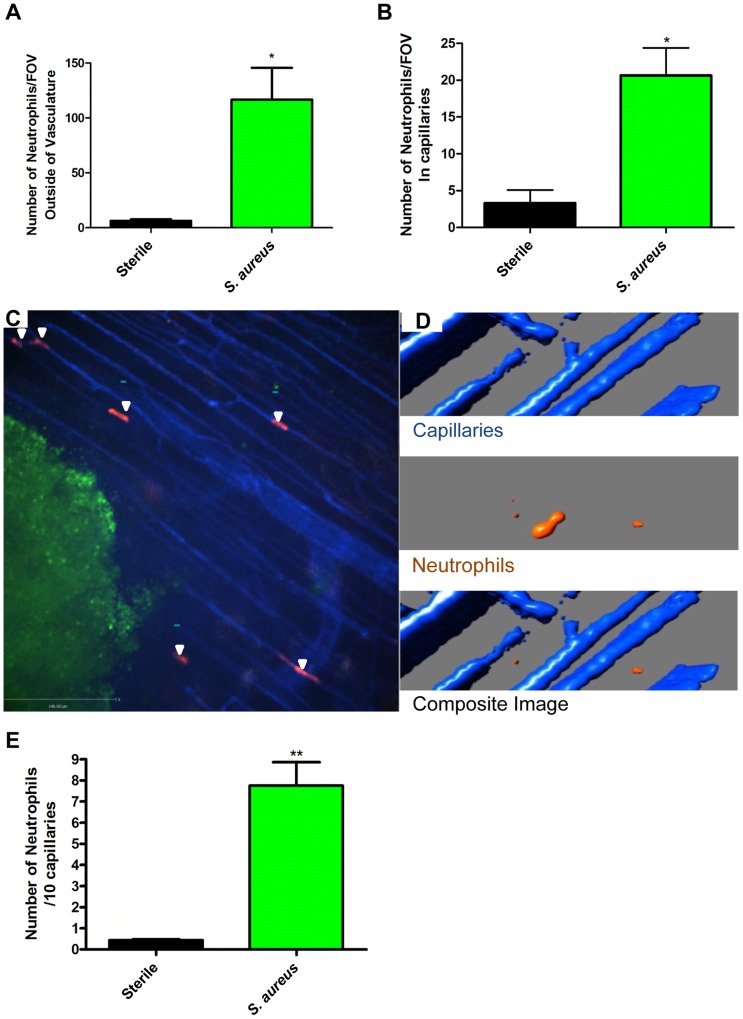
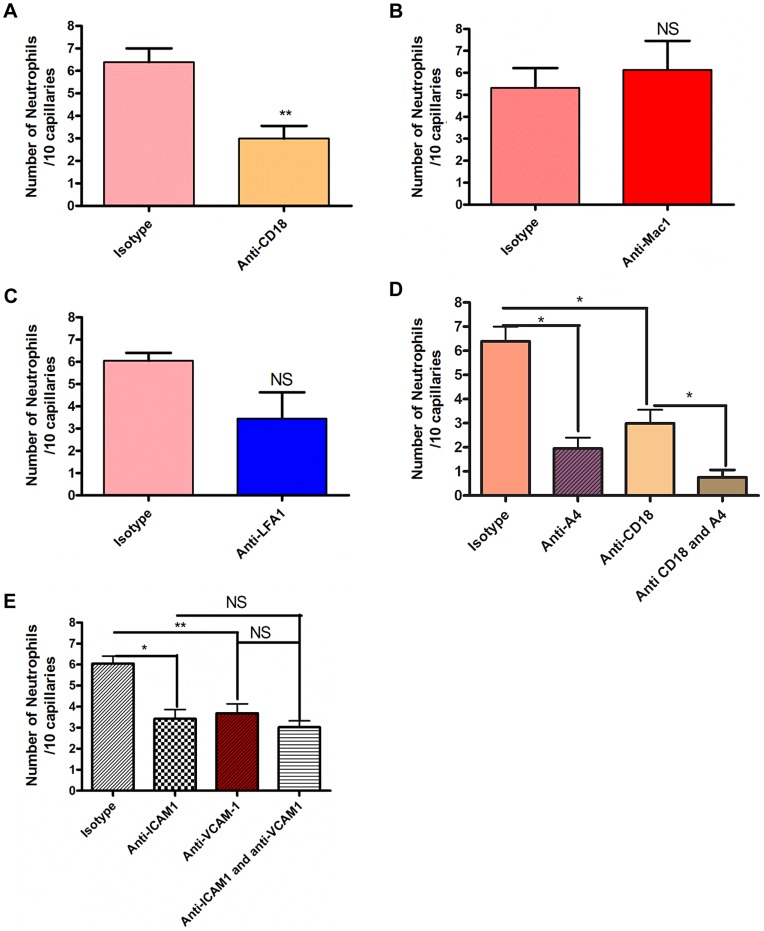
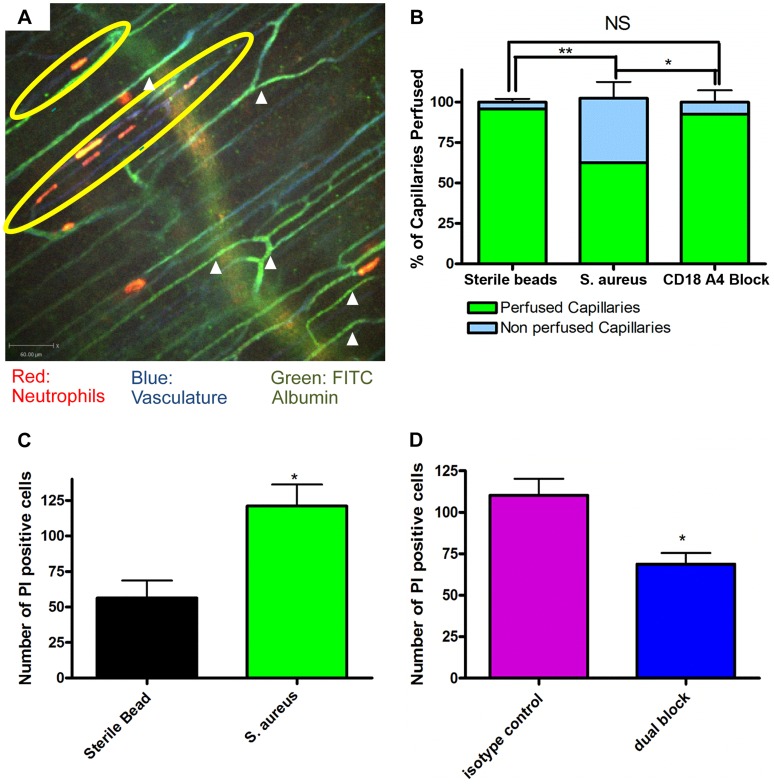
Methicillin-resistant Staphylococcus aureus (MRSA), particularly the USA300 strain, is a highly virulent pathogen responsible for an increasing number of skin and soft tissue infections globally. Furthermore, MRSA-induced soft tissue infections can rapidly progress into life-threatening conditions, such as sepsis and necrotizing fasciitis. The importance of neutrophils in these devastating soft tissue infections remains ambiguous, partly because of our incomplete understanding of their behaviour. Spinning disk confocal microscopy was used to visualize the behaviour of GR1-labelled neutrophils in subcutaneous tissue in response to GFP-expressing MRSA attached to a foreign particle (agarose bead). We observed significant directional neutrophil recruitment towards the S. aureus agarose bead but not a control agarose bead. A significant increase in neutrophil crawling within the capillaries surrounding the infectious nidus was noted, with impaired capillary perfusion in these vessels and increased parenchymal cell death. No neutrophils were able to emigrate from capillaries. The crawling within these capillaries was mediated by the β(2) and α(4) integrins and blocking these integrins 2 hours post infection eliminated neutrophil crawling, improved capillary perfusion, reduced cell death and reduced lesion size. Blocking prior to infection increased pathology. Neutrophil crawling within capillaries during MRSA soft tissue infections, while potentially contributing to walling off or preventing early dissemination of the pathogen, resulted in impaired perfusion and increased tissue injury with time.
耐甲氧西林金黄色葡萄球菌(MRSA),尤其是USA300菌株,是一种高毒力病原体,在全球范围内导致越来越多的皮肤和软组织感染。此外,MRSA引起的软组织感染可迅速发展为危及生命的疾病,如败血症和坏死性筋膜炎。中性粒细胞在这些毁灭性软组织感染中的重要性仍不明确,部分原因是我们对其行为的理解不完整。使用旋转盘共聚焦显微镜观察GR1标记的中性粒细胞在皮下组织中对附着在异物(琼脂糖珠)上的表达绿色荧光蛋白的MRSA的反应行为。我们观察到中性粒细胞显著向金黄色葡萄球菌琼脂糖珠定向募集,而对对照琼脂糖珠则无此现象。注意到感染灶周围毛细血管内中性粒细胞爬行显著增加,这些血管的毛细血管灌注受损,实质细胞死亡增加。没有中性粒细胞能够从毛细血管中移出。这些毛细血管内的爬行由β(2)和α(4)整合素介导,感染后2小时阻断这些整合素可消除中性粒细胞爬行,改善毛细血管灌注,减少细胞死亡并减小病变大小。感染前阻断会增加病理变化。在MRSA软组织感染期间,中性粒细胞在毛细血管内爬行,虽然可能有助于隔离或阻止病原体的早期传播,但随着时间的推移会导致灌注受损和组织损伤增加。