Medina Jose M, Mackey Joel L, Garg Neil K, Houk K N
Department of Chemistry and Biochemistry, University of California , Los Angeles, California 90095, United States.
J Am Chem Soc. 2014 Nov 5;136(44):15798-805. doi: 10.1021/ja5099935. Epub 2014 Oct 23.
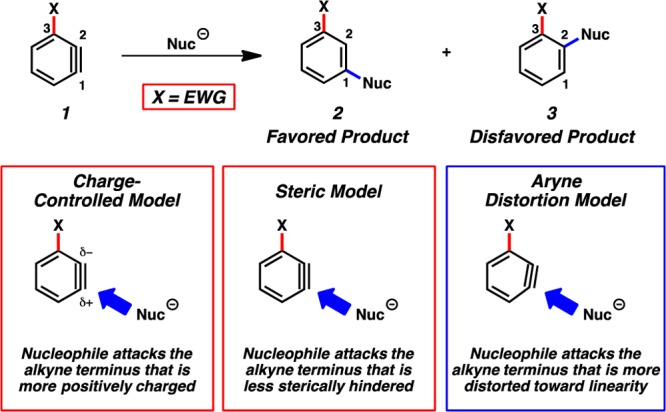
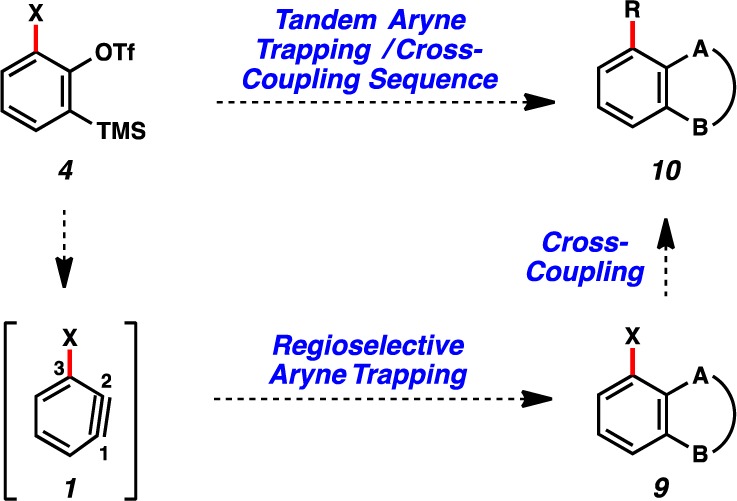
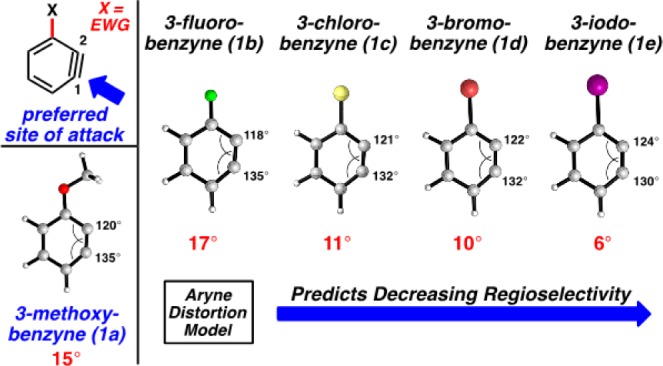
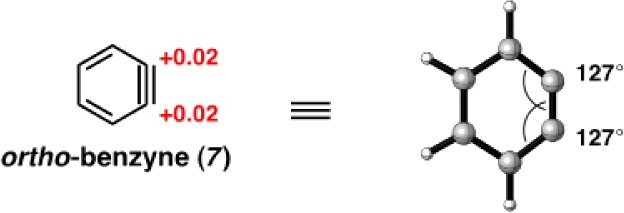
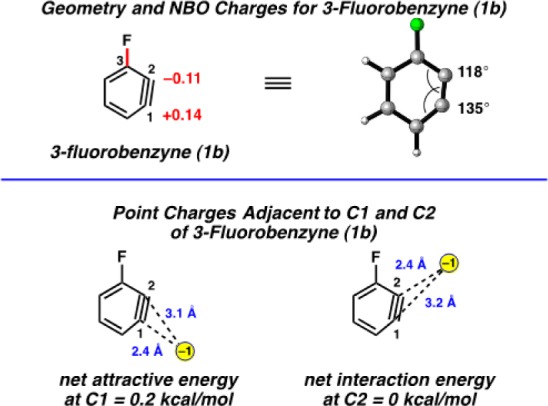
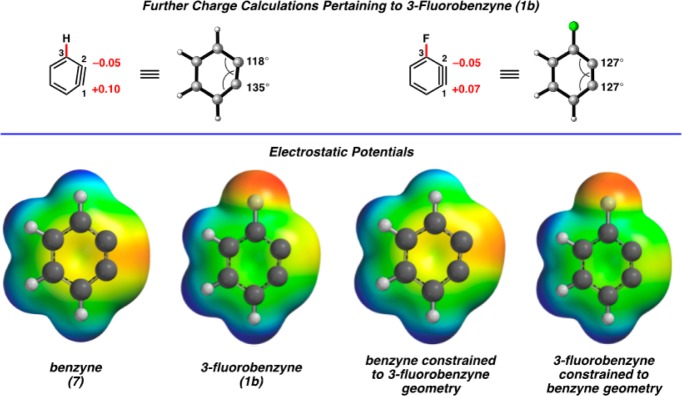
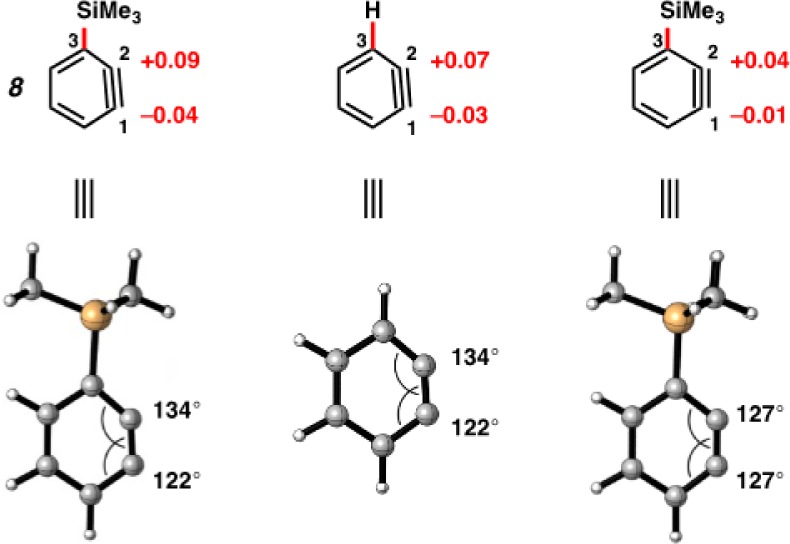
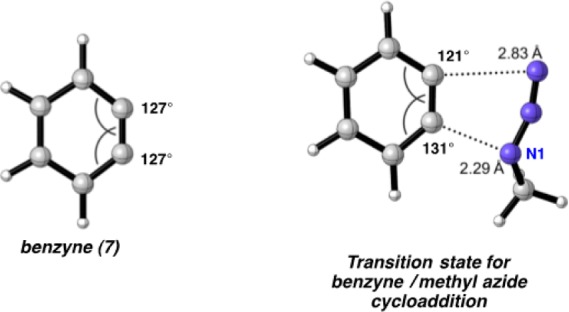
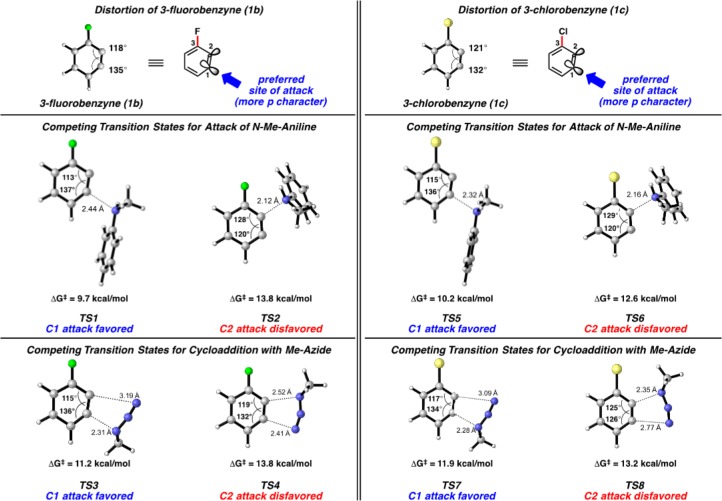
The distortion/interaction model has been used to explain and predict reactivity in a variety of reactions where more common explanations, such as steric and electronic factors, do not suffice. This model has also provided new fundamental insight into regioselectivity trends in reactions of unsymmetrical arynes, which in turn has fueled advances in aryne methodology and natural product synthesis. This article describes a systematic experimental and computational study of one particularly important class of arynes, 3-halobenzynes. 3-Halobenzynes are useful synthetic building blocks whose regioselectivities have been explained by several different models over the past few decades. Our efforts show that aryne distortion, rather than steric factors or charge distribution, are responsible for the regioselectivities observed in 3-haloaryne trapping experiments. We also demonstrate the synthetic utility of 3-halobenzynes for the efficient synthesis of functionalized heterocycles, using a tandem aryne-trapping/cross-coupling sequence involving 3-chlorobenzyne.
扭曲/相互作用模型已被用于解释和预测多种反应中的反应活性,而诸如空间位阻和电子因素等更常见的解释并不充分。该模型还为不对称芳炔反应中的区域选择性趋势提供了新的基本见解,这反过来又推动了芳炔方法学和天然产物合成的进展。本文描述了对一类特别重要的芳炔——3-卤代苯炔进行的系统实验和计算研究。3-卤代苯炔是有用的合成砌块,在过去几十年里,其区域选择性已由几种不同的模型进行了解释。我们的研究表明,芳炔扭曲而非空间位阻因素或电荷分布,是3-卤代苯炔捕获实验中观察到的区域选择性的原因。我们还展示了3-卤代苯炔在高效合成功能化杂环化合物方面的合成效用,采用了涉及3-氯苯炔的串联芳炔捕获/交叉偶联序列。