Latronico Nicola, Nattino Giovanni, Guarneri Bruno, Fagoni Nazzareno, Amantini Aldo, Bertolini Guido
Department of Anesthesia and Critical Care Medicine, University of Brescia at Spedali Civili, Brescia, 25123, Italy.
Department of Clinical Epidemiology, IRCCS-Istituto di Ricerche Farmacologiche Mario Negri, Ranica (BG), 24020, Italy.
F1000Res. 2014 Jun 11;3:127. doi: 10.12688/f1000research.3933.3. eCollection 2014.
To evaluate the accuracy of the peroneal nerve test (PENT) in the diagnosis of critical illness polyneuropathy (CIP) and myopathy (CIM) in the intensive care unit (ICU). We hypothesised that abnormal reduction of peroneal compound muscle action potential (CMAP) amplitude predicts CIP/CIM diagnosed using a complete nerve conduction study and electromyography (NCS-EMG) as a reference diagnostic standard.
prospective observational study.
Nine Italian ICUs.
One-hundred and twenty-one adult (≥18 years) neurologic (106) and non-neurologic (15) critically ill patients with an ICU stay of at least 3 days.
None.
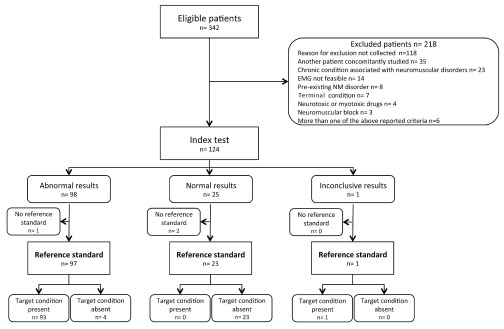
PATIENTS underwent PENT and NCS-EMG testing on the same day conducted by two independent clinicians who were blind to the results of the other test. Cases were considered as true negative if both NCS-EMG and PENT measurements were normal. Cases were considered as true positive if the PENT result was abnormal and NCS-EMG showed symmetric abnormal findings, independently from the specific diagnosis by NCS-EMG (CIP, CIM, or combined CIP and CIM). All data were centrally reviewed and diagnoses were evaluated for consistency with predefined electrophysiological diagnostic criteria for CIP/CIM. During the study period, 342 patients were evaluated, 124 (36.3%) were enrolled and 121 individuals with no protocol violation were studied. Sensitivity and specificity of PENT were 100% (95% CI 96.1-100.0) and 85.2% (95% CI 66.3-95.8). Of 23 patients with normal results, all presented normal values on both tests with no false negative results. Of 97 patients with abnormal results, 93 had abnormal values on both tests (true positive), whereas four with abnormal findings with PENT had only single peroneal nerve neuropathy at complete NCS-EMG (false positive).
PENT has 100% sensitivity and high specificity, and can be used as a screening test to diagnose CIP/CIM in the ICU.
评估在重症监护病房(ICU)中,腓总神经试验(PENT)对诊断重症疾病性多发性神经病(CIP)和重症疾病性肌病(CIM)的准确性。我们假设,腓总复合肌肉动作电位(CMAP)波幅异常降低可预测采用完整神经传导研究和肌电图(NCS-EMG)作为参考诊断标准所诊断的CIP/CIM。
前瞻性观察性研究。
意大利的9个ICU。
121例成年(≥18岁)神经科(106例)和非神经科(15例)重症患者,在ICU至少停留3天。
无。
患者在同一天接受PENT和NCS-EMG检测,由两名对另一项检测结果不知情的独立临床医生进行。如果NCS-EMG和PENT测量结果均正常,则病例被视为真阴性。如果PENT结果异常且NCS-EMG显示对称异常结果,无论NCS-EMG的具体诊断(CIP、CIM或CIP与CIM合并)如何,病例都被视为真阳性。所有数据均进行集中审查,并根据CIP/CIM的预定义电生理诊断标准评估诊断的一致性。在研究期间,共评估了342例患者,124例(36.3%)被纳入研究,121例无方案违规的个体被研究。PENT的敏感性和特异性分别为100%(95%CI 96.1-100.0)和85.2%(95%CI 66.3-95.8)。在23例结果正常的患者中,两项检测结果均正常,无假阴性结果。在97例结果异常的患者中,93例两项检测结果均异常(真阳性),而4例PENT结果异常的患者在完整NCS-EMG检查时仅患有单发性腓总神经病变(假阳性)。
PENT具有100%的敏感性和高特异性,可作为ICU中诊断CIP/CIM的筛查试验。