Pirilä Satu, Taskinen Mervi, Turanlahti Maila, Kajosaari Merja, Mäkitie Outi, Saarinen-Pihkala Ulla M, Viljakainen Heli
Children's Hospital, University of Helsinki and Helsinki University Central Hospital, Helsinki, Finland.
Children's Hospital, University of Helsinki and Helsinki University Central Hospital, Helsinki, Finland; Folkhälsan Research Centre, Helsinki, Finland.
PLoS One. 2014 Oct 13;9(10):e108040. doi: 10.1371/journal.pone.0108040. eCollection 2014.
Both osteoporosis and cardiovascular disease (CVD) are diseases that comprise a growing medical and economic burden in ageing populations. They share many risk factors, including ageing, low physical activity, and possibly overweight. We aimed to study associations between individual risk factors for CVD and bone mineral density (BMD) and turnover markers (BTMs) in apparently healthy cohort.
A cross-sectional assessment of 155 healthy 32-year-old adults (74 males) was performed for skeletal status, CVD risk factors and lifestyle factors.
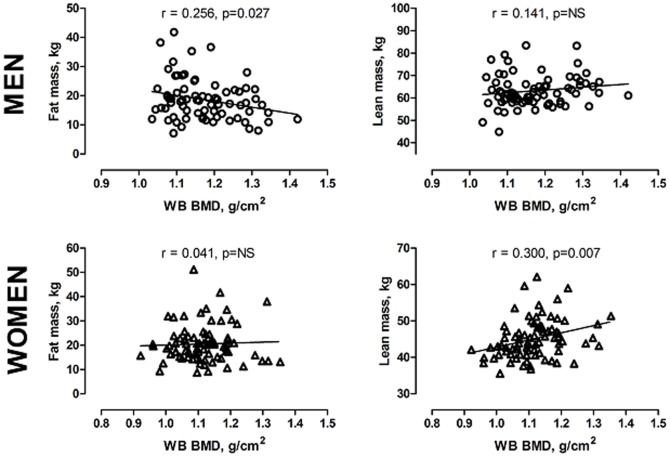
We analysed serum osteocalcin, procollagen I aminoterminal propeptide (P1NP), collagen I carboxy-terminal telopeptide (ICTP) and urine collagen I aminoterminal telopeptide (U-NTX), as well as serum insulin, plasma glucose, triglyceride and HDL-cholesterol levels. BMD, fat and lean mass were assessed using DXA scanning. Associations were tested with partial correlations in crude and adjusted models. Bone status was compared between men with or without metabolic syndrome (defined according to the NCEP-ATPIII criteria) with multivariate analysis.
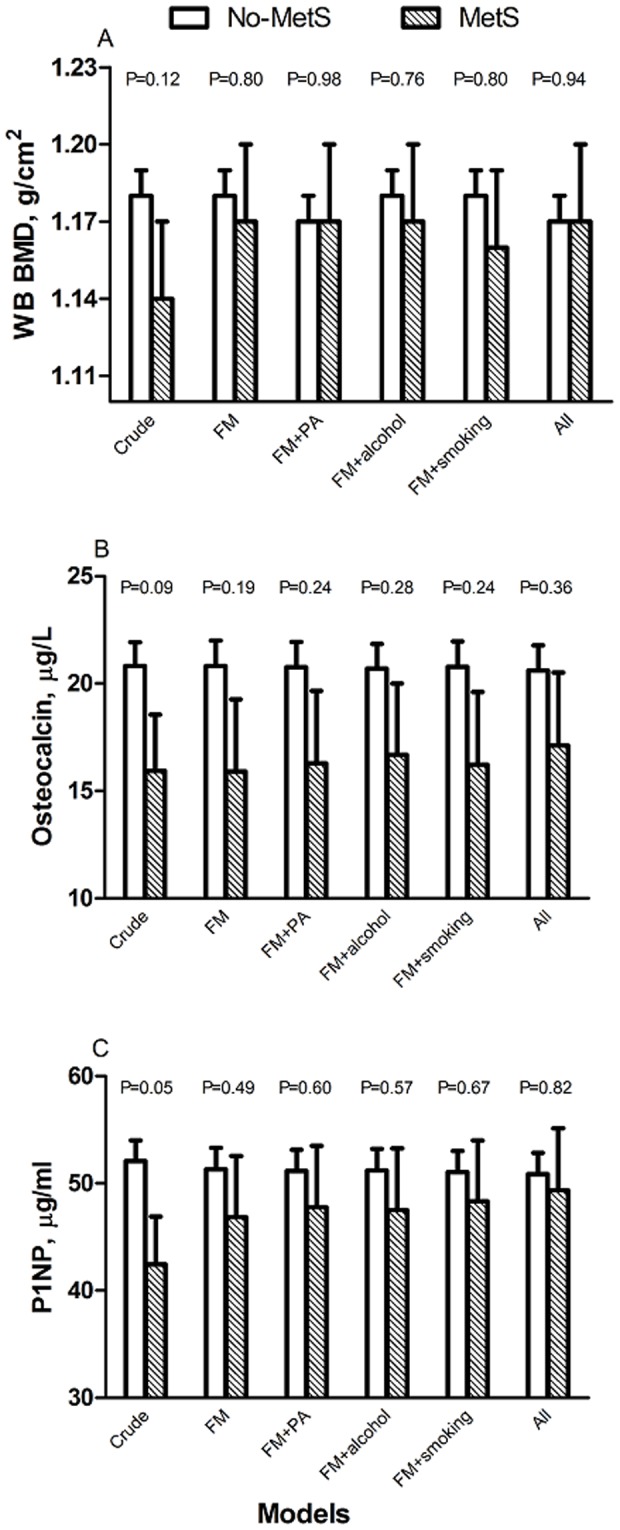
Osteocalcin and P1NP correlated inversely with insulin (R = -0.243, P = 0.003 and R = -0.187, P = 0.021) and glucose (R = -0.213, P = 0.009 and R = -0.190, P = 0.019), but after controlling for fat mass and lifestyle factors, the associations attenuated with insulin (R = -0.162, P = 0.053 and R = -0.093, P = 0.266) and with glucose (R = -0.099, P = 0.240 and R = -0.133, P = 0.110), respectively. Whole body BMD associated inversely only with triglycerides in fully adjusted model. In men with metabolic syndrome, whole body BMD, osteocalcin and P1NP were lower compared to healthy men, but these findings disappeared in fully adjusted model.
In young adults, inverse associations between BTM/BMD and risk factors of CVD appeared in crude models, but after adjusting for fat mass, no association continued to be present. In addition to fat mass, lifestyle factors, especially physical activity, modified the associations between CVD and bone characteristics. Prospective studies are needed to specify the role of mediators and lifestyle factors in the prevention of CVD and osteoporosis.
骨质疏松症和心血管疾病(CVD)都是在老龄化人群中构成日益加重的医学和经济负担的疾病。它们有许多共同的风险因素,包括老龄化、身体活动不足以及可能的超重。我们旨在研究在看似健康的队列中,CVD的个体风险因素与骨矿物质密度(BMD)和骨转换标志物(BTMs)之间的关联。
对155名健康的32岁成年人(74名男性)进行了横断面评估,以了解骨骼状况、CVD风险因素和生活方式因素。
我们分析了血清骨钙素、I型前胶原氨基端前肽(P1NP)、I型胶原羧基末端肽(ICTP)和尿I型胶原氨基末端肽(U-NTX),以及血清胰岛素、血浆葡萄糖、甘油三酯和高密度脂蛋白胆固醇水平。使用双能X线吸收法扫描评估BMD、脂肪量和瘦体重。在粗模型和调整模型中用偏相关检验关联。采用多变量分析比较有或无代谢综合征(根据NCEP-ATPIII标准定义)的男性之间的骨骼状况。
骨钙素和P1NP与胰岛素(R = -0.243,P = 0.003和R = -0.187,P = 0.021)及葡萄糖(R = -0.213,P = 0.009和R = -0.190,P = 0.019)呈负相关,但在控制脂肪量和生活方式因素后,与胰岛素(R = -0.162,P = 0.053和R = -0.093,P = 0.266)及与葡萄糖(R = -0.099,P = 0.240和R = -0.133,P = 0.110)的关联分别减弱。在完全调整模型中,全身BMD仅与甘油三酯呈负相关。在患有代谢综合征的男性中,全身BMD、骨钙素和P1NP低于健康男性,但在完全调整模型中这些结果消失。
在年轻人中,BTM/BMD与CVD风险因素之间的负相关在粗模型中出现,但在调整脂肪量后,不再存在关联。除脂肪量外,生活方式因素,尤其是身体活动,改变了CVD与骨骼特征之间的关联。需要进行前瞻性研究以明确中介因素和生活方式因素在预防CVD和骨质疏松症中的作用。